
Last letters from the living dead man
David Patterson (Spirit) Hatch
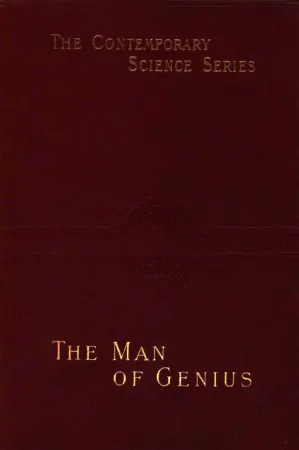
THE CLASSIC COLLECTION · 1891
"The Man of Genius" by Cesare Lombroso is a scientific publication written in the late 19th century. The book delves into the complex relationship between genius and madness, exploring the characteristics of individuals considered genius and how these traits intersect with patterns of mental illness. Lombroso examines historical figures and provides a foundational analysis of genius through a lens of physiological and psychological phenomena. The opening of the work sets the stage for an exploration of genius by referencing significant historical thoughts on the topic, from Aristotle to more contemporary thinkers. Lombroso reflects on his evolving views about genius relating to degradation and neurosis, suggesting that exceptional intellectual capabilities often stem from psychological anomalies. He lays out an argument that associates genius with various signs of degeneration, prompting readers to reconsider what defines genius and how societal perceptions may have historically conflated brilliance with madness. This thought-provoking introduction invites further examination of the intertwining nature of genius, mental health, and societal recognition.
Introduction adapted from the source catalogue; source summaries may be automatically generated.
Free to read · English · 130,716 words · No account needed
MAKE TIME FOR A GOOD BOOK
On by default. Untick to stop anonymous reading totals. Each page counts after 10 seconds in view. How this works.
Anonymous counting is on unless you have switched it off.
It has often happened that stonecutters in the quarries of Florence, in the old Republican times, have become celebrated sculptors, like Mino da Fiesole, Desiderio da Settignano, and Cronaca. Canova and Vincenzo Vela were also quarrymen, and Hugh Miller, from working as a mason, became a highly-esteemed geologist.
Andrea del Castagno, a shepherd of Mugello, one day, when overtaken by a storm, took refuge in an oratory, where a house-painter was daubing a picture of the Virgin. From thenceforth he felt an irresistible desire to imitate him, and practised drawing figures in charcoal whenever he could; so much so, that his fame soon spread among the peasants, and, afterwards, by the assistance of Bernadino de’ Medici, who enabled him to study, he became a celebrated painter.
Vespasiano de’ Bisticci, a Florentine paper-maker, whose profession involved the handling of many books, and contact with a great number of literary and learned men, took to literature himself.
More frequently, however, opportunity is only the last drop which makes the vessel run over. This is so true that the cases in which genius has manifested itself in spite of adverse circumstances and even violent opposition, are innumerable. It is sufficient to recall Boccaccio, Goldoni, Muratori, Leopardi, Ascoli, Cellini, Cavour, Petrarch, Metastasio, and, finally, Socrates, who was obliged to cut and carve stones. All our recent great musicians--Wagner, Rossini, Verdi--were misunderstood in their youth.
Long ago, it was said, “He to whom Nature would not tell it, would not be told by a thousand Athens and a thousand Romes.”[280]
Circumstances, then, and a certain degree of civilization gain acceptance and toleration for genius and its discoveries which, under other conditions, would have either passed unnoticed, or met with ridicule, and even persecution.
History shows that great discoveries are rarely absolute novelties, and that they have long existed as toys or curiosities. “Steam,” says Fournier, “was a plaything for children in the time of Hero of Alexandria, and Anthemius of Tralles. The human mind and the needs of our race have to work by experience, a million times over, before deducing all the consequences of a fact.[281]
In 1765, Spedding offered portable gas, prepared and ready for use, to the corporation of Whitehaven, and was refused. At a later date came Chaussier, Minkelers, Lebon, and Windsor, who had no other merit than that of appropriating his discovery.
Your reading position is saved on this browser. Take it to another device with a library code. Reading pages adapt to text, rather than matching a printed edition.
BEHIND THE BOOK
This eBook is for the use of anyone anywhere in the United States and most other parts of the world at no cost and with almost no restrictions whatsoever. You may copy it, give it away or re-use it under the terms of the Project Gutenberg License included with this eBook or online at www.gutenberg.org. If you are not located in the United States, you will have to check the laws of the country where you are located before using this eBook. Read the source licence.
The original source file, including credits and licence, is retained by this library. Request an original-format copy at no charge. Please include the book title and Project Gutenberg identifier #50539.
KEEP YOUR CURIOSITY GOING
David Patterson (Spirit) Hatch
Coulson Kernahan

Ralph Waldo Emerson
Frances Wright

Edwin Abbott Abbott

Joseph Droz