
Last letters from the living dead man
David Patterson (Spirit) Hatch
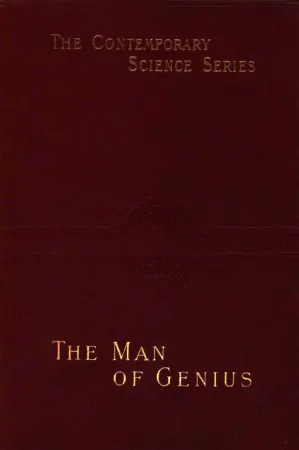
THE CLASSIC COLLECTION · 1891
"The Man of Genius" by Cesare Lombroso is a scientific publication written in the late 19th century. The book delves into the complex relationship between genius and madness, exploring the characteristics of individuals considered genius and how these traits intersect with patterns of mental illness. Lombroso examines historical figures and provides a foundational analysis of genius through a lens of physiological and psychological phenomena. The opening of the work sets the stage for an exploration of genius by referencing significant historical thoughts on the topic, from Aristotle to more contemporary thinkers. Lombroso reflects on his evolving views about genius relating to degradation and neurosis, suggesting that exceptional intellectual capabilities often stem from psychological anomalies. He lays out an argument that associates genius with various signs of degeneration, prompting readers to reconsider what defines genius and how societal perceptions may have historically conflated brilliance with madness. This thought-provoking introduction invites further examination of the intertwining nature of genius, mental health, and societal recognition.
Introduction adapted from the source catalogue; source summaries may be automatically generated.
Free to read · English · 130,716 words · No account needed
MAKE TIME FOR A GOOD BOOK
On by default. Untick to stop anonymous reading totals. Each page counts after 10 seconds in view. How this works.
Anonymous counting is on unless you have switched it off.
Jews have given to the world musicians like Meyerbeer, Halèvy, Gutzkow, Mendelssohn, Offenbach, Rubinstein, Joachim, Benedict, Moscheles, Cowen, Sullivan, Goldmark, Strauss; poets, novelists, humourists, &c., like Heine, Saphir, Camerini, Revere, Jung, Weill, Fortis, Gozlan, Moritz Hartmann, Auerbach, Börne, Ratisbonne, Kompert, Grace Aguilar, Franzos, Massarani, Lindau, Catulle Mendes; linguists like Ascoli, Benfey, Munk, Fiorentino, Luzzato, Oppert, Bernhardi, Friedland, Weil, Lazarus, Steinthal; physicians like Valentin, Hermann, Haidenhain, Schiff, Casper, Stilling, Gluge, Traube, Fraenkel, Kuhn, Cohnheim, Hirsch, Liebreich, Bernstein, Remak, Weigert, Meynert, Hitzig, Westphal, Mendel, Leidesdorf, Benedikt; philosophers like Spinoza, Maimon, Sommerhausen, Moses Mendelssohn; naturalists like Cohn; economists like Ricardo, Lassalle, Karl Marx; jurists and statesmen like Stahl, Gans, Beaconsfield, Crémieux. Even in sciences in which the Semite formerly showed no ability, such as mathematics and astronomy, we find such men as Goldschmidt, Beer, Sylvester, Kronecker, and Jacobi.
It must be observed that a very large proportion of these men of genius have been radically creative; revolutionary in politics, and in religion, and in science. Jews, indeed, initiated Nihilism and Socialism on the one hand, Mosaism and Christianity on the other. Commerce owes to them the bill of exchange, philosophy owes to them Positivism, literature the Neo-humourism.
Jacobs shows that this abundance of Jewish men of genius of the first order is allied with a deficiency in men of the second order of intellect. He explains the superiority by the higher level of education among the Jews, their devotion to family life, the almost complete absence of priests and dogmas, the facilities which the study of Hebrew offers for investigations in philosophy and for that kind of music which forms part of their religious ceremonies. It is difficult, however, to find a relationship between this rhythmical caterwauling and the sublime notes of Meyerbeer and Mendelssohn; and Jews possess more than enough of priests and dogmas. I would add that if the Jews have not yet produced men like Newton, Darwin, and Michelangelo, it is because they have not yet accomplished their ethnic evolution, as they show by the obstinacy with which they cling to their ancient beliefs.
It is strange that among the factors of Jewish superiority in genius Jacobs does not mention the neurotic tendency, the existence of which, as we shall see, he has himself shown. This would also well explain the deficiency of Jews in intellect of medium quality in which the morbid element is always less marked.
Your reading position is saved on this browser. Take it to another device with a library code. Reading pages adapt to text, rather than matching a printed edition.
BEHIND THE BOOK
This eBook is for the use of anyone anywhere in the United States and most other parts of the world at no cost and with almost no restrictions whatsoever. You may copy it, give it away or re-use it under the terms of the Project Gutenberg License included with this eBook or online at www.gutenberg.org. If you are not located in the United States, you will have to check the laws of the country where you are located before using this eBook. Read the source licence.
The original source file, including credits and licence, is retained by this library. Request an original-format copy at no charge. Please include the book title and Project Gutenberg identifier #50539.
KEEP YOUR CURIOSITY GOING
David Patterson (Spirit) Hatch
Coulson Kernahan

Ralph Waldo Emerson
Frances Wright

Edwin Abbott Abbott

Joseph Droz