
Last letters from the living dead man
David Patterson (Spirit) Hatch
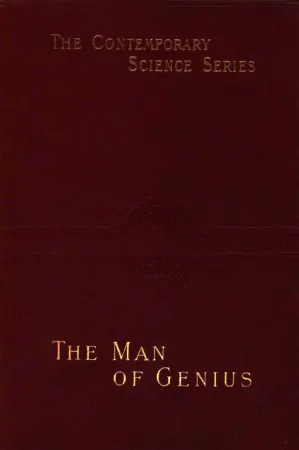
THE CLASSIC COLLECTION · 1891
"The Man of Genius" by Cesare Lombroso is a scientific publication written in the late 19th century. The book delves into the complex relationship between genius and madness, exploring the characteristics of individuals considered genius and how these traits intersect with patterns of mental illness. Lombroso examines historical figures and provides a foundational analysis of genius through a lens of physiological and psychological phenomena. The opening of the work sets the stage for an exploration of genius by referencing significant historical thoughts on the topic, from Aristotle to more contemporary thinkers. Lombroso reflects on his evolving views about genius relating to degradation and neurosis, suggesting that exceptional intellectual capabilities often stem from psychological anomalies. He lays out an argument that associates genius with various signs of degeneration, prompting readers to reconsider what defines genius and how societal perceptions may have historically conflated brilliance with madness. This thought-provoking introduction invites further examination of the intertwining nature of genius, mental health, and societal recognition.
Introduction adapted from the source catalogue; source summaries may be automatically generated.
Free to read · English · 130,716 words · No account needed
MAKE TIME FOR A GOOD BOOK
On by default. Untick to stop anonymous reading totals. Each page counts after 10 seconds in view. How this works.
Anonymous counting is on unless you have switched it off.
Thus, in searching Clément’s book, and Florimo’s,[232] we find that out of 118 great composers, 44, or more than a third, belong to Italy; and that among these last, 27, or more than half, are supplied by Sicily (Scarlatti, Pacini, Bellini), and by Naples and neighbouring places, especially Aversa (Jomelli, Stradella, Piccinni, Leo, Feo, Vinci, Fenaroli, the inventor of opéra-bouffe, Speranza, Contumaci, Sala, Caffaro, Duni, Sacchini, Carafa, Paisiello, Cimarosa, Zingarelli, Mercadante, Durante, the two Ricci and Petrella), no doubt owing to the influence of Greek race and warm climate. Of the other 17, a few belong to Upper Italy: Donizetti, Verdi, Allegri, Frescobaldi, the two Monteverdi, Salieri, Marcello, Paganini (these last three to the sea-coast); and all the others to Central Italy; Palestrina and Clementi to Rome, and Spontini, Lulli, and Pergolese, to Perugia and Florence.[233]
If we compare the regions which have produced the greatest composers and relatively few minor masters, we find that Pesaro, Catania, Arezzo, and Alessandria come first. The coincidence of musical geniuses and mediocrities, both in large numbers, is found at Naples, Rome, Parma, Florence, Milan, Cremona, and Venice, with an evident influence here also of warm maritime climate, of the Greco-Etruscan race and of great centres (5 out of 7).
In painting we find that the large towns predominate both for number and celebrity, with the exception of Sardinia and Sicily. Bologna, Florence, Venice, and Milan come first as regards number; Florence, and in the second line Verona, Naples, Rome, and Venice, both for number and celebrity; and we still find that, after large towns, mountainous countries give the highest figures as regards number. It is sufficient to name Perugia, Arezzo, Siena, Udine, Verona, Vicenza, Parma, Brescia.[234]
Almost the same relations are observed in regard to sculptors and architects. We see the great centres of civilization and hilly regions in the first rank; Florence especially, then Milan, Venice, Naples, Como, Siena, Verona, Massa, and in the third line Arezzo, Perugia, Vicenza, Bergamo, Macerata, Catania, and Palermo.[235]
Your reading position is saved on this browser. Take it to another device with a library code. Reading pages adapt to text, rather than matching a printed edition.
BEHIND THE BOOK
This eBook is for the use of anyone anywhere in the United States and most other parts of the world at no cost and with almost no restrictions whatsoever. You may copy it, give it away or re-use it under the terms of the Project Gutenberg License included with this eBook or online at www.gutenberg.org. If you are not located in the United States, you will have to check the laws of the country where you are located before using this eBook. Read the source licence.
The original source file, including credits and licence, is retained by this library. Request an original-format copy at no charge. Please include the book title and Project Gutenberg identifier #50539.
KEEP YOUR CURIOSITY GOING
David Patterson (Spirit) Hatch
Coulson Kernahan

Ralph Waldo Emerson
Frances Wright

Edwin Abbott Abbott

Joseph Droz