
Last letters from the living dead man
David Patterson (Spirit) Hatch
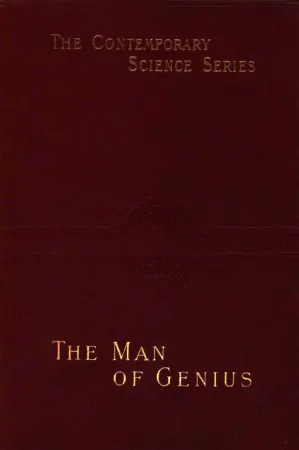
THE CLASSIC COLLECTION · 1891
"The Man of Genius" by Cesare Lombroso is a scientific publication written in the late 19th century. The book delves into the complex relationship between genius and madness, exploring the characteristics of individuals considered genius and how these traits intersect with patterns of mental illness. Lombroso examines historical figures and provides a foundational analysis of genius through a lens of physiological and psychological phenomena. The opening of the work sets the stage for an exploration of genius by referencing significant historical thoughts on the topic, from Aristotle to more contemporary thinkers. Lombroso reflects on his evolving views about genius relating to degradation and neurosis, suggesting that exceptional intellectual capabilities often stem from psychological anomalies. He lays out an argument that associates genius with various signs of degeneration, prompting readers to reconsider what defines genius and how societal perceptions may have historically conflated brilliance with madness. This thought-provoking introduction invites further examination of the intertwining nature of genius, mental health, and societal recognition.
Introduction adapted from the source catalogue; source summaries may be automatically generated.
Free to read · English · 130,716 words · No account needed
MAKE TIME FOR A GOOD BOOK
On by default. Untick to stop anonymous reading totals. Each page counts after 10 seconds in view. How this works.
Anonymous counting is on unless you have switched it off.
If we now group these data according to seasons, which will allow us to include other data in which the exact month cannot be stated, we shall find that the maximum of artistic and literary creation falls in spring, 388; then comes summer, with 347; then autumn, 335; and lastly, winter, with 280.
The majority of great physical, chemical, and mathematical discoveries took place in spring, 22; then autumn, 15; very few in summer, 10; and only five in winter. I have separated astronomical discoveries from physical, and other discoveries, because their precise dates are less doubtful and therefore more important. We find 135 in autumn; 131 in spring; 120 in summer; and only 83 in winter. Taking these 1,871 great discoveries altogether, we find spring coming first, with 541; then autumn, with 485; with 477 in summer; and 368 in winter.
It is evident, then, that the first warm months distinctly predominate in the creations of genius, as well as in organic nature generally, although the question cannot be absolutely resolved on account of the scarcity of data, as regards both quantity and quality. It was, however, in the spring that the discovery of America was conceived, as well as galvanism, the barometer, the telescope, and the lightning conductor; in the spring, Michelangelo had the idea of his great cartoon, Dante of his Divina Commedia, Leonardo of his book on light, Goethe of his Faust; it was in the spring that Kepler discovered his law, that Milton conceived his great poem, Darwin his great theory, and Wagner the Fliegende Holländer, the first of his great music dramas.
It may be added that in the few cases in which we may follow, day by day, the traces of the works of great men, we usually find that their activity increases in the warm months and decreases in the cold months. Thus in Spallanzani’s journals, and especially during the years 1777-78 and 1780-81, in which he was undertaking his investigations into moulds, digestion, and fecundation, I found 50 days of observation in March, 65 in April, 143 in May, 41 in June, 33 in August, 24 in September; while there were only 17 in December, 10 in November, 18 in January, 17 in July, and 2 in February.
If we examine the curious journal of his own observations, which Malpighi kept day by day for thirty-four years, we find, grouping the observations according to months, July coming first with 71 days, followed by June with 66, May 42, October 40, January 36, September 34, April 33, March 31, August 28, November 20, December 13.[225] Out of over four hundred observations less than a fifth took place in the winter months.
Your reading position is saved on this browser. Take it to another device with a library code. Reading pages adapt to text, rather than matching a printed edition.
BEHIND THE BOOK
This eBook is for the use of anyone anywhere in the United States and most other parts of the world at no cost and with almost no restrictions whatsoever. You may copy it, give it away or re-use it under the terms of the Project Gutenberg License included with this eBook or online at www.gutenberg.org. If you are not located in the United States, you will have to check the laws of the country where you are located before using this eBook. Read the source licence.
The original source file, including credits and licence, is retained by this library. Request an original-format copy at no charge. Please include the book title and Project Gutenberg identifier #50539.
KEEP YOUR CURIOSITY GOING
David Patterson (Spirit) Hatch
Coulson Kernahan

Ralph Waldo Emerson
Frances Wright

Edwin Abbott Abbott

Joseph Droz