
Last letters from the living dead man
David Patterson (Spirit) Hatch
THE CLASSIC COLLECTION · 1891
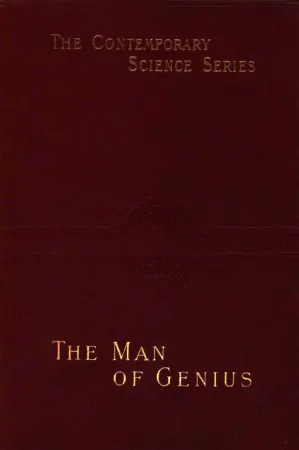
"The Man of Genius" by Cesare Lombroso is a scientific publication written in the late 19th century. The book delves into the complex relationship between genius and madness, exploring the characteristics of individuals considered genius and how these traits intersect with patterns of mental illness. Lombroso examines historical figures and provides a foundational analysis of genius through a lens of physiological and psychological phenomena. The opening of the work sets the stage for an exploration of genius by referencing significant historical thoughts on the topic, from Aristotle to more contemporary thinkers. Lombroso reflects on his evolving views about genius relating to degradation and neurosis, suggesting that exceptional intellectual capabilities often stem from psychological anomalies. He lays out an argument that associates genius with various signs of degeneration, prompting readers to reconsider what defines genius and how societal perceptions may have historically conflated brilliance with madness. This thought-provoking introduction invites further examination of the intertwining nature of genius, mental health, and societal recognition.
Introduction adapted from the source catalogue; source summaries may be automatically generated.
Free to read · English · 130,716 words · No account needed
MAKE TIME FOR A GOOD BOOK
On by default. Untick to stop anonymous reading totals. Each page counts after 10 seconds in view. How this works.
Anonymous counting is on unless you have switched it off.
If historians, who have squandered so much time and so many volumes in detailing minutely to us the most shameless exploits of kings, had sought with as much care the memorable epoch in which a great discovery or a masterpiece of art was conceived, they would no doubt have found that the hottest months and days have always been most fruitful for genius, as for nature generally.
Let us endeavour to find more precise proofs of this little-suspected
influence.
Dante wrote his first sonnet on the 15th of June, 1282; in the spring of 1300 he wrote the Vita Nuova; on the 3rd of April he began his great poem.[196] Darwin had the earliest ideas of his great work first in March, then in June.[197] Petrarch conceived the Africa in March, 1338. Michelangelo’s great cartoon, the work which so competent a judge as Cellini considered his most wonderful masterpiece, was imagined and executed between April and July, 1506. Manzoni wrote his 5 Maggio in summer. Milton’s great poem was conceived in the spring. Galileo discovered Saturn’s ring in April, 1611. Balzac wrote La Cousine Bette in August and September, Père Goriot in September, La Recherche de l’Absolu in June to September. Sterne began Tristram Shandy in January, the first of his sermons in April, the famous one on errors of conscience in May.[198] Giordano Bruno composed his Candelajo in July; and in his witty dedication he attributed it to the heat of the dog-days. Voltaire wrote Tancred in August. Byron wrote the fourth canto of Childe Harold in September, his Prophecy of Dante in June, his Prisoner of Chillon during the summer in Switzerland. Giusti wrote of Gingillino and Pero: “Here are the only leaves that April has drawn out of my head after fourteen months of idleness.” Schiller, it appears from his letters to Goethe, conceived Don Carlos and Wallenstein in the autumn, as well as Fiesco and Wilhelm Tell; Wallensteins Lager and Letters on Æsthetics in September; Kabale und Liebe in winter; the Magician, the Glove, the Ring of Polycrates, the Cranes of Ibycus, and Nadowessir’s Song in June; the Jungfrau von Orleans in July. Goethe wrote Werther in autumn; Mignon and other lyric poems in May; Cellini, Alexis, Euphrosyne, Metamorphosis of Plants, and Parnass in June and July; the Xenien, Hermann und Dorothea, Westöstlichen Divan, and Natürliche Tochter in winter. In the first days of March, 1788, which, he wrote, were worth more to him than a whole month, he dictated, besides other poems, the beginning of Faust.[199] Salorno’s hymn to Liberty was written in May. Rossini composed the Semiramide almost entirely in February, and in November the last part of the Stabat Mater.[200] Mozart composed the Mitridate in October; Beethoven his ninth symphony in February.[201] Donizetti composed Lucia di Lammermoor, perhaps entirely, in September; in any case, the famous Tu che a Dio spiegasti l’ale belongs to that date; the Figlia del Reggimento was also composed in autumn; Linda de Chamounix in spring; Rita in summer; Don Pasquale and the Miserere in winter.[202] Wagner composed Der Fliegende Holländer in the spring of 1841. Canova modelled his first work, Orpheus and Eurydice, in October.[203] Michelangelo conceived his Pietà between September and October, 1498,[204] the design of the Libreria in December, the model in wood of the tomb of Pope Julius in August.[205] Leonardo da Vinci conceived the equestrian statue of the Sforza and began his book Della luce e delle Ombre in April; for we find in his autograph manuscript these words: “On April the 23rd, 1492, I commenced this book and recommenced the horse.” On the 2nd of July, 1491, he designed the pavilion of the Duchess’s Bath; on the 3rd of March, 1509, St. Christopher’s Canal.[206] The first idea of the discovery of America came to Columbus between May and June, in 1474, in the form of a search for the western passage to India.[207] Galileo discovered the sun’s spots contemporaneously with, or before, Scheiner in April, 1611;[208] in December, 1610, and even in September (since he speaks of his observation having been made three months previously), he discovered the analogy between the phases of Venus and those of the moon; in May, 1609, he invented the telescope;[209] in July, 1610, he discovered two stars, afterwards found to be the most luminous points of Saturn’s ring, a discovery which, according to his custom, he expressed in verse:--
Your reading position is saved on this browser. Take it to another device with a library code. Reading pages adapt to text, rather than matching a printed edition.
BEHIND THE BOOK
This eBook is for the use of anyone anywhere in the United States and most other parts of the world at no cost and with almost no restrictions whatsoever. You may copy it, give it away or re-use it under the terms of the Project Gutenberg License included with this eBook or online at www.gutenberg.org. If you are not located in the United States, you will have to check the laws of the country where you are located before using this eBook. Read the source licence.
The original source file, including credits and licence, is retained by this library. Request an original-format copy at no charge. Please include the book title and Project Gutenberg identifier #50539.
KEEP YOUR CURIOSITY GOING
David Patterson (Spirit) Hatch
Coulson Kernahan

Ralph Waldo Emerson
Frances Wright

Edwin Abbott Abbott

Joseph Droz