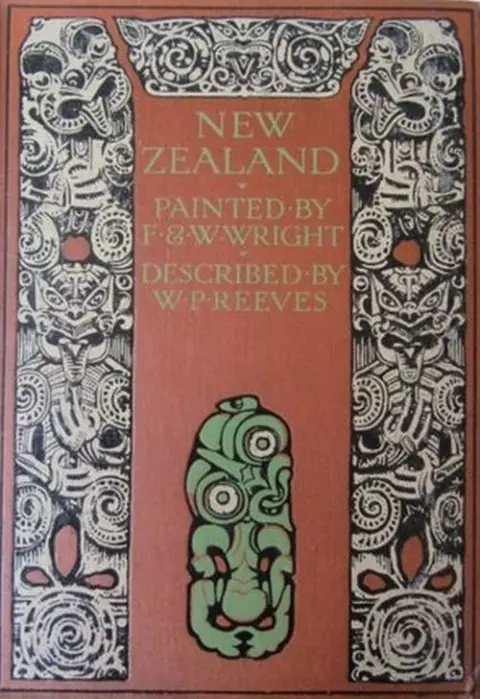
New Zealand
William Pember Reeves
THE CLASSIC COLLECTION · 1898
"The Long White Cloud: 'Ao Tea Roa'" by William Pember Reeves is a historical account written in the late 19th century. It provides an insightful exploration of New Zealand's genesis and development, tracing the island's history from the arrival of its earliest Polynesian settlers, the Maoris, to its status as a British colony. The work highlights the cultural, political, and natural aspects of New Zealand, aiming to shed light on its landscape and the complexities of its colonization. At the start of the book, Reeves establishes the backdrop of New Zealand's early European encounters. He notes the isolation and distinctiveness of the islands, contrasting their features with those of Britain and Australia. The opening portion delves into the arrival of the Maoris, their efforts in navigating the ocean to find New Zealand, and the rich, yet challenging landscape they encountered. Reeves also addresses the inadvertent impact of European settlers on the indigenous population and environment, setting the stage for a nuanced exploration of New Zealand's evolution through its unique struggles and successes.
Introduction adapted from the source catalogue; source summaries may be automatically generated.
Free to read · English · 102,986 words · No account needed
MAKE TIME FOR A GOOD BOOK
On by default. Untick to stop anonymous reading totals. Each page counts after 10 seconds in view. How this works.
Anonymous counting is on unless you have switched it off.
[Footnote 1: The lines with which Mr. Punch in December, 1867, saluted "Selwyn the pious and plucky," then just translated to Lichfield, had truth in them as well as fun:--
"Where lawn sleeves and silk apron had turned with a shiver, From the current that roared 'twixt his business and him, If no boat could be come at he breasted the river, And woe to his chaplain who craned at a swim!
"What to him were short commons, wet jacket, hard-lying The savage's blood-feud, the elements' strife, Whose guard was the Cross, at his peak proudly flying, Whose fare was the bread and the water of life?"]
Among the many interesting figures on the stage of the New Zealand of the first generation three seem to me to rise head and shoulders above the crowd--Gibbon Wakefield, Grey, and Selwyn, the founder, the ruler, the pastor. Nor must it be supposed, because these towered above their fellow-actors, that the latter were puny men. Plenty of ability found its way to the Colony, and under the stress of its early troubles wits were sharpened and faculties brightened. There is nothing like the colonial grindstone for putting an edge on good steel. Grey, Selwyn, and Wakefield, as unlike morally as they were in manner, had this in common, that they were leaders of men, and that they had men to lead. That for thirty years the representatives of the English Government, from Busby to Browne, were, with the exception of Grey, commonplace persons or worse, must not blind us to the interest of the drama or to the capacity of many of the men whom these commonplace persons were sent to guide.
Of the trio referred to, Grey is the greatest figure, and most attractive and complex study. Of such a man destiny might have made a great visionary, a capable general, an eloquent tribune, or a graceful writer. He had in him the stuff for any of these. But the south wing of the British Empire had to be built, and the gods made Grey a social architect in the guise of a pro-consul. Among the colonies of the southern hemisphere he is already a figure of history, and amongst them no man has played so many parts in so many theatres with so much success. Not merely was he the saviour and organizer of New Zealand, South Australia, and South Africa; not merely was he an explorer of the deserts of New Holland, and a successful campaigner in New Zealand bush-warfare, but he found time, by way of recreation, to be an ethnologist, a literary pioneer, and an ardent book-collector who twice was generous enough to found libraries with the books which had been the solace and happiness of his working life. A mere episode of this life was the fanning of the spark of Imperialism into flame in England thirty years ago. There are those who will think the eloquence with which he led the New Zealand democracy, the results he indirectly obtained for it, and the stand which at the extreme end of his career he made with success for a popular basis for the inevitable Australian Federation, among the least of his feats. To the writer they do not seem so. Before a life so strenuous, so dramatic, and so fruitful, criticism--at least colonial criticism--is inclined respectfully to lay down its pen. But when we come to the man himself, to the mistakes he made, and the misunderstandings he caused, and to the endeavour to give some sort of sketch of what he was, the task is neither easy nor always pleasant. I have known those who thought Grey a nobler Gracchus and a more practical Gordon; and I have known those who thought him a mean copy of Dryden's Achitophel. His island-retreat, where Froude described him as a kind of evangelical Cincinnatus, seemed to others merely the convenient lurking-place of a political rogue-elephant. The viceroy whose hated household the Adelaide tradesmen would not deal with in 1844, and the statesman whose visit to Adelaide in 1891 was a triumphal progress, the public servant whom the Duke of Buckingham insulted in 1868, and the empire-builder whom the Queen delighted to honour in 1894, were one and the same man. So were the Governor against whom New Zealanders inveighed as an arch-despot in 1848, and the popular leader denounced as arch-demagogue by some of the same New Zealanders thirty years afterwards. In a long life of bustle and change his strong but mixed character changed and moulded circumstances, and circumstances also changed and moulded him. The ignorant injustice of some of his Downing Street masters might well have warped his disposition even more than it did. The many honest and acute men who did not keep step with Grey, who were disappointed in him, or repelled by and embittered against him, were not always wrong. Some of his eulogists have been silly. But the student of his peculiar nature must be an odd analyst who does not in the end conclude that Grey was on the whole more akin to the Christian hero painted by Froude and Olive Schreiner than to the malevolent political chess-player of innumerable colonial leader-writers.
Your reading position is saved on this browser. Take it to another device with a library code. Reading pages adapt to text, rather than matching a printed edition.
William Pember Reeves
BEHIND THE BOOK
This eBook is for the use of anyone anywhere in the United States and most other parts of the world at no cost and with almost no restrictions whatsoever. You may copy it, give it away or re-use it under the terms of the Project Gutenberg License included with this eBook or online at www.gutenberg.org. If you are not located in the United States, you will have to check the laws of the country where you are located before using this eBook. Read the source licence.
The original source file, including credits and licence, is retained by this library. Request an original-format copy at no charge. Please include the book title and Project Gutenberg identifier #12411.
KEEP YOUR CURIOSITY GOING
Cécile Tormay

Moritz Busch
John L. Ransom
Frances Wright
Cécile Tormay

Mabel Potter Daggett