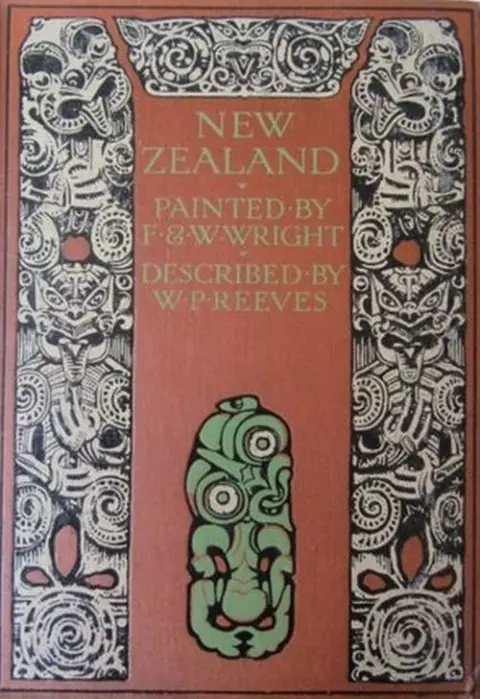
New Zealand
William Pember Reeves
THE CLASSIC COLLECTION · 1898
"The Long White Cloud: 'Ao Tea Roa'" by William Pember Reeves is a historical account written in the late 19th century. It provides an insightful exploration of New Zealand's genesis and development, tracing the island's history from the arrival of its earliest Polynesian settlers, the Maoris, to its status as a British colony. The work highlights the cultural, political, and natural aspects of New Zealand, aiming to shed light on its landscape and the complexities of its colonization. At the start of the book, Reeves establishes the backdrop of New Zealand's early European encounters. He notes the isolation and distinctiveness of the islands, contrasting their features with those of Britain and Australia. The opening portion delves into the arrival of the Maoris, their efforts in navigating the ocean to find New Zealand, and the rich, yet challenging landscape they encountered. Reeves also addresses the inadvertent impact of European settlers on the indigenous population and environment, setting the stage for a nuanced exploration of New Zealand's evolution through its unique struggles and successes.
Introduction adapted from the source catalogue; source summaries may be automatically generated.
Free to read · English · 102,986 words · No account needed
MAKE TIME FOR A GOOD BOOK
On by default. Untick to stop anonymous reading totals. Each page counts after 10 seconds in view. How this works.
Anonymous counting is on unless you have switched it off.
After a good deal of tedious litigation Grey was able to settle nearly all the outstanding land claims. By a misuse of one of Fitzroy's freakish ordinances land-grabbers had got hold of much of the land near Auckland. Grey was able to make many of them disgorge. His influence with the Maoris enabled him to buy considerable tracts of land. By him the Colonial Office was persuaded to have a reasonable force retained for the protection of the Colony. He put an end to the office of "Protector of the Aborigines," the source of much well-meant but unpractical advice. When Earl Grey sent out in 1846 a constitution prematurely conferring upon the Colonists the right of governing themselves--and also of governing the Maoris--Sir George had the moral courage and good sense to stand in the way of its adoption. For this, and for refusing to allow private purchase of native land, he was bitterly attacked; but he stood his ground, to the advantage of both races. Especially in the settlements of the New Zealand Company was the agitation for free institutions carried on with vigour and ability.
It is scarcely needful now to scan in detail the various compromises and expedients by which Grey vainly endeavoured to satisfy the Colonists, first with nominated councils, then with local self-governing powers; or how, finally, he completely changed front, went further than Lord Grey, and drafted and sent home a constitution which, for that day, seemed the quintessence of Radicalism.
Meanwhile he remained an autocrat. Even an autocrat has his advisers, and in some of them he was fortunate. Mr. William Swainson, his Attorney-General, was an English lawyer of striking abilities of more than one kind. Fortunately one of these lay in drafting statutes. On him devolved the drawing-up of the laws of the infant Colony. In doing so he ventured to be much simpler in language and much less of a slave to technical subtleties than was usual in his day. By an ordinance dealing with conveyancing he swept away a host of cumbrous English precedents relating to that great branch of law. Other excellent enactments dealt with legal procedure and marriage. Mr. Swainson's ordinances were not only good in themselves, but set an example in New Zealand which later law reformers were only too glad to follow and improve upon. Another official of ability and high character was Sir William Martin, Chief Justice, long known, not only as a refined gentleman and upright judge, but as an enthusiastic and unswerving champion of what he believed to be the rights of the Maori race. But a more commanding figure than either Martin or Swainson was George Augustus Selwyn, the first Bishop of the Colony. No better selection could have been made than that by which England sent this muscular Christian to organize and administer a Church of mingled savages and pioneers. Bishop Selwyn was both physically and mentally a ruler of men. When young, his tall, lithe frame, and long, clean-cut aquiline features were those of the finest type of English gentleman. When old, the lines on his face marked honourably the unresting toil of the intellectual athlete. Hard sometimes to others, he was always hardest to himself. When in the wilderness, he could outride or outwalk his guides, and could press on when hunger made his companions flag wearily. He would stride through rivers in his Bishop's dress, and laugh at such trifles as wet clothes, and would trudge through the bush with his blankets rolled up on his back like any swag-man. When at sea in his missionary schooner, he could haul on the ropes or take the helm--and did so.[1] If his demeanour and actions savoured at times somewhat of the dramatic, and if he had more of iron than honey in his manner, it must be remembered that his duty lay in wild places and amongst rough men, where strength of will and force of character were more needed than gentler virtues. For more than a generation he laboured strenuously amongst Maoris and Europeans, loved by many and respected by all. He organized the Episcopal Church in New Zealand upon a basis which showed a rare insight into the democratic character of the community with which he had to deal. The basis of his system is found in the representative synods of clergy and laity which assemble annually in each New Zealand diocese. The first draft of this Church constitution came indeed from the brain and hand of Sir George Grey, but for the rest the credit of it belongs to Selwyn.
Your reading position is saved on this browser. Take it to another device with a library code. Reading pages adapt to text, rather than matching a printed edition.
William Pember Reeves
BEHIND THE BOOK
This eBook is for the use of anyone anywhere in the United States and most other parts of the world at no cost and with almost no restrictions whatsoever. You may copy it, give it away or re-use it under the terms of the Project Gutenberg License included with this eBook or online at www.gutenberg.org. If you are not located in the United States, you will have to check the laws of the country where you are located before using this eBook. Read the source licence.
The original source file, including credits and licence, is retained by this library. Request an original-format copy at no charge. Please include the book title and Project Gutenberg identifier #12411.
KEEP YOUR CURIOSITY GOING
Cécile Tormay

Moritz Busch
John L. Ransom
Frances Wright
Cécile Tormay

Mabel Potter Daggett