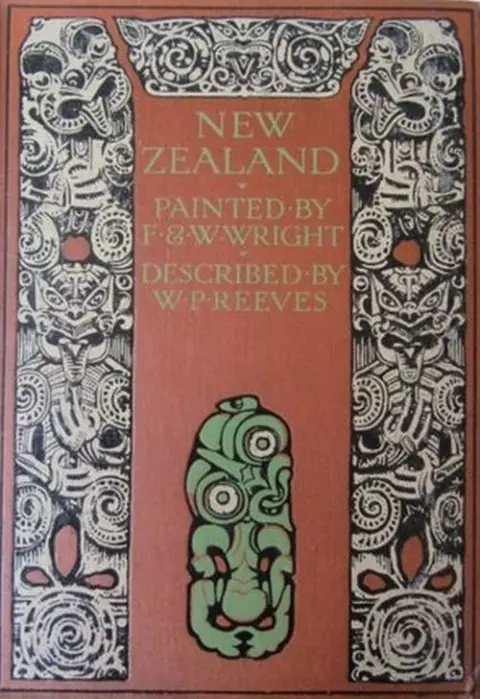
New Zealand
William Pember Reeves
THE CLASSIC COLLECTION · 1898
"The Long White Cloud: 'Ao Tea Roa'" by William Pember Reeves is a historical account written in the late 19th century. It provides an insightful exploration of New Zealand's genesis and development, tracing the island's history from the arrival of its earliest Polynesian settlers, the Maoris, to its status as a British colony. The work highlights the cultural, political, and natural aspects of New Zealand, aiming to shed light on its landscape and the complexities of its colonization. At the start of the book, Reeves establishes the backdrop of New Zealand's early European encounters. He notes the isolation and distinctiveness of the islands, contrasting their features with those of Britain and Australia. The opening portion delves into the arrival of the Maoris, their efforts in navigating the ocean to find New Zealand, and the rich, yet challenging landscape they encountered. Reeves also addresses the inadvertent impact of European settlers on the indigenous population and environment, setting the stage for a nuanced exploration of New Zealand's evolution through its unique struggles and successes.
Introduction adapted from the source catalogue; source summaries may be automatically generated.
Free to read · English · 102,986 words · No account needed
MAKE TIME FOR A GOOD BOOK
On by default. Untick to stop anonymous reading totals. Each page counts after 10 seconds in view. How this works.
Anonymous counting is on unless you have switched it off.
"Fortune, they say, flies from us: she but wheels
Like the fleet sea-bird round the fowler's skiff,
Lost in the mist one moment, and the next
Brushing the white sail with a whiter wing
As if to court the aim. Experience watches,
And has her on the turn."
When the Waitara war broke out the white population did not number more than seventy-five thousand. When Te Kooti was chased into the King Country it had grown to nearly four times that sum, in the face of debt, doubt, and the paralyzing effects of war. A great ally of settlement had come upon the scene. In 1861 profitable goldfields were discovered in Otago. The little Free Church colony, which in thirteen years had scarcely increased to that number of thousands, was thunderstruck at the news. For years there had been rumours of gold in the river beds and amongst the mountains of the South Island. From 1857 to 1860 about £150,000 had been won in Nelson. In 1858, a certain Asiatic, Edward Peters, known to his familiars as Black Pete, who had somehow wandered from his native Bombay through Australia to Otago, had struck gold there; and in March, 1861, there was a rush to a short-lived goldfield at the Lindis, another spot in that province. But it was not until the winter of that year that the prospector, Gabriel Read, found in a gully at Tuapeka the indubitable signs of a good alluvial field. Digging with a butcher's knife, he collected in ten hours nearly five-and-twenty pounds' worth of the yellow metal. Then he sunk hole after hole for some distance, finding gold in all. Unlike most discoverers, Read made no attempt to keep his fortune to himself, but wrote frankly of it to Sir John Richardson, the superintendent of the province. For this he was ultimately paid the not extravagant reward of £1,000. The good Presbyterians of Dunedin hardly knew in what spirit to receive the tidings. But some of them did not hesitate to test the field. Very soberly, almost in sad solemnity, they set to work there, and the result solved all doubts. Half Dunedin rushed to Tuapeka. At one of the country kirks the congregation was reduced to the minister and precentor. The news went across the seas. Diggers from Australia and elsewhere poured in by the thousand. Before many months the province's population had doubled, and the prayerful and painful era of caution, the day of small things, was whisked away in a whirl of Victorian enterprise. For the next few years the history of Otago became a series of rushes. Economically, no doubt, "rush" is the proper word to apply to the old stampedes to colonial goldfields. But in New Zealand, at any rate, the physical methods of progression thither were laborious in the extreme. The would-be miner tramped slowly and painfully along, carrying as much in the way of provisions and tools as his back would bear. Lucky was the man who had a horse to ride, or the rudest cart to drive in. When, as time went on, gold was found high up the streams amongst the ice-cold rivers and bleak tussock-covered mountains of the interior, the hardships endured by the gold-seekers were often very great. The country was treeless and wind-swept. Sheep roamed over the tussocks, but of other provisions there were none. Hungry diggers were thankful to pay half a crown for enough flour to fill a tin pannikin. £120 a ton was charged for carting goods from Dunedin. Not only did fuel fetch siege prices, but five pounds would be paid for an old gin-case, for the boards of a dray, or any few pieces of wood out of which a miner's "cradle" could be patched up. The miners did not exactly make light of these obstacles, for, of the thousands who poured into the province after the first discoveries, large numbers fled from the snow and starvation of the winters, when the swollen rivers rose, and covered up the rich drift on the beaches under their banks. But enough remained to carry on the work of prospecting, and the finds were rich enough to lure new-comers. In the year 1863 the export of gold from Otago rose to more than two millions sterling. Extraordinary patches were found in the sands and drift of the mountain torrents. It is recorded of one party that, when crossing a river, their dog was swept away by the current on to a small rocky point. A digger went to rescue it, and never was humanity more promptly rewarded, for from the sands by the rock he unearthed more than £1,000 worth of gold before nightfall. Some of the more fortunate prospectors had their footsteps dogged by watchful bands bent on sharing their good luck. One of them, however, named Fox, managed to elude this espionage for some time, and it was the Government geologist--now Sir James Hector--who, while on a scientific journey, discovered him and some forty companions quietly working in a lonely valley.
Your reading position is saved on this browser. Take it to another device with a library code. Reading pages adapt to text, rather than matching a printed edition.
William Pember Reeves
BEHIND THE BOOK
This eBook is for the use of anyone anywhere in the United States and most other parts of the world at no cost and with almost no restrictions whatsoever. You may copy it, give it away or re-use it under the terms of the Project Gutenberg License included with this eBook or online at www.gutenberg.org. If you are not located in the United States, you will have to check the laws of the country where you are located before using this eBook. Read the source licence.
The original source file, including credits and licence, is retained by this library. Request an original-format copy at no charge. Please include the book title and Project Gutenberg identifier #12411.
KEEP YOUR CURIOSITY GOING
Cécile Tormay

Moritz Busch
John L. Ransom
Frances Wright
Cécile Tormay

Mabel Potter Daggett