THE CLASSIC COLLECTION✦A dead man’s diaryCLASSIC FREE BOOKS
A dead man’s diary
Coulson Kernahan
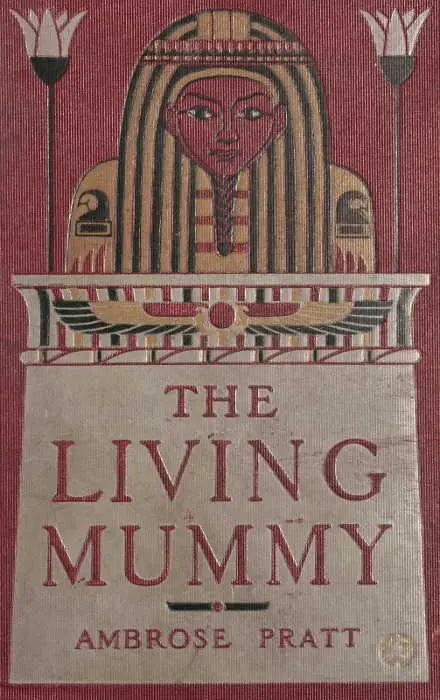
THE CLASSIC COLLECTION · 1910
"The Living Mummy" by Ambrose Pratt is a fiction novel written in the early 20th century. The story is set in the Libyan desert, where the main character, Dr. Pinsent, is an Egyptologist who becomes embroiled in a mysterious and thrilling adventure involving the famous explorer Sir Robert Ottley and his daughter, Miss Ottley. The narrative introduces a fascinating premise centered around ancient Egyptian history, particularly revolving around the discovery of a tomb belonging to a powerful priest named Ptahmes, and explores themes of curiosity, ambition, and the supernatural. The opening of the narrative sets the stage with Dr. Pinsent intensely focused on his academic work when he is unexpectedly interrupted by the arrival of Sir Robert Ottley and his daughter. The excitement builds as they embark on a journey to explore a tomb that Ottley has searched for years. However, mysterious and ominous elements start to surface, including the enigmatic allure of the sarcophagus and the supernatural presence that seems to haunt the characters. Through tense interactions and the introduction of a shadowy figure that appears to threaten their safety, the opening hints at a deeper connection between the ancient past and the unfolding drama, enticing the reader to delve further into the book's mysteries and character dynamics.
Introduction adapted from the source catalogue; source summaries may be automatically generated.
Free to read · English · 72,228 words · No account needed
MAKE TIME FOR A GOOD BOOK
On by default. Untick to stop anonymous reading totals. Each page counts after 10 seconds in view. How this works.
Anonymous counting is on unless you have switched it off.
He did not flinch from the blistering flash of the discharge. It seemed to me that it should have seared his face and that the bullet should have split his skull. I had a momentary glimpse of a ghastly, brownish-yellow visage and of two dull widely separated eyes peering into mine. Then all was dark again and I was struggling as never I had struggled in my life before. Long, stiff fingers clutched my throat. A rigid wood-like form was pressed against my own and my nostrils were filled with a sickly penetrating odour which I all too sharply recognised. It was the perfume that had issued from the sarcophagus of Ptahmes when I drove my chisel through the lead. At first I grasped nothing but air. But clutching wildly at the things that gripped my throat, I caught hands at last composed of bone. There was no flesh on them, or so it seemed to me. Yet it was good to grip something. It gave me heart. I had a horrible feeling for some awful seconds of contending with the supernatural. But those hands were hard and firm. They compressed my windpipe. Back and fro we writhed. I heard nothing but my own hard breathing. I was being slowly strangled. It was very hard to drag those hands apart. But I am strong, stronger than many men who earn their living by exhibiting to the vulgar feats of strength. Impelled by fear of death, I exerted my reserve of force, and driving will and muscle into one supreme united effort I tore the death grip from my neck and flung the Arab off. Uttering a sobbing howl of relief and rage, I followed him and caught him by the middle. Then stooping low, I heaved him high and dashed him to the ground. There came a sound of snapping wood or bones, but neither sigh nor cry of any sort. "We'll see," I growled, and struck a match. The sand before me was dinted, but deserted. The Arab had vanished. My senses rocked in horrified astonishment. My flesh crept. A cold chill of vague unreasoning terror caught me. I listened, all my nerves taut strained, peering wildly round into the dark. But the silence was unbroken. Nothing was to be heard, nothing was to be seen. Were it not for the dinted sand and the marks of feet other than my own where we had stepped and struggled, I could have come to the conclusion I had dreamed. After a while spent in soothing panic fears, I sneaked off to my baggage and extracted from the pile a candle lamp. This I lighted and, returning, searched the sands on hands and knees. The stranger's footprints were longer than my own and they were toe-marked. Plainly, then, he had stolen on me naked-footed. Looking wide around the dint made by his falling body I came presently upon some more of them. They were each a yard apart, and led towards the Hill of Rakh. Yet only for a little while. Soon they grew fainter and fainter. Finally they disappeared. Tortured by the mystery of it all, I halted where the footprints vanished and, putting out the lamp, squatted on the ground to wait for dawn. It came an hour later, but it told me nothing fresh. Indeed, it only rendered the riddle more intolerably maddening. Where had my Arab gone? And how had he come? For there was not a single footprint leading to the camp. Of course he might have thrown a cloak before him on which to walk; and thus he might have progressed and left no trace. But wherefore such extraordinary caution? And why should he be so anxious to conceal himself? It was hard to give up the riddle, but easier to abandon than to solve it. Calling philosophy to my aid and imagination, I determined that my Arab was some mad hermit upon whose solitude Ottley had intruded in the first instance, and I in the second. And that he had conceived a particular animosity for some unknown reason against my humble self and wished to kill me. Without a doubt, he had some secret hiding-place and feared lest I should seek to discover it. Perhaps he had found some treasure of which he had constituted himself the jealous guardian. I felt sure, at any rate, that he was mad. His actions had always been so peculiar and his speechlessness so baffling and astonishing and crassly unreasonable. But he or someone had killed my donkey. I found the poor beast lying in a hollow, dead as Cæsar. A knife had been employed, a long, sharp-pointed knife--perhaps a sword. It had searched out the creature's heart and pierced it. I made a hasty autopsy in order to be sure. The circumstance was most exasperating. It condemned me to the task of being my own beast of burthen. And the load was not a light one. I made, however, the best of a bad job, and having fortified myself with a good breakfast, I started off laden like a pack-horse for the Hill of Rakh. Having covered four miles, I stopped. Miss Ottley and Captain Frankfort Weldon had suddenly come into view. They were mounted. I sat down on my baggage, lighted a cigarette and waited. Common elementary Christian charity would compel them to offer me a lift. It was a good thought. It is not right that a man should work like a beast. And, besides, it was cheering to see Miss Ottley again. She came up looking rather care-worn and a good deal surprised. I arose and doffed my hat like a courtier. Captain Weldon touched his helmet with his whip by way of salute. He might have just stepped out of a bandbox. I felt he did not like me. The girl looked at me with level brows.
Your reading position is saved on this browser. Take it to another device with a library code. Reading pages adapt to text, rather than matching a printed edition.
BEHIND THE BOOK
This eBook is for the use of anyone anywhere in the United States and most other parts of the world at no cost and with almost no restrictions whatsoever. You may copy it, give it away or re-use it under the terms of the Project Gutenberg License included with this eBook or online at www.gutenberg.org. If you are not located in the United States, you will have to check the laws of the country where you are located before using this eBook. Read the source licence.
The original source file, including credits and licence, is retained by this library. Request an original-format copy at no charge. Please include the book title and Project Gutenberg identifier #58944.
KEEP YOUR CURIOSITY GOING
Coulson Kernahan

Maurice Baring
Frances Wright
Cécile Tormay
Francis Greenleaf Allinson & Anne C. E. (Anne Crosby Emery) Allinson

Frederic Jesup Stimson