THE CLASSIC COLLECTION✦A dead man’s diaryCLASSIC FREE BOOKS
A dead man’s diary
Coulson Kernahan
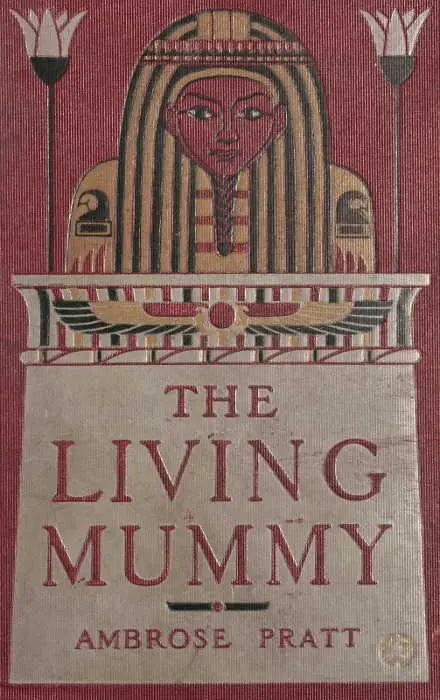
THE CLASSIC COLLECTION · 1910
"The Living Mummy" by Ambrose Pratt is a fiction novel written in the early 20th century. The story is set in the Libyan desert, where the main character, Dr. Pinsent, is an Egyptologist who becomes embroiled in a mysterious and thrilling adventure involving the famous explorer Sir Robert Ottley and his daughter, Miss Ottley. The narrative introduces a fascinating premise centered around ancient Egyptian history, particularly revolving around the discovery of a tomb belonging to a powerful priest named Ptahmes, and explores themes of curiosity, ambition, and the supernatural. The opening of the narrative sets the stage with Dr. Pinsent intensely focused on his academic work when he is unexpectedly interrupted by the arrival of Sir Robert Ottley and his daughter. The excitement builds as they embark on a journey to explore a tomb that Ottley has searched for years. However, mysterious and ominous elements start to surface, including the enigmatic allure of the sarcophagus and the supernatural presence that seems to haunt the characters. Through tense interactions and the introduction of a shadowy figure that appears to threaten their safety, the opening hints at a deeper connection between the ancient past and the unfolding drama, enticing the reader to delve further into the book's mysteries and character dynamics.
Introduction adapted from the source catalogue; source summaries may be automatically generated.
Free to read · English · 72,228 words · No account needed
MAKE TIME FOR A GOOD BOOK
On by default. Untick to stop anonymous reading totals. Each page counts after 10 seconds in view. How this works.
Anonymous counting is on unless you have switched it off.
He stooped floorwards with the match and instantly a mighty flame shot up that licked the very roof. "Revenge!" he shrieked. "Revenge! I've fooled you, Pinsent, fooled you. Now we all shall die together. Look!" With that, he steeped both hands in the burning fluid and, flitting like a salamander through the flames, he made for the sarcophagus. I could not have stayed him had I wished, for there was a sea of fire between us. But in good truth I was too dazed for the while, at least, to move a muscle. Reaching the great lead tomb, the dreadful flaming object that had once been Belleville thrust his lambent hands into the coffin. There followed an explosion of appalling fury. A mass of brilliant, white, combustible shot up with a mighty roar from the sarcophagus to the ceiling. It pierced the padded lining like a thunderbolt and flashed into the room above. But on its impact with the ceiling it also splashed a rain of fire about the great laboratory. In two seconds the whole place ran with flames. By a miracle I was not touched. But it was not so with Miss Ottley. Her skirt was ablaze. I rushed forward and tore the thing off in strips before it burnt her--then seizing her in my arms, I made like a madman to the door. A hideous burning object lay before it shrieking sulphurous curses. It was Belleville. But he had come to the end of his strength and he could not stay me. The catch yielded to my hand and I dashed into the passage half blinded with fire and smoke, but safe. I did not rest until I had reached the staircase. Miss Ottley was then awake. She struggled in my arms, so I set her down and faced her. But she did not see me. Her dress was smouldering in places. She seemed utterly bewildered. A woman ran up to her and began to put out the burning patches with her hands. The house was in an uproar. Servants--they were all either Arabs or Nubians--ran hither and thither shouting and screaming in a panic. The woman, evidently a nurse, who attended to Miss Ottley, was the only white person to be seen. She was evidently terrified, but she did not lose her head. She kept asking Miss Ottley in French to explain what had happened. Nobody seemed aware that the house was on fire. They had all been merely alarmed by the noises they had heard. Miss Ottley in the middle of it all began to weep. She was thoroughly upset and ill, and I perceived at once that she was on the verge of a mental and physical collapse. In the circumstances, I judged it best to remain a silent onlooker of events and not to take any action unless there arose a real necessity. It was plain that I was still invisible. And as for the house being on fire, I deemed it utterly desirable that it should burn down to the last shaving and thus fittingly entomb in its destruction the ghastly tragedy of the laboratory. The issue tallied largely with my wishes. The fire was seen first from the street. There followed a veritable pandemonium. The coloured servants fled like cowards for their lives, and in an incredibly short space of time the house was in the hands of firemen and police. Miss Ottley was taken by the nurse out into the street and there questioned by a sergeant. But she was quite unable to answer his insistent queries satisfactorily. All she could say was that she had been a long time ill. She had fainted in her room that afternoon, and Dr. Belleville or someone had carried her to the laboratory. When she woke up she had heard a frightful noise. She supposed it was one of the Doctor's experiments. She thought she had fainted again, but she remembered nothing more until she found herself with her dress on fire at the foot of the staircase. She could not explain how she got there. The sergeant was civil enough to her, but the fool, in his fussy officiousness, overlooked her weak condition, and the girl broke down and utterly collapsed before he realised his quite unnecessary cruelty. The worst of it was that the French nurse had disappeared during the colloquy. There was, therefore, no woman at hand to attend to my poor sweetheart. Fortunately, however, a physician appeared opportunely on the scene, and at his direction she was immediately conveyed to a hospital. After she had gone, I did not tarry very long. Choosing a place where the cordoned crowd was thinnest, I slipped back through the park railings, over which I climbed and dropped into the park, feeling the weight of my invisibility acutely. From this vantage point I watched the conflagration for a while. The house was manifestly doomed. Indeed, the efforts of the firemen were entirely directed to save adjoining buildings. A hundred jets of water played upon the walls of these in thin continuous streams. Men about me were talking the matter over as if it personally appealed to them. They mostly viewed it with a sort of half-secret satisfaction. The misfortunes of millionaires do not excite much sympathy in the hearts of the mob.
Your reading position is saved on this browser. Take it to another device with a library code. Reading pages adapt to text, rather than matching a printed edition.
BEHIND THE BOOK
This eBook is for the use of anyone anywhere in the United States and most other parts of the world at no cost and with almost no restrictions whatsoever. You may copy it, give it away or re-use it under the terms of the Project Gutenberg License included with this eBook or online at www.gutenberg.org. If you are not located in the United States, you will have to check the laws of the country where you are located before using this eBook. Read the source licence.
The original source file, including credits and licence, is retained by this library. Request an original-format copy at no charge. Please include the book title and Project Gutenberg identifier #58944.
KEEP YOUR CURIOSITY GOING
Coulson Kernahan

Maurice Baring
Frances Wright
Cécile Tormay
Francis Greenleaf Allinson & Anne C. E. (Anne Crosby Emery) Allinson

Frederic Jesup Stimson