THE CLASSIC COLLECTION✦A dead man’s diaryCLASSIC FREE BOOKS
A dead man’s diary
Coulson Kernahan
THE CLASSIC COLLECTION · 1910
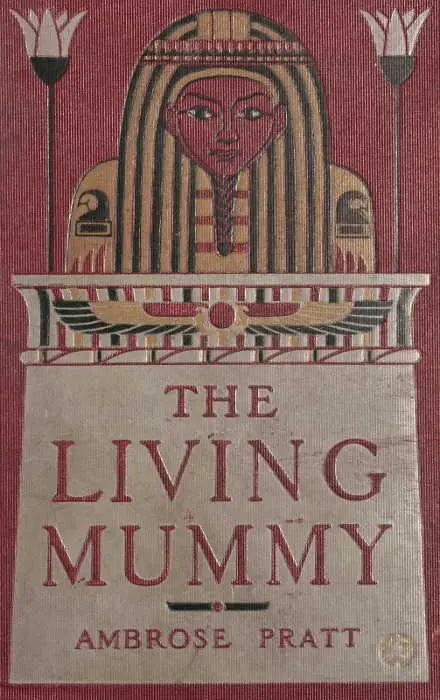
"The Living Mummy" by Ambrose Pratt is a fiction novel written in the early 20th century. The story is set in the Libyan desert, where the main character, Dr. Pinsent, is an Egyptologist who becomes embroiled in a mysterious and thrilling adventure involving the famous explorer Sir Robert Ottley and his daughter, Miss Ottley. The narrative introduces a fascinating premise centered around ancient Egyptian history, particularly revolving around the discovery of a tomb belonging to a powerful priest named Ptahmes, and explores themes of curiosity, ambition, and the supernatural. The opening of the narrative sets the stage with Dr. Pinsent intensely focused on his academic work when he is unexpectedly interrupted by the arrival of Sir Robert Ottley and his daughter. The excitement builds as they embark on a journey to explore a tomb that Ottley has searched for years. However, mysterious and ominous elements start to surface, including the enigmatic allure of the sarcophagus and the supernatural presence that seems to haunt the characters. Through tense interactions and the introduction of a shadowy figure that appears to threaten their safety, the opening hints at a deeper connection between the ancient past and the unfolding drama, enticing the reader to delve further into the book's mysteries and character dynamics.
Introduction adapted from the source catalogue; source summaries may be automatically generated.
Free to read · English · 72,228 words · No account needed
MAKE TIME FOR A GOOD BOOK
On by default. Untick to stop anonymous reading totals. Each page counts after 10 seconds in view. How this works.
Anonymous counting is on unless you have switched it off.
"Belleville!" said I.
He started as though an adder had stung him, then seeing his pistol gone, he let both vase and lanthorn fall in his dismay and swung on heel to face my voice.
"It's my turn now," I muttered. "Hands above your head--up, man, up--higher--higher!" He saw the muzzle pointing at his breast and sullenly obeyed. I made him walk backwards to the chair that formerly had prisoned me and sit in it. And then, the steel pressed to his ear to keep him still, I managed, with one hand, to pass a strap around his throat and buckle it. Afterwards I similarly bound his wrists and ankles. When all was done I was so sore spent, so hideously full of weary pain, that I lay upon the floor and sank immediately into a troubled sleep. Belleville woke me with his struggles to get free. Somehow or other he had pryed himself on tiptoe backward, and the heavy chair, overbalancing, had dragged him over in its fall. That I had not heard, but the weight of iron and his own body was all curiously pressed upon one forearm, and the pain of it set him groaning like a wounded bull. The strangest thing of all was that this arm was free. Somehow or other he had writhed it loose. After I had tied it up again I sat down to think what I should do. I was not, however, in the mood to sit in judgment on him then, for although much stronger from my sleep, the exertion hurt, and every pang I suffered was too powerful an advocate of vengeance to let me try the rascal soberly. I needed food and drink. Not finding any in the room, I tried the door and after some short search, made out its fastening--a simple but clever slip of prodigious strength. I found the key to it in Belleville's pocket. He was madly anxious to be made acquainted with his fate, but I turned a deaf ear to all his questions, and slipping out of the room, I slammed the door on his solicitations. I found myself in a long, blind passage, lighted with a single jet, with another padded door set in its farthest end. This opened to the same key as the first. It gave me egress on a second passage, which led by three right angles to a big velvet-draped arch and a bifurcated maze of broad-balconied corridors. Here I saw the natural light of day for the first time in more than a week. Ah! how I revelled in it. I stopped before an open window and peered forth on a walled courtyard and the blank, tall wall of a neighbouring mansion beyond. Street sounds percolated to my ears. It was like coming back to life from the grave. Drawing back from the window, after some deep, delicious moments, I looked to find my body and my hands and feet. But I could not see aught but vague, delusive shadows, though the sunbeams glistened on me. The phenomenon filled me with a new sense of marvel and uncertainty. I had to pinch myself to make sure I was not a disembodied phantom--such stuff as dreams are made of. Yet I was real enough to touch, thank Heaven. Reassured, I made for the nearest door and softly tried it. Within was a man's bedroom--Belleville's, perhaps. It was untenanted. The next apartment was a sitting-room. It was also untenanted, but it contained a table, cover-spread for two. With a sigh of joy, I entered and hurried to the table. Under the first cover was a cold partridge pie. I did not touch the others, but, Lord, how I enjoyed that pie! I might have been a wolf--and then champagne! Later, seduced by an open cigar-box on the mantel, I threw myself upon a lounge and lit a weed. In ten minutes I was my own man again, and almost comfortable, for the torments that had racked my wretched muscles on reawakening from their tethered lethargy, were disappearing fast. But I was not permitted longer rest. Warned by a tap on the door, I had barely time to toss my cigar into the grate, when the door opened and a short, squat negro stepped into the room. He carried a salver of sweetmeats to the table; he stopped short and uttered a guttural exclamation of surprise. Next instant he was joined by a companion, but no negro, an Arab, a tall, thin Arab, who was the living counterpart of the mummified corpse of Ptahmes I had left in the laboratory, and of the mysterious scoundrel who had attempted my life in the cave temple at Rakh, and at my camp on the banks of the Nile. I was so utterly astounded that I wonder I did not shout out my amazement.
Your reading position is saved on this browser. Take it to another device with a library code. Reading pages adapt to text, rather than matching a printed edition.
BEHIND THE BOOK
This eBook is for the use of anyone anywhere in the United States and most other parts of the world at no cost and with almost no restrictions whatsoever. You may copy it, give it away or re-use it under the terms of the Project Gutenberg License included with this eBook or online at www.gutenberg.org. If you are not located in the United States, you will have to check the laws of the country where you are located before using this eBook. Read the source licence.
The original source file, including credits and licence, is retained by this library. Request an original-format copy at no charge. Please include the book title and Project Gutenberg identifier #58944.
KEEP YOUR CURIOSITY GOING
Coulson Kernahan

Maurice Baring
Frances Wright
Cécile Tormay
Francis Greenleaf Allinson & Anne C. E. (Anne Crosby Emery) Allinson

Frederic Jesup Stimson