THE CLASSIC COLLECTION✦A dead man’s diaryCLASSIC FREE BOOKS
A dead man’s diary
Coulson Kernahan
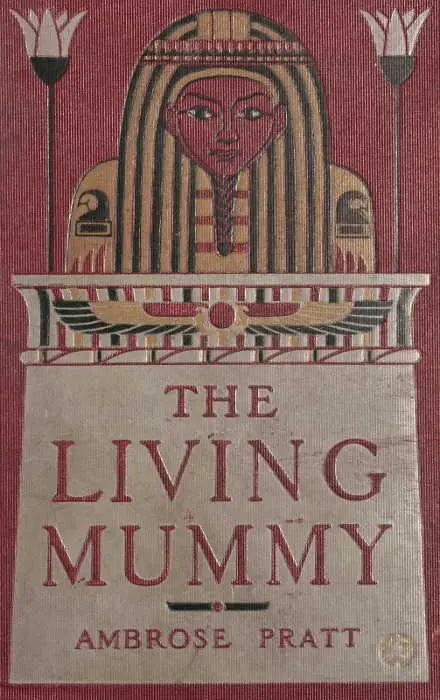
THE CLASSIC COLLECTION · 1910
"The Living Mummy" by Ambrose Pratt is a fiction novel written in the early 20th century. The story is set in the Libyan desert, where the main character, Dr. Pinsent, is an Egyptologist who becomes embroiled in a mysterious and thrilling adventure involving the famous explorer Sir Robert Ottley and his daughter, Miss Ottley. The narrative introduces a fascinating premise centered around ancient Egyptian history, particularly revolving around the discovery of a tomb belonging to a powerful priest named Ptahmes, and explores themes of curiosity, ambition, and the supernatural. The opening of the narrative sets the stage with Dr. Pinsent intensely focused on his academic work when he is unexpectedly interrupted by the arrival of Sir Robert Ottley and his daughter. The excitement builds as they embark on a journey to explore a tomb that Ottley has searched for years. However, mysterious and ominous elements start to surface, including the enigmatic allure of the sarcophagus and the supernatural presence that seems to haunt the characters. Through tense interactions and the introduction of a shadowy figure that appears to threaten their safety, the opening hints at a deeper connection between the ancient past and the unfolding drama, enticing the reader to delve further into the book's mysteries and character dynamics.
Introduction adapted from the source catalogue; source summaries may be automatically generated.
Free to read · English · 72,228 words · No account needed
MAKE TIME FOR A GOOD BOOK
On by default. Untick to stop anonymous reading totals. Each page counts after 10 seconds in view. How this works.
Anonymous counting is on unless you have switched it off.
I felt my senses rock at the recollection; and then I went hot all over with shame, to think of my neglect, my inattention. Until that moment--despite his dying direction, I had utterly forgotten his sad trust. And the thing he had given me to keep--where was it now? Where, indeed, but in the pocket of that coat where I had placed it. Oh! It was safe enough, no doubt--but that did not absolve me. For weeks I had been a recreant trustee. I had, I saw it now, I had been a coward. I felt his death so much that I had resolutely put all thoughts of him aside, smothered them with work, fearing the misery which they must bring. And I had been his friend!
I took up the coat and felt in the pocket. Yes, it was there. What was it? I drew it out before the light and saw nothing! Yet I held something heavy and hard. Was I going mad? Was my sight diseased or what? I rubbed my eyes and looked again. Nothing! I strode over to the gas jet and held the thing between my visual organs and the flame. Ah! something now! But how describe it? I saw a small light blur; a sort of shapeless haze off which the rays, the jet of light diffused, recoiled obliquely. It was not transparent, but neither was it in the true sense visible. It seemed to defy the light rays, to repulse them rather than absorb them. When held directly before the flame I could not see the gas jet through it, and yet itself I could not truly see. It confused and disarranged my vision as a watery mote does floating on the surface of an eyeball. Slowly and surely experimenting with the thing, I found that the farther I withdrew it from the lamp the less sensibly my sense became aware of its existence. But when I placed it directly against the lamp the flame became mysteriously obscured. I say mysteriously, because the thing cast no discoverable shadow, and although solid to the sense of touch, it was not otherwise apparently opaque. The flame still burned behind it, and I still saw the flame, yet not through, but over and around an intermediate blur. In that connection the thing did not resemble glass. Had the reverse been the case I should have seen the flame through it directly. As it was, as far as I can make out, the impression of the flame was conveyed to my retina by rays of light that did not travel in a straight path. They climbed over and surrounded the interposed object first, and thus gave me a slightly distorted image of the flame; and instead of revealing the obstacle which they had to overcome in transit, all they did was to indicate vaguely its situation. Thus, above and below the indiscernible point where their straight and proper course was interfered with I perceived a misty, indefinable haze. And at the point where the rays seemed to reassemble and readjust themselves to the resumption of their ordinary business there was a blur. Perhaps the best way to depict the effect was to present the hypothesis of a weak flame held up before a stronger one. This does not exactly describe the phenomenon I witnessed and investigated, but it approximates as closely as I can manage. The chief points of difference are, that every flame casts a shadow, and this thing did not, unless a blur of light be a shadow; and furthermore, a flame may be seen even confronted with a stronger flame, and this thing I held was destitute of a perceptible outline. The pity was that I was then working without a single clue to any comprehension of the thing; and the greater pity is that though my knowledge became fuller, I am still ignorant of the action of the properties which made the thing visually impalpable. I can only guess at them. But I think I guess correctly when I conjecturally assert that it was surface coated with some essence which had the power to compel the great majority of the light rays to travel along its sides and surface and to resume their original direction afterwards. I do not pretend to understand how this essence could so interfere with and control the laws of light. But granting that it could, the explanation is a natural one. And though scientists may frown at me for advancing a theory which I am unable to substantiate, I prefer to incur their scorn rather than adopt the alternative--supernatural agency. I simply decline to believe in the supernatural. It is my profound conviction that nothing has ever happened on this planet, however mysterious and inexplicable, which has not been produced by a purely and perfectly natural cause. And the longer I live the more certain do I become that, deep and wonderful as our scientific acquaintance with Nature undoubtedly is, we have not yet even thoroughly explored the porch of her palace of secrets, her vast treasure-house of wonders.
Your reading position is saved on this browser. Take it to another device with a library code. Reading pages adapt to text, rather than matching a printed edition.
BEHIND THE BOOK
This eBook is for the use of anyone anywhere in the United States and most other parts of the world at no cost and with almost no restrictions whatsoever. You may copy it, give it away or re-use it under the terms of the Project Gutenberg License included with this eBook or online at www.gutenberg.org. If you are not located in the United States, you will have to check the laws of the country where you are located before using this eBook. Read the source licence.
The original source file, including credits and licence, is retained by this library. Request an original-format copy at no charge. Please include the book title and Project Gutenberg identifier #58944.
KEEP YOUR CURIOSITY GOING
Coulson Kernahan

Maurice Baring
Frances Wright
Cécile Tormay
Francis Greenleaf Allinson & Anne C. E. (Anne Crosby Emery) Allinson

Frederic Jesup Stimson