
A Son of Ishmael: A Novel
L. T. Meade
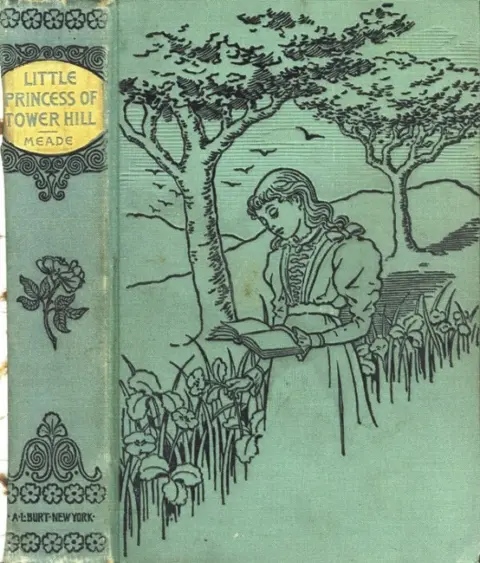
THE CLASSIC COLLECTION · 1889
"The Little Princess of Tower Hill" by L. T. Meade is a children's novel written in the late 19th century. The story revolves around a young girl named Maggie Ascot, who is affectionately called the "Little Princess of Tower Hill." The book explores themes of privilege, childhood innocence, and the challenges of growing up as Maggie interacts with her family and other children, particularly in the context of her relationships with her new cousin Ralph and her longing to be liked by others. At the start of the narrative, readers are introduced to Maggie, a precocious almost eight-year-old girl who enjoys a life of luxury and attention as the only child of her affluent parents, Sir John and Lady Ascot. Her spoiled nature becomes apparent as she grapples with the arrival of her cousin Ralph, who challenges her perceptions of happiness and worth. Maggie's experiences shift from being carefree to learning lessons about responsibility, friendship, and the consequences of her actions, especially after losing her father's prized rabbits. This opening sets the stage for Maggie's growth as she navigates her relationships and begins to understand the broader implications of her privileged lifestyle within her social circle.
Introduction adapted from the source catalogue; source summaries may be automatically generated.
Free to read · English · 53,769 words · No account needed
MAKE TIME FOR A GOOD BOOK
On by default. Untick to stop anonymous reading totals. Each page counts after 10 seconds in view. How this works.
Anonymous counting is on unless you have switched it off.
Billy was a small boy of ten; he was thin and wiry, had a freckled face, and a good deal of short, rather stumpy red hair.
He was by no means young-looking for his ten years; and only that his figure was small, his shoulders narrow, and his little legs sadly like spindles, he might have passed for a boy of twelve or thirteen.
Billy had a weight of care upon his shoulders--he had the entire charge of
a baby.
The baby was a year old, fairly heavy, fairly well grown; she was cutting her teeth badly, and in consequence was often cross and unmanageable.
Billy had to do with her night and day, and no one who saw the two together could for a moment wonder at the premature lines of care about his small thin face.
A year ago, on a certain January morning, Billy had been called away from a delightful game of hop-scotch. A red-faced woman had come to the door of a tall house, which over-looked the alley where Billy was playing so contentedly, and beckoned him mysteriously to follow her.
"Yer'd better make no noise, and take off those heavy clumps of shoes," she
remarked.
Billy looked down at his small feet, on which some very large and much-battered specimens of the shoemaker's craft were hanging loosely.
"I can shuffle of 'em off right there, under the stairs," he remarked, raising his blue eyes in a confident manner to the red-faced woman.
She nodded, but did not trouble to speak further, and barefooted Billy crept up the stairs; up and up, until he came to an attic room, which he knew well, for it represented his home.
He was still fresh from his hop-scotch, and eager to go back to his game; and when a thin, rather rasping woman's voice called him, he ran up eagerly to a bedside.
"Wot is it, mother? I want to go back to punch Tom Jones."
Alas! for poor Billy--his fate was fixed from that moment, and the wild
bird was caged.
"Another time, Billy," said his mother; "you 'as got other work to see to now. Pull down the bedclothes, and look wot's under 'em."
Billy eagerly drew aside the dirty counterpane and sheet, and saw a very small and pink morsel of humanity--a morsel of humanity which greeted his rough intrusion on her privacy with several contortions of the tiny features, and some piercing screams.
"Why, sakes alive, ef it ain't a baby," said Billy, falling back a step or
two in astonishment.
Your reading position is saved on this browser. Take it to another device with a library code. Reading pages adapt to text, rather than matching a printed edition.
BEHIND THE BOOK
This eBook is for the use of anyone anywhere in the United States and most other parts of the world at no cost and with almost no restrictions whatsoever. You may copy it, give it away or re-use it under the terms of the Project Gutenberg License included with this eBook or online at www.gutenberg.org. If you are not located in the United States, you will have to check the laws of the country where you are located before using this eBook. Read the source licence.
The original source file, including credits and licence, is retained by this library. Request an original-format copy at no charge. Please include the book title and Project Gutenberg identifier #38771.
KEEP YOUR CURIOSITY GOING
Coulson Kernahan

Maurice Baring
Frances Wright
Cécile Tormay

Frederic Jesup Stimson

W. H. P. (William Henry Pope) Jarvis


