
A Son of Ishmael: A Novel
L. T. Meade
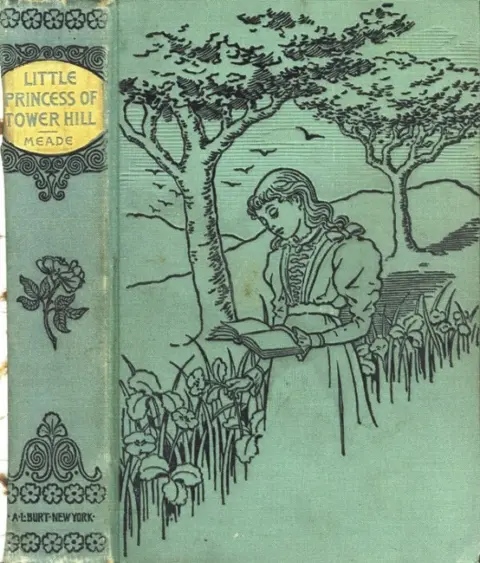
THE CLASSIC COLLECTION · 1889
"The Little Princess of Tower Hill" by L. T. Meade is a children's novel written in the late 19th century. The story revolves around a young girl named Maggie Ascot, who is affectionately called the "Little Princess of Tower Hill." The book explores themes of privilege, childhood innocence, and the challenges of growing up as Maggie interacts with her family and other children, particularly in the context of her relationships with her new cousin Ralph and her longing to be liked by others. At the start of the narrative, readers are introduced to Maggie, a precocious almost eight-year-old girl who enjoys a life of luxury and attention as the only child of her affluent parents, Sir John and Lady Ascot. Her spoiled nature becomes apparent as she grapples with the arrival of her cousin Ralph, who challenges her perceptions of happiness and worth. Maggie's experiences shift from being carefree to learning lessons about responsibility, friendship, and the consequences of her actions, especially after losing her father's prized rabbits. This opening sets the stage for Maggie's growth as she navigates her relationships and begins to understand the broader implications of her privileged lifestyle within her social circle.
Introduction adapted from the source catalogue; source summaries may be automatically generated.
Free to read · English · 53,769 words · No account needed
MAKE TIME FOR A GOOD BOOK
On by default. Untick to stop anonymous reading totals. Each page counts after 10 seconds in view. How this works.
Anonymous counting is on unless you have switched it off.
She was awakened from her first sleep by her father bending over her and kissing her passionately. Never had she seen Sir John's face so red, and his eyes quite looked--only of course that was impossible--as if he had been crying.
"Oh, father, I am glad to see you," exclaimed Maggie, "only I wish you had come last night, for then I wouldn't have tried to sell my hat, and you'd have given me the money for the tambourine. I wish you had come last night, father, dear."
"So do I, Mag-Mag," answered poor Sir John. "God knows it might have saved me from a broken heart."
Maggie could not understand either her father or aunt.
She began, perhaps, to have a certain glimmering as to the meaning of it all when, a few days later, she felt very hot, and languid, and heavy, when her throat ached, and her head ached, and although it was a warm summer's day, she was glad to lie with a shawl over her on the sofa. Then certain words of the doctor's, as he bent over her, penetrated her dull ears, and crept somehow down into her heart.
"There is no doubt whatever that she has taken the fever from Susy Aylmer. Well, all we have to do now is to pull her through as quickly as possible, and of course, Mrs. Grenville, as Ralph is still quite well, and as he was not exposed to anything like the same amount of infection as Maggie, you will send him away."
Mrs. Grenville responded in rather a choking voice, and she and the doctor left the room together.
A few moments later Mrs. Grenville came back and bent over the sick child.
"Is that you, Auntie Violet?" asked Maggie.
"Yes, my darling," responded her aunt.
"What's fever, auntie?"
"An illness, dear."
"And am I going to be very, very ill?"
"I hope not very ill, Maggie. We are going to nurse you so well that we trust that will not be the case; but I am afraid my poor little girl will not feel comfortable for some time."
"And did I take the fever that's to make me so sick from Susy--only Susy
wasn't sick, auntie?"
"No, dearest; but she carried the infection on her clothes, and there is no doubt you took it from her."
"Then I'm 'fraid," continued Maggie, "you're very angry with her still."
"I cannot say that I'm pleased with her, darling."
"Oh, but, auntie, I want you to forgive her, and I want father to forgive her, 'cause she didn't know nothing about 'fection or fevers--and--and--do forgive her, Auntie Violet."
Your reading position is saved on this browser. Take it to another device with a library code. Reading pages adapt to text, rather than matching a printed edition.
BEHIND THE BOOK
This eBook is for the use of anyone anywhere in the United States and most other parts of the world at no cost and with almost no restrictions whatsoever. You may copy it, give it away or re-use it under the terms of the Project Gutenberg License included with this eBook or online at www.gutenberg.org. If you are not located in the United States, you will have to check the laws of the country where you are located before using this eBook. Read the source licence.
The original source file, including credits and licence, is retained by this library. Request an original-format copy at no charge. Please include the book title and Project Gutenberg identifier #38771.
KEEP YOUR CURIOSITY GOING
Coulson Kernahan

Maurice Baring
Frances Wright
Cécile Tormay

Frederic Jesup Stimson

W. H. P. (William Henry Pope) Jarvis


