
A Son of Ishmael: A Novel
L. T. Meade
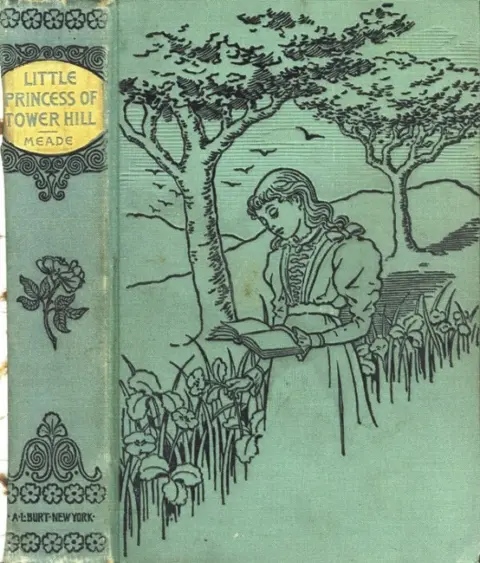
THE CLASSIC COLLECTION · 1889
"The Little Princess of Tower Hill" by L. T. Meade is a children's novel written in the late 19th century. The story revolves around a young girl named Maggie Ascot, who is affectionately called the "Little Princess of Tower Hill." The book explores themes of privilege, childhood innocence, and the challenges of growing up as Maggie interacts with her family and other children, particularly in the context of her relationships with her new cousin Ralph and her longing to be liked by others. At the start of the narrative, readers are introduced to Maggie, a precocious almost eight-year-old girl who enjoys a life of luxury and attention as the only child of her affluent parents, Sir John and Lady Ascot. Her spoiled nature becomes apparent as she grapples with the arrival of her cousin Ralph, who challenges her perceptions of happiness and worth. Maggie's experiences shift from being carefree to learning lessons about responsibility, friendship, and the consequences of her actions, especially after losing her father's prized rabbits. This opening sets the stage for Maggie's growth as she navigates her relationships and begins to understand the broader implications of her privileged lifestyle within her social circle.
Introduction adapted from the source catalogue; source summaries may be automatically generated.
Free to read · English · 53,769 words · No account needed
MAKE TIME FOR A GOOD BOOK
On by default. Untick to stop anonymous reading totals. Each page counts after 10 seconds in view. How this works.
Anonymous counting is on unless you have switched it off.
Jim opened his eyes and raised his eyebrows a trifle at this proof of inconstancy on Maggie's part, but he thought fit to offer no verbal objection, and the two walked together in the direction of the stables. Here the large stable clock attracted the erratic little maid's attention; she suddenly remembered the dreadful feeling of shame which had swept over her when Ralph had asked her to tell him the hour. She had earnestly wished at that moment that she had been a good child, and had learned how to tell the time when Miss Grey offered to teach her. It would never do for Ralph to discover her deficiency in this matter. Perhaps Jim could teach her. She turned to him eagerly.
"Jim, do you know what o'clock it is?"
"Yes, missie, of course; it's a quarter-past six."
"Oh! how clever of you, Jim, to know that. Did you find it out by looking up at the stable clock?"
"Why, of course, Miss Maggie; there it is in front of us. You can see for
yourself."
Maggie's face became very grave, and her eyes assumed quite a sad
expression.
"I want to whisper something to you, Jim," she said. "Stoop down; I want to say it very, very low. I don't know the clock time."
Jim received this solemn secret in a grave manner. He was silent for a moment; then he said slowly:
"You can learn it, I suppose, Miss Maggie?"
"Oh, yes, dear Jim; and you can teach me."
Jim began to rumple up his hair and to look perplexed.
"I--oh! that's another thing," he said.
"Yes, you can, Jim; and you must begin right away. There's a big, round white thing, and there are little figures marked on it; and there are two hands that move, 'cause I've watched them; and there's a funny thing at the bottom that goes tick-tick all the time."
"That's the pend'lum, Miss Maggie."
"Yes, the pend'lum," repeated Maggie glibly. "I'll remember that word; I won't forget. Now, go on, Jim. What's the next thing?"
"Well, there's the two 'ands, miss; the little 'and points to the hours, and the big 'un to the minutes."
"It sounds very puzzling," said Maggie.
"So it is, miss; so it is. You couldn't learn the clock not for a score of days. I took a week of Sundays over it myself, and I'm not to say dull. The clock's a puzzler, Miss Maggie, and can't be learned off in a jiffy, anyhow."
Your reading position is saved on this browser. Take it to another device with a library code. Reading pages adapt to text, rather than matching a printed edition.
BEHIND THE BOOK
This eBook is for the use of anyone anywhere in the United States and most other parts of the world at no cost and with almost no restrictions whatsoever. You may copy it, give it away or re-use it under the terms of the Project Gutenberg License included with this eBook or online at www.gutenberg.org. If you are not located in the United States, you will have to check the laws of the country where you are located before using this eBook. Read the source licence.
The original source file, including credits and licence, is retained by this library. Request an original-format copy at no charge. Please include the book title and Project Gutenberg identifier #38771.
KEEP YOUR CURIOSITY GOING
Coulson Kernahan

Maurice Baring
Frances Wright
Cécile Tormay

Frederic Jesup Stimson

W. H. P. (William Henry Pope) Jarvis


