THE CLASSIC COLLECTION✦Wedded by fateCLASSIC FREE BOOKS
Wedded by fate
Georgie, Mrs. Sheldon
THE CLASSIC COLLECTION · 1884
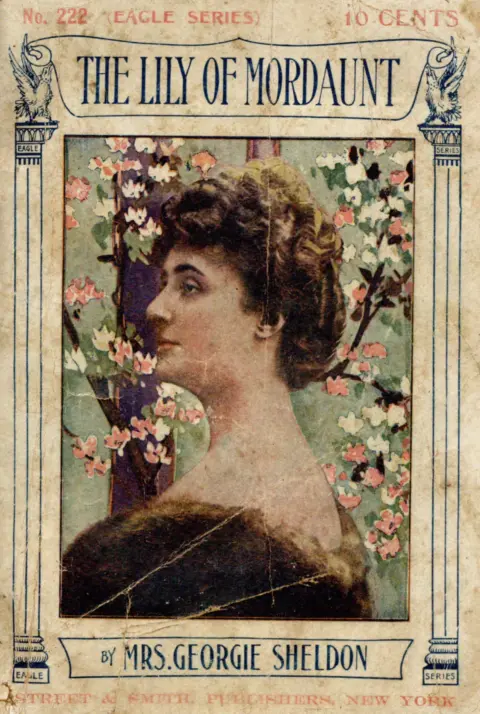
"The lily of Mordaunt" by Mrs. Georgie Sheldon is a novel written in the late 19th century. It appears to be a romantic society drama set in the English countryside, centering on Lady Elaine Warburton—an heiress nicknamed the “Lily of Mordaunt”—her devoted admirer Wil Hamilton, the witty heiress Arley Wentworth, and the ambitious barrister Philip Paxton. Expect a tale of courtship, jealousy, and social maneuvering where friendship and ambition collide against questions of love and fortune.
The opening of the novel introduces the country-house world of Hazelmere through Wil Hamilton’s exuberant letter inviting his friend Philip to meet the household: Lady Elaine, Arley, Annie Hamilton, and Fred Vane. Philip arrives skeptical of “Elaine” but is instantly captivated by her beauty, while Arley deftly thwarts his efforts to monopolize the heiress, giving Wil chances to be near her. At a grand dinner, Wil’s jealousy flares; a moonlit row and a rare night-blooming lily steady him, and the flower becomes a tender token between him and Elaine. Philip seizes a private moment to propose; Elaine refuses him, and Wil, misreading a brief handshake, plunges into despair until Elaine finds him in the woods and they clear the misunderstanding, confessing mutual love. Their engagement is announced the next morning, prompting Philip’s anger, a private financial setback, and a resolve to mask his feelings while recalibrating his ambitions.
Introduction adapted from the source catalogue; source summaries may be automatically generated.
Free to read · English · 124,077 words · No account needed
MAKE TIME FOR A GOOD BOOK
On by default. Untick to stop anonymous reading totals. Each page counts after 10 seconds in view. How this works.
Anonymous counting is on unless you have switched it off.
Tears actually started to the invalid’s eyes; he could hardly believe that the beautiful girl was fatally ill; yet he remembered how hollow her cough had sounded the last time he saw her, and how, several times, she had involuntarily put her hand to her side as if a sharp pain had suddenly pierced her.
Arrow soon recovered his composure, and then told him that Mimosa had been out in a storm and taken a sudden cold; that during his illness she had several slight hemorrhages, and only a day or two previous she had been attacked with one more violent than the others, and was now confined to her couch.
This made Wil very sad, for he had been greatly interested in the bright, intelligent maiden, and it seemed almost cruel that she must die so young.
Another week passed, and then she came again to see him, and he was shocked at the change which the past fortnight had wrought in her, though she did not appear nearly so sad as she had done the last time he saw her.
“I am sorry you have been sick, Mimosa,” he said, holding out his hand
in greeting to her.
She laid hers for a moment within it, and it almost burned him with its
fever heat.
“Mimosa will be better soon,” she answered, quietly, as she sat down
beside him.
Then, fixing her dark eyes with a mournful look on his face, she asked,
significantly:
“Can the paleface be patient a little longer?”
Wil’s heart bounded into his throat at the question, for something told him she had devised a way for him to escape from his captors.
“How?--patient for what?” he asked, trying to speak calmly.
She held up her hand between him and the sunlight that poured in between the parted curtains of his tent, and he saw that it was almost transparent, and trembling from weakness.
“See!” she said, with a sad smile, “the life is almost gone; two moons will not wax and wane before it will be cold and still. When Mimosa’s heart ceases to beat, the paleface shall be free!”
“Mimosa! surely you do not think you are going to die!” Wil said, startled by her words, and in his anxiety for her heedless for the moment of their full import.
She smiled again, a trifle bitterly.
“Does the paleface care?”
“Truly I do,” he said, earnestly; “I should grieve sorely.”
“Will he remember the poor Indian girl when he goes back to the
golden-haired squaw?”
Your reading position is saved on this browser. Take it to another device with a library code. Reading pages adapt to text, rather than matching a printed edition.
Georgie, Mrs. Sheldon
Georgie, Mrs. Sheldon
Georgie, Mrs. Sheldon
Georgie, Mrs. Sheldon
BEHIND THE BOOK
This eBook is for the use of anyone anywhere in the United States and most other parts of the world at no cost and with almost no restrictions whatsoever. You may copy it, give it away or re-use it under the terms of the Project Gutenberg License included with this eBook or online at www.gutenberg.org. If you are not located in the United States, you will have to check the laws of the country where you are located before using this eBook. Read the source licence.
The original source file, including credits and licence, is retained by this library. Request an original-format copy at no charge. Please include the book title and Project Gutenberg identifier #78682.
KEEP YOUR CURIOSITY GOING
Coulson Kernahan

Maurice Baring
Frances Wright
Cécile Tormay

Frederic Jesup Stimson

W. H. P. (William Henry Pope) Jarvis