THE CLASSIC COLLECTION✦Wedded by fateCLASSIC FREE BOOKS
Wedded by fate
Georgie, Mrs. Sheldon
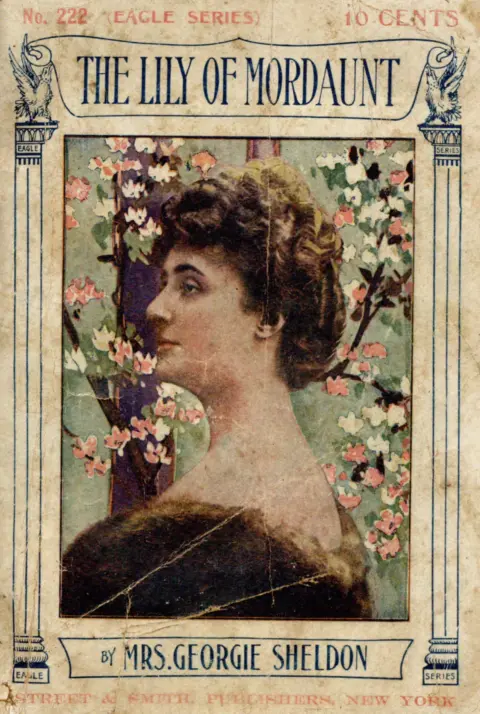
THE CLASSIC COLLECTION · 1884
"The lily of Mordaunt" by Mrs. Georgie Sheldon is a novel written in the late 19th century. It appears to be a romantic society drama set in the English countryside, centering on Lady Elaine Warburton—an heiress nicknamed the “Lily of Mordaunt”—her devoted admirer Wil Hamilton, the witty heiress Arley Wentworth, and the ambitious barrister Philip Paxton. Expect a tale of courtship, jealousy, and social maneuvering where friendship and ambition collide against questions of love and fortune.
The opening of the novel introduces the country-house world of Hazelmere through Wil Hamilton’s exuberant letter inviting his friend Philip to meet the household: Lady Elaine, Arley, Annie Hamilton, and Fred Vane. Philip arrives skeptical of “Elaine” but is instantly captivated by her beauty, while Arley deftly thwarts his efforts to monopolize the heiress, giving Wil chances to be near her. At a grand dinner, Wil’s jealousy flares; a moonlit row and a rare night-blooming lily steady him, and the flower becomes a tender token between him and Elaine. Philip seizes a private moment to propose; Elaine refuses him, and Wil, misreading a brief handshake, plunges into despair until Elaine finds him in the woods and they clear the misunderstanding, confessing mutual love. Their engagement is announced the next morning, prompting Philip’s anger, a private financial setback, and a resolve to mask his feelings while recalibrating his ambitions.
Introduction adapted from the source catalogue; source summaries may be automatically generated.
Free to read · English · 124,077 words · No account needed
MAKE TIME FOR A GOOD BOOK
On by default. Untick to stop anonymous reading totals. Each page counts after 10 seconds in view. How this works.
Anonymous counting is on unless you have switched it off.
“Did you climb those crags?” he cried, astonished.
She shrugged her pretty shoulders, while her lips curled a trifle.
“The chamois is not more sure-footed than Mimosa,” she said, briefly.
“Do you love flowers?” Wil asked, with a growing interest in her.
The quick color flashed over her face like a glow of light.
“They are the smiles of the Great Spirit,” she said, reverentially, while her eyes rested fondly upon the gay colors in his hand.
“You do love them, or you never would have said that,” Wil returned, earnestly, and deeply touched by the pretty smile; “and so do I. I am very thankful to you for thinking of me in my loneliness. But I have nothing to give you in return, unless you will let me choose one of these for you to wear as a token of my gratitude.”
“To wear?” she repeated, blankly, not comprehending his meaning at all.
“Yes. In my country, when a gentleman gives a lady a flower, if she cares anything for it, she pins it at her throat, or wears it in her belt. Here is this beautiful scarlet bell, which I will choose for you, as my thank-offering for the bouquet.”
He held it out to her as he spoke and she advanced shyly to take it, her eyes glowing, and the rich color sweeping up to her forehead as her fingers touched his in the act.
“I should be glad if you could come and see me again, Mimosa,” Wil said, as she was turning, without a word, to leave him.
“Mimosa has seen the paleface often, but he knew it not; he was sleeping, and the braves were on the trail,” she returned, thus indicating that it was only by stealth that she dared to approach his wigwam.
Then turning, she disappeared, like some bright bird, and the place seemed even more gloomy than before to its sad-hearted occupant.
Every day after Mimosa’s brief visit to him Wil received a lovely bouquet of flowers. Sometimes they were thrust just inside his curtains by a small, delicately-formed hand, which quickly disappeared again like a frightened bird; sometimes they were laid upon his pillow, where he would find them on his return from a walk, or they would be dropped in the very path at his feet from some invisible source above.
But he was at no loss to know to whom he was indebted for these choice floral offerings, although it was long before he had another opportunity to converse with the chieftain’s beautiful daughter.
Your reading position is saved on this browser. Take it to another device with a library code. Reading pages adapt to text, rather than matching a printed edition.
Georgie, Mrs. Sheldon
Georgie, Mrs. Sheldon
Georgie, Mrs. Sheldon
Georgie, Mrs. Sheldon
BEHIND THE BOOK
This eBook is for the use of anyone anywhere in the United States and most other parts of the world at no cost and with almost no restrictions whatsoever. You may copy it, give it away or re-use it under the terms of the Project Gutenberg License included with this eBook or online at www.gutenberg.org. If you are not located in the United States, you will have to check the laws of the country where you are located before using this eBook. Read the source licence.
The original source file, including credits and licence, is retained by this library. Request an original-format copy at no charge. Please include the book title and Project Gutenberg identifier #78682.
KEEP YOUR CURIOSITY GOING
Coulson Kernahan

Maurice Baring
Frances Wright
Cécile Tormay

Frederic Jesup Stimson

W. H. P. (William Henry Pope) Jarvis