THE CLASSIC COLLECTION✦Wedded by fateCLASSIC FREE BOOKS
Wedded by fate
Georgie, Mrs. Sheldon
THE CLASSIC COLLECTION · 1884
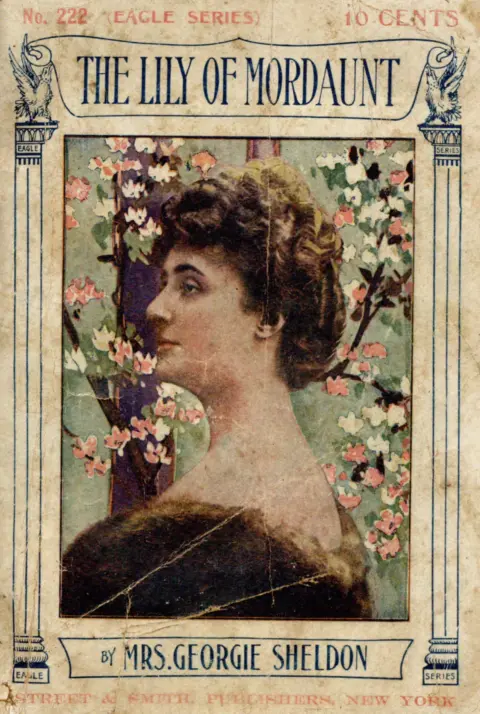
"The lily of Mordaunt" by Mrs. Georgie Sheldon is a novel written in the late 19th century. It appears to be a romantic society drama set in the English countryside, centering on Lady Elaine Warburton—an heiress nicknamed the “Lily of Mordaunt”—her devoted admirer Wil Hamilton, the witty heiress Arley Wentworth, and the ambitious barrister Philip Paxton. Expect a tale of courtship, jealousy, and social maneuvering where friendship and ambition collide against questions of love and fortune.
The opening of the novel introduces the country-house world of Hazelmere through Wil Hamilton’s exuberant letter inviting his friend Philip to meet the household: Lady Elaine, Arley, Annie Hamilton, and Fred Vane. Philip arrives skeptical of “Elaine” but is instantly captivated by her beauty, while Arley deftly thwarts his efforts to monopolize the heiress, giving Wil chances to be near her. At a grand dinner, Wil’s jealousy flares; a moonlit row and a rare night-blooming lily steady him, and the flower becomes a tender token between him and Elaine. Philip seizes a private moment to propose; Elaine refuses him, and Wil, misreading a brief handshake, plunges into despair until Elaine finds him in the woods and they clear the misunderstanding, confessing mutual love. Their engagement is announced the next morning, prompting Philip’s anger, a private financial setback, and a resolve to mask his feelings while recalibrating his ambitions.
Introduction adapted from the source catalogue; source summaries may be automatically generated.
Free to read · English · 124,077 words · No account needed
MAKE TIME FOR A GOOD BOOK
On by default. Untick to stop anonymous reading totals. Each page counts after 10 seconds in view. How this works.
Anonymous counting is on unless you have switched it off.
A day or two after her visit to Jane Collins, Arley was impelled to go
to the art exhibition.
She had thought much about the pale, intellectual boy, and she felt herself growing unaccountably interested in the poor little cripple.
Perhaps it was because of his condition, and the fact that he was an orphan, which appealed to her sympathies; or it might be on account of his evident love for art; at all events, she hoped she would meet him again, and she found herself looking eagerly about for him in every room that she entered.
She spent two or three hours in the galleries, but without catching sight of her new little friend, and she had at length come to the conclusion that he was not there at all, and, with a feeling of disappointment, was about to take her own departure, when she suddenly espied him in a small room, sitting upon a box behind a huge easel, as if he desired to escape observation, and working away in his sketchbook most diligently.
“Ah! I have found you at last,” Arley said, in a low, eager tone, as she bent over his shoulder to see what he was engaged upon. “I have been looking for you this long time.”
“Have you?” Eddie cried, lifting a bright, flushed face to her, while he might have told her that he had anxiously scanned every face there for several days in the hope of seeing her again.
“Yes, I have; and, do you know, I went away the other day without asking your name, and so I’ve been obliged to think of you as ‘that boy’ ever since,” Arley said, with a musical laugh.
“My name is Eddie Winthrope.”
“Thank you, Eddie,” she returned, “and your uncle?”
“Oh, he isn’t my uncle really, you know.”
“Not your uncle!” Arley cried, with a sudden thrill.
“No, but you are almost a stranger to me, and perhaps you wouldn’t care anything about it,” Eddie said, beginning to feel as if he was thrusting his story upon her.
“Oh, yes I do care; please tell me. I always love to know about people who are kind and good,” Arley returned.
Then the boy told of the accident and of how he had been adopted.
Arley felt very strangely while listening to the boy’s story, and the thought had flashed upon her, “what if he should prove to be Philip Paxton?”
Then she scorned the idea, for there was not the least similarity of character between him and this good man of whom she had just been told; it could not be possible that it was Philip.
Your reading position is saved on this browser. Take it to another device with a library code. Reading pages adapt to text, rather than matching a printed edition.
Georgie, Mrs. Sheldon
Georgie, Mrs. Sheldon
Georgie, Mrs. Sheldon
Georgie, Mrs. Sheldon
BEHIND THE BOOK
This eBook is for the use of anyone anywhere in the United States and most other parts of the world at no cost and with almost no restrictions whatsoever. You may copy it, give it away or re-use it under the terms of the Project Gutenberg License included with this eBook or online at www.gutenberg.org. If you are not located in the United States, you will have to check the laws of the country where you are located before using this eBook. Read the source licence.
The original source file, including credits and licence, is retained by this library. Request an original-format copy at no charge. Please include the book title and Project Gutenberg identifier #78682.
KEEP YOUR CURIOSITY GOING
Coulson Kernahan

Maurice Baring
Frances Wright
Cécile Tormay

Frederic Jesup Stimson

W. H. P. (William Henry Pope) Jarvis