THE CLASSIC COLLECTION✦Wedded by fateCLASSIC FREE BOOKS
Wedded by fate
Georgie, Mrs. Sheldon
THE CLASSIC COLLECTION · 1884
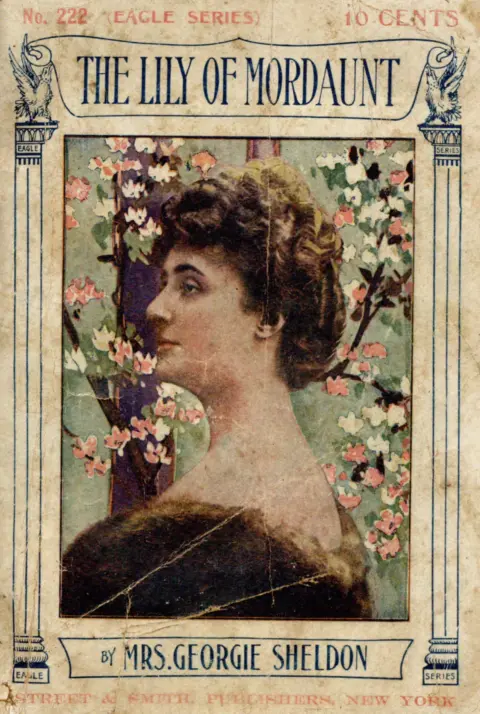
"The lily of Mordaunt" by Mrs. Georgie Sheldon is a novel written in the late 19th century. It appears to be a romantic society drama set in the English countryside, centering on Lady Elaine Warburton—an heiress nicknamed the “Lily of Mordaunt”—her devoted admirer Wil Hamilton, the witty heiress Arley Wentworth, and the ambitious barrister Philip Paxton. Expect a tale of courtship, jealousy, and social maneuvering where friendship and ambition collide against questions of love and fortune.
The opening of the novel introduces the country-house world of Hazelmere through Wil Hamilton’s exuberant letter inviting his friend Philip to meet the household: Lady Elaine, Arley, Annie Hamilton, and Fred Vane. Philip arrives skeptical of “Elaine” but is instantly captivated by her beauty, while Arley deftly thwarts his efforts to monopolize the heiress, giving Wil chances to be near her. At a grand dinner, Wil’s jealousy flares; a moonlit row and a rare night-blooming lily steady him, and the flower becomes a tender token between him and Elaine. Philip seizes a private moment to propose; Elaine refuses him, and Wil, misreading a brief handshake, plunges into despair until Elaine finds him in the woods and they clear the misunderstanding, confessing mutual love. Their engagement is announced the next morning, prompting Philip’s anger, a private financial setback, and a resolve to mask his feelings while recalibrating his ambitions.
Introduction adapted from the source catalogue; source summaries may be automatically generated.
Free to read · English · 124,077 words · No account needed
MAKE TIME FOR A GOOD BOOK
On by default. Untick to stop anonymous reading totals. Each page counts after 10 seconds in view. How this works.
Anonymous counting is on unless you have switched it off.
“The paleface would make a brave warrior. If he could be content, he might become a great chief by and by.”
“No, no, that would be impossible,” he returned, with an unseen gesture
of disgust.
“Tell Mimosa why.”
“Because--because--listen, Mimosa: You have always been a child of the forest; you have been free and unfettered as a bird, and no other life would be possible for you; that is, you could not enjoy any other. How would you like it if some one should carry you away to a large city and shut you up in small, close rooms, never allowing you to go out, and where you could never get a breath of your native air, or see one of your own people?”
“Mimosa would die,” she said, briefly; “her heart would break.”
“Yes, that is it. I am in a strange, wild country, my liberty is taken from me, and my heart is breaking to go back to my friends and my country.”
“The paleface is a man, and the hearts of the brave do not break,” the girl replied, with an accent of scorn.
“Perhaps not,” he assented, with a flush at the implied weakness; “I might not die, but I am very unhappy to be detained here against my will.”
Again he heard that sigh, then:
“Ah! if only the paleface could be happy here, Mimosa would live but to serve him, and--he should be a great chief.”
There was a sadness and an earnestness in the sweet voice that thrilled
her listener.
He started, as a thought flashed upon him.
Could it be possible that this beautiful Indian girl was learning to love him? and was that the secret of her past attentions to him and of her wish for him to remain and become one of her people?
He hoped that such was not the case; at all events, he resolved to nip any such sentiment in the bud.
“That could never be,” he said, gravely. “My heart is with my own people, and I must go back to them. Will you help me, Mimosa?”
Surely a sob smote his ear at this. He was not quite sure, but it was very like it. Then the girl said, in a passionate voice:
“When the paleface goes home, far across the sea, Mimosa--dies!”
Her voice died away to a hoarse whisper at the last word.
It was as he had feared, after all. The mischief was done--the Indian maiden loved him; and for a moment he was speechless--appalled.
Your reading position is saved on this browser. Take it to another device with a library code. Reading pages adapt to text, rather than matching a printed edition.
Georgie, Mrs. Sheldon
Georgie, Mrs. Sheldon
Georgie, Mrs. Sheldon
Georgie, Mrs. Sheldon
BEHIND THE BOOK
This eBook is for the use of anyone anywhere in the United States and most other parts of the world at no cost and with almost no restrictions whatsoever. You may copy it, give it away or re-use it under the terms of the Project Gutenberg License included with this eBook or online at www.gutenberg.org. If you are not located in the United States, you will have to check the laws of the country where you are located before using this eBook. Read the source licence.
The original source file, including credits and licence, is retained by this library. Request an original-format copy at no charge. Please include the book title and Project Gutenberg identifier #78682.
KEEP YOUR CURIOSITY GOING
Coulson Kernahan

Maurice Baring
Frances Wright
Cécile Tormay

Frederic Jesup Stimson

W. H. P. (William Henry Pope) Jarvis