THE CLASSIC COLLECTION✦Wedded by fateCLASSIC FREE BOOKS
Wedded by fate
Georgie, Mrs. Sheldon
THE CLASSIC COLLECTION · 1884
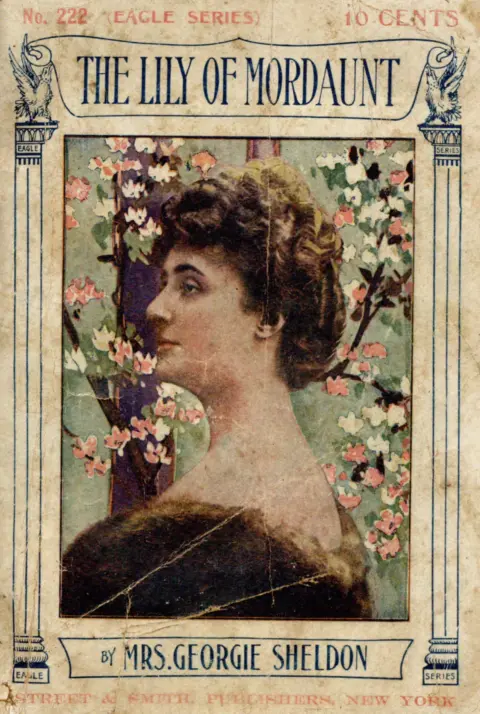
"The lily of Mordaunt" by Mrs. Georgie Sheldon is a novel written in the late 19th century. It appears to be a romantic society drama set in the English countryside, centering on Lady Elaine Warburton—an heiress nicknamed the “Lily of Mordaunt”—her devoted admirer Wil Hamilton, the witty heiress Arley Wentworth, and the ambitious barrister Philip Paxton. Expect a tale of courtship, jealousy, and social maneuvering where friendship and ambition collide against questions of love and fortune.
The opening of the novel introduces the country-house world of Hazelmere through Wil Hamilton’s exuberant letter inviting his friend Philip to meet the household: Lady Elaine, Arley, Annie Hamilton, and Fred Vane. Philip arrives skeptical of “Elaine” but is instantly captivated by her beauty, while Arley deftly thwarts his efforts to monopolize the heiress, giving Wil chances to be near her. At a grand dinner, Wil’s jealousy flares; a moonlit row and a rare night-blooming lily steady him, and the flower becomes a tender token between him and Elaine. Philip seizes a private moment to propose; Elaine refuses him, and Wil, misreading a brief handshake, plunges into despair until Elaine finds him in the woods and they clear the misunderstanding, confessing mutual love. Their engagement is announced the next morning, prompting Philip’s anger, a private financial setback, and a resolve to mask his feelings while recalibrating his ambitions.
Introduction adapted from the source catalogue; source summaries may be automatically generated.
Free to read · English · 124,077 words · No account needed
MAKE TIME FOR A GOOD BOOK
On by default. Untick to stop anonymous reading totals. Each page counts after 10 seconds in view. How this works.
Anonymous counting is on unless you have switched it off.
Wil was so delighted to hear his mother-tongue once more that his face brightened like magic, and he answered with all the courtesy of which he was master:
“Yes, thank you, I am better, though, of course, I am still helpless on account of my broken bones.”
The young Indian bowed gravely, while his keen eyes seemed to be studying the worn, though still handsome countenance of the stranger.
“The paleface may be thankful that he is here, even with broken bones,”
he said, briefly.
“That is so,” Wil answered, heartily, “and though I would much prefer to be with my own friends, yet your people have given me very kind care, and I am very grateful.”
The young brave’s face relaxed a trifle, as if the appreciative words
had pleased him.
“I have been very lonely,” Wil continued, “for I could talk with none. I am glad to find some one who speaks the English language.”
Again the brave merely bowed in reply.
“How far are we from a white settlement?” Wil inquired, anxious to learn something regarding his situation.
The Indian frowned slightly.
“Ten days’ march for the red man, fifteen days’ march for the paleface,” he replied, tersely.
Wil sighed heavily. That meant many, very many miles from civilization. There was no help for him, except from some such quarter, and he might be in the hands of a band of hostile savages.
“Would one of your braves carry a letter to the nearest post office for me?” he asked, after a moment of thought.
“Ugh? Isn’t the paleface comfortable?” the Indian demanded, with a
quick flash of his eye.
“Oh, yes, as comfortable as possible under the circumstances; but my friends will be very anxious about me, and I wish to relieve them of their suspense.”
“Paleface use big words; poor Indian no see,” was the somewhat scornful rejoinder. “But,” pointing to the bandaged arm, “how can he make a letter?”
“Oh, I could manage with my other hand to let them know that I am not dead, as I know they must believe me,” Wil said.
The brave shrugged his shoulders.
“Ugh, too warm for Indian to go to village, and the chief goes north as the sun gets higher.”
“North? Does that mean farther away?” Wil asked, with a sinking heart.
“It means to the heart of the cool forest, where the hot sun does not burn, where the trees are greenest and the wild bird’s songs are sweetest,” assented the Indian, with kindling eyes; then turning abruptly he left the tent.
Your reading position is saved on this browser. Take it to another device with a library code. Reading pages adapt to text, rather than matching a printed edition.
Georgie, Mrs. Sheldon
Georgie, Mrs. Sheldon
Georgie, Mrs. Sheldon
Georgie, Mrs. Sheldon
BEHIND THE BOOK
This eBook is for the use of anyone anywhere in the United States and most other parts of the world at no cost and with almost no restrictions whatsoever. You may copy it, give it away or re-use it under the terms of the Project Gutenberg License included with this eBook or online at www.gutenberg.org. If you are not located in the United States, you will have to check the laws of the country where you are located before using this eBook. Read the source licence.
The original source file, including credits and licence, is retained by this library. Request an original-format copy at no charge. Please include the book title and Project Gutenberg identifier #78682.
KEEP YOUR CURIOSITY GOING
Coulson Kernahan

Maurice Baring
Frances Wright
Cécile Tormay

Frederic Jesup Stimson

W. H. P. (William Henry Pope) Jarvis