THE CLASSIC COLLECTION✦Eline VereCLASSIC FREE BOOKS
Eline Vere
Louis Couperus
THE CLASSIC COLLECTION · 1921
"The Law Inevitable" by Louis Couperus is a novel written in the early 20th century. The story follows Cornélie de Retz van Loo, a young divorced woman traveling in Rome, seeking solace and a fresh start in life. As she navigates her new environment, the novel explores themes of identity, societal constraints, and the complexity of human relationships, set against the backdrop of a vibrant yet complex city. At the start of the book, the reader is introduced to Cornélie as she arrives at the Marchesa Belloni's boarding house in Rome. A mix of excitement and trepidation fills her as she settles into her new surroundings, and the initial interactions with other boarders reveal a rich tapestry of personalities, including the charming Mr. Rudyard, who seems to have a hidden agenda. Cornélie’s observations about her fellow guests and her inner musings about her past and future gradually paint a portrait of a woman in search of meaning amidst her disillusionment with the art and society she hoped would provide her solace. The opening chapters set the stage for her journey of self-discovery, as she grapples with loneliness, cultural expectations, and her desire to forge a new path in life.
Introduction adapted from the source catalogue; source summaries may be automatically generated.
Free to read · English · 85,792 words · No account needed
MAKE TIME FOR A GOOD BOOK
On by default. Untick to stop anonymous reading totals. Each page counts after 10 seconds in view. How this works.
Anonymous counting is on unless you have switched it off.
"Yes! You were cleverer than I then. To morrow perhaps I shall be
cleverer than you."
"Who knows!"
They both laughed. He nibbled the chocolates in the dish, one after the other, and asked if he might have a glass of port instead of tea. She poured him out a glass.
"May I give you something?"
"What?"
"A souvenir of our first acquaintance."
"It is very charming of you. What is it to be?"
He took something, wrapped in tissue-paper, from his pocket and handed it to her. She opened the little parcel and saw a strip of old Venetian lace, worked in the shape of a flounce, for a low bodice.
"Do accept it," he besought her. "It is a lovely piece. It is such a pleasure to me to give it to you."
She looked at him with all her coquetry in her eyes, as though she were trying to see through him.
"You must wear it like this."
He stood up, took the lace and draped it over her white tea-gown from shoulder to shoulder. His fingers fumbled with the folds, his lips just touched her hair.
She thanked him for his gift. He sat down again:
"I am glad that you will accept it."
"Have you given Miss Hope something too?"
He laughed, with his little laugh of conquest:
"Patterns are all she wants, patterns of the queen's ball-dresses. I wouldn't dare to give you patterns. To you I give old lace."
"But you nearly ruined your career for the sake of that pattern?"
"Oh, well!" he laughed.
"Which career?"
"Oh, don't!" he said, evasively. "Tell me, what do you advise me to do?"
"What do you mean?"
"Shall I marry her?"
"I am against all marriage, between cultivated people."
She wanted to repeat some of her phrases, but thought to herself, why? He would not understand them. He looked at her profoundly, with his carbuncle eyes:
"So you are in favour of free love?"
"Sometimes. Not always. Between cultivated people."
He was certain now, had any doubt still lingered in his mind, that a liaison existed between her and Van der Staal.
"And do you think me ... cultivated?"
She laughed provocatively, with a touch of scorn in her voice:
"Listen. Shall I speak to you seriously?"
"I wish you would."
"I consider neither you nor Miss Hope suited for free love."
"So I am not cultivated?"
"I don't mean it in the sense of being civilized. I mean modern
culture."
"So I am not modern?"
"No," she said, slightly irritated.
"Teach me to be modern."
She gave a nervous laugh:
Your reading position is saved on this browser. Take it to another device with a library code. Reading pages adapt to text, rather than matching a printed edition.
Louis Couperus

Louis Couperus

Louis Couperus
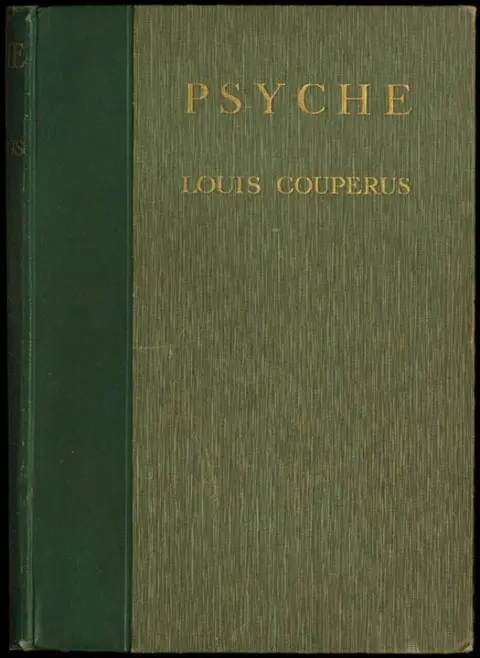
Louis Couperus
BEHIND THE BOOK
This eBook is for the use of anyone anywhere in the United States and most other parts of the world at no cost and with almost no restrictions whatsoever. You may copy it, give it away or re-use it under the terms of the Project Gutenberg License included with this eBook or online at www.gutenberg.org. If you are not located in the United States, you will have to check the laws of the country where you are located before using this eBook. Read the source licence.
The original source file, including credits and licence, is retained by this library. Request an original-format copy at no charge. Please include the book title and Project Gutenberg identifier #43827.
KEEP YOUR CURIOSITY GOING
Coulson Kernahan

Maurice Baring
Frances Wright
Cécile Tormay

Frederic Jesup Stimson

W. H. P. (William Henry Pope) Jarvis