THE CLASSIC COLLECTION✦Eline VereCLASSIC FREE BOOKS
Eline Vere
Louis Couperus
THE CLASSIC COLLECTION · 1921
"The Law Inevitable" by Louis Couperus is a novel written in the early 20th century. The story follows Cornélie de Retz van Loo, a young divorced woman traveling in Rome, seeking solace and a fresh start in life. As she navigates her new environment, the novel explores themes of identity, societal constraints, and the complexity of human relationships, set against the backdrop of a vibrant yet complex city. At the start of the book, the reader is introduced to Cornélie as she arrives at the Marchesa Belloni's boarding house in Rome. A mix of excitement and trepidation fills her as she settles into her new surroundings, and the initial interactions with other boarders reveal a rich tapestry of personalities, including the charming Mr. Rudyard, who seems to have a hidden agenda. Cornélie’s observations about her fellow guests and her inner musings about her past and future gradually paint a portrait of a woman in search of meaning amidst her disillusionment with the art and society she hoped would provide her solace. The opening chapters set the stage for her journey of self-discovery, as she grapples with loneliness, cultural expectations, and her desire to forge a new path in life.
Introduction adapted from the source catalogue; source summaries may be automatically generated.
Free to read · English · 85,792 words · No account needed
MAKE TIME FOR A GOOD BOOK
On by default. Untick to stop anonymous reading totals. Each page counts after 10 seconds in view. How this works.
Anonymous counting is on unless you have switched it off.
She remained indoors for a day or two and had her meals served in her room. One morning, however, she was going for a stroll in the Villa Borghese, when she met young Van der Staal, on his bicycle.
"Don't you ride?" he asked, jumping off.
"No."
"Why not?"
"It is an exercise which doesn't suit my style," Cornélie replied, vexed at meeting any one who disturbed the solitude of her stroll.
"May I walk with you?"
"Certainly."
He gave his machine into the charge of the porter at the gate and walked on with her, quite naturally, without saying very much:
"It's beautiful here," he remarked.
His words seemed to convey a simple meaning. She looked at him, for the
first time, attentively:
"You're an archæologist?" she asked.
"No," he said, deprecatingly.
"What are you, then?"
"Nothing. Mamma says that, just to excuse me. I'm nothing and a very useless member of society at that. And I'm not even well off."
"But you are studying, aren't you?"
"No. I do a little casual reading. My sisters call it studying."
"Do you like going about, as your sisters do?"
"No, I hate it. I never go with them."
"Don't you like meeting and studying people?"
"No. I like pictures, statues and trees."
"A poet?"
"No. Nothing. I am nothing, really."
She looked at him, with increased attention. He was walking very simply by her side, a tall, thin fellow of perhaps twenty-six, more of a boy than a man in face and figure, but endowed with a certain assurance and restfulness that made him seem older than his years. He was pale; he had dark, cool, almost reproachful eyes; and his long, lean figure, in his badly-kept cycling-suit, betrayed a slight indifference, as though he did not care what his arms and legs looked like.
He said nothing but walked on pleasantly, unembarrassed, without finding it necessary to talk. Cornélie, however, grew fidgety and sought for words:
"It is beautiful here," she stammered.
"Oh, it's very beautiful!" he replied, calmly, without seeing that she was constrained. "So green, so spacious, so peaceful: those long avenues, those vistas of avenues, like an antique arch, over yonder; and, far away in the distance, look, St. Peter's, always St. Peter's. It's a pity about those queer things lower down: that restaurant, that milk-tent. People spoil everything nowadays.... Let us sit down here: it is so lovely here."
They sat down on a bench.
"It is such a joy when a thing is beautiful," he continued. "People are never beautiful. Things are beautiful: statues and paintings. And then trees and clouds!"
"Do you paint?"
Your reading position is saved on this browser. Take it to another device with a library code. Reading pages adapt to text, rather than matching a printed edition.
Louis Couperus

Louis Couperus

Louis Couperus
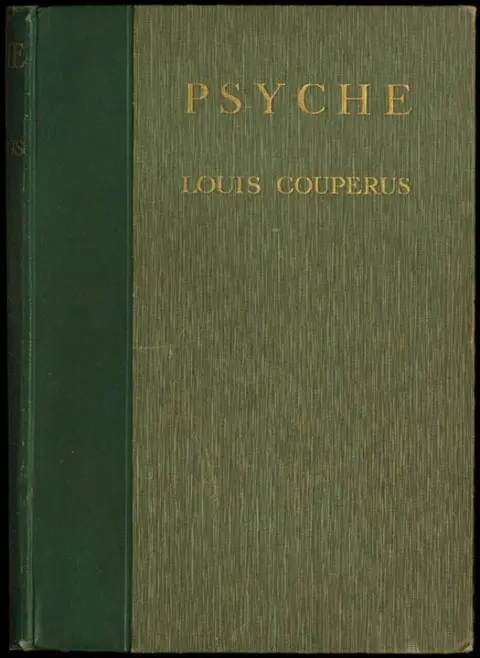
Louis Couperus
BEHIND THE BOOK
This eBook is for the use of anyone anywhere in the United States and most other parts of the world at no cost and with almost no restrictions whatsoever. You may copy it, give it away or re-use it under the terms of the Project Gutenberg License included with this eBook or online at www.gutenberg.org. If you are not located in the United States, you will have to check the laws of the country where you are located before using this eBook. Read the source licence.
The original source file, including credits and licence, is retained by this library. Request an original-format copy at no charge. Please include the book title and Project Gutenberg identifier #43827.
KEEP YOUR CURIOSITY GOING
Coulson Kernahan

Maurice Baring
Frances Wright
Cécile Tormay

Frederic Jesup Stimson

W. H. P. (William Henry Pope) Jarvis