THE CLASSIC COLLECTION✦Eline VereCLASSIC FREE BOOKS
Eline Vere
Louis Couperus
THE CLASSIC COLLECTION · 1921
"The Law Inevitable" by Louis Couperus is a novel written in the early 20th century. The story follows Cornélie de Retz van Loo, a young divorced woman traveling in Rome, seeking solace and a fresh start in life. As she navigates her new environment, the novel explores themes of identity, societal constraints, and the complexity of human relationships, set against the backdrop of a vibrant yet complex city. At the start of the book, the reader is introduced to Cornélie as she arrives at the Marchesa Belloni's boarding house in Rome. A mix of excitement and trepidation fills her as she settles into her new surroundings, and the initial interactions with other boarders reveal a rich tapestry of personalities, including the charming Mr. Rudyard, who seems to have a hidden agenda. Cornélie’s observations about her fellow guests and her inner musings about her past and future gradually paint a portrait of a woman in search of meaning amidst her disillusionment with the art and society she hoped would provide her solace. The opening chapters set the stage for her journey of self-discovery, as she grapples with loneliness, cultural expectations, and her desire to forge a new path in life.
Introduction adapted from the source catalogue; source summaries may be automatically generated.
Free to read · English · 85,792 words · No account needed
MAKE TIME FOR A GOOD BOOK
On by default. Untick to stop anonymous reading totals. Each page counts after 10 seconds in view. How this works.
Anonymous counting is on unless you have switched it off.
At the hotel, however, he spoke to Cornélie politely, as though there had been no embarrassment, no wrangling interchange of words between them, and he even asked her quite simply--because his mother and sisters had some calls to pay that afternoon--whether they should go to the Palatine together.
"I passed it the other day," she said, indifferently. "And don't you
intend to see the ruins?"
"No."
"Why not?"
"They don't interest me. I can't see the past in them. I merely see
ruins."
"But then why did you come to Rome?" he asked, irritably.
She looked at him and could have burst into sobs:
"I don't know," she said, meekly. "I might just as well have gone somewhere else. But I had formed a great idea of Rome; and Rome disappoints me."
"How so?"
"I find it hard and inexorable and devoid of feeling. I don't know why, but that's the impression it makes upon me. And I am in a mood at present which somehow makes me want something less insensible and imperturbable."
He smiled:
"Come along," he said. "Come with me to the Palatine. I must show you
Rome. It is so beautiful."
She felt too much depressed to remain alone; and she put on her things and left the hotel with him.
The cabmen outside cracked their whips:
"Vole? Vole?" they shouted.
He picked out one:
"This is Gaetano," he said. "I always take him. He knows me, don't you,
Gaetano?"
"Si, signorino. Cavallo di sangue, signorina!" said Gaetano, pointing
to his horse.
They drove away.
"I am always frightened of these cabmen," said Cornélie.
"You don't know them," he answered, smiling. "I like them. I like the people. They're nice people."
"You approve of everything in Rome."
"And you submit without reserve to a mistaken impression."
"Why mistaken?"
"Because that first impression of Rome, as hard and unfeeling, is always the same and always mistaken."
"Yes, it's that. Look, we are driving by the Forum. Whenever I see the Forum, I think of Miss Hope and her orange lining."
He felt annoyed and did not answer.
"This is the Palatine."
They alighted and passed through the entrance.
"This wooden staircase takes us to the Palace of Tiberius. Above the palace, on the top of the arches, is a garden from which we look down on the Forum."
"Tell me about Tiberius. I know that there were good and bad emperors. We were taught that at school. Tiberius was a bad emperor, wasn't he?"
"He was a gloomy brute. But why do you want me to tell you about him?"
"Because otherwise I can take no interest in those arches and chambers."
Your reading position is saved on this browser. Take it to another device with a library code. Reading pages adapt to text, rather than matching a printed edition.
Louis Couperus

Louis Couperus

Louis Couperus
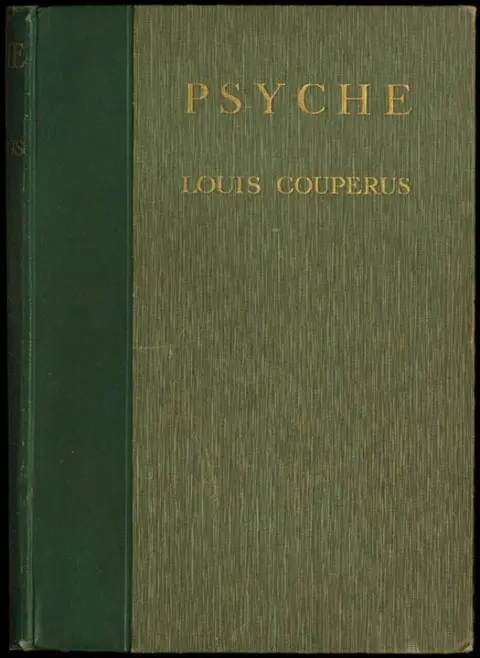
Louis Couperus
BEHIND THE BOOK
This eBook is for the use of anyone anywhere in the United States and most other parts of the world at no cost and with almost no restrictions whatsoever. You may copy it, give it away or re-use it under the terms of the Project Gutenberg License included with this eBook or online at www.gutenberg.org. If you are not located in the United States, you will have to check the laws of the country where you are located before using this eBook. Read the source licence.
The original source file, including credits and licence, is retained by this library. Request an original-format copy at no charge. Please include the book title and Project Gutenberg identifier #43827.
KEEP YOUR CURIOSITY GOING
Coulson Kernahan

Maurice Baring
Frances Wright
Cécile Tormay

Frederic Jesup Stimson

W. H. P. (William Henry Pope) Jarvis