THE CLASSIC COLLECTION✦Eline VereCLASSIC FREE BOOKS
Eline Vere
Louis Couperus
THE CLASSIC COLLECTION · 1921
"The Law Inevitable" by Louis Couperus is a novel written in the early 20th century. The story follows Cornélie de Retz van Loo, a young divorced woman traveling in Rome, seeking solace and a fresh start in life. As she navigates her new environment, the novel explores themes of identity, societal constraints, and the complexity of human relationships, set against the backdrop of a vibrant yet complex city. At the start of the book, the reader is introduced to Cornélie as she arrives at the Marchesa Belloni's boarding house in Rome. A mix of excitement and trepidation fills her as she settles into her new surroundings, and the initial interactions with other boarders reveal a rich tapestry of personalities, including the charming Mr. Rudyard, who seems to have a hidden agenda. Cornélie’s observations about her fellow guests and her inner musings about her past and future gradually paint a portrait of a woman in search of meaning amidst her disillusionment with the art and society she hoped would provide her solace. The opening chapters set the stage for her journey of self-discovery, as she grapples with loneliness, cultural expectations, and her desire to forge a new path in life.
Introduction adapted from the source catalogue; source summaries may be automatically generated.
Free to read · English · 85,792 words · No account needed
MAKE TIME FOR A GOOD BOOK
On by default. Untick to stop anonymous reading totals. Each page counts after 10 seconds in view. How this works.
Anonymous counting is on unless you have switched it off.
The divorce followed. He had not consented at first, content, in spite of all, to have a house and in that house a wife, female to him, the male, and declining to return to the discomfort of life in chambers, until she simply ran away, first to her parents, then to friends in the country, protesting loudly against the law, which was so unjust to women. He had yielded at last and allowed himself to be accused of infidelity, which was not beside the truth. She was now free, but stood as it were alone, looked at askance by all her acquaintances, refusing to yield to their conventional demand for that sort of half-mourning which, according to their conventional ideas, should surround a divorced woman and at once returning to her former life, the gay life of an unmarried girl. But she had felt that this could not go on, both because of her acquaintances and because of herself: her acquaintances looking at her askance and she loathing her acquaintances, loathing their parties and dinners, until she felt profoundly unhappy, lonely and forlorn, without anything or anybody to cling to, and experienced all the depression that weighs down on the divorced woman. Sometimes, in her heart of hearts, she reflected that by dint of great patience and great tact she might have managed that man, that he was not wicked, only coarse, that she was still fond of him, or at least of his handsome face and his sturdy figure. Love, no, it was not love; but had she ever thought of love as she now sometimes pictured it? And did not nearly everybody live more or less so-so, with a good deal of give and take?
But this regret she hardly confessed to herself, did not now confess to Duco; and what she did confess was her bitterness, her hatred of her husband, of marriage, of convention, of people, of the world, of all the great generalities, generalizing her own feelings into one great curse against life. He listened to her with pity. He felt that there was something noble in her, which, however, had been stifled from, the beginning. He forgave her for not being artistic, but he was sorry that she had never found herself, that she did not know what she was, who she was, what her life should be, or where the line of her life wound, the only path which she ought to tread, as every life follows one path. Oh, how often, if a person would let herself go, like a flower, like a bird, like a cloud, like a star which so obediently ran its course, she would find her happiness and her life, even as the flower or the bird finds them, even as the cloud drifts before the sun, even as the star follows its course through the heavens! But he told her nothing of his thoughts, knowing that, especially in her present mood of bitterness, she would not understand them and could derive no comfort from them, because they would be too vague for her and too far removed from her own manner of thinking. She thought of herself, but imagined that she was thinking of women and girls and their movement towards the future. Women's lines ... but had not every woman a line of her own? Only, how few of them knew it: their direction, their path, their line of life, their wavering course in the twilight of the future. And perhaps, because they did not know it for themselves, they were now all seeking together a broad path, a main road, along which they would march in troops, in a threatening multitude of women, in regiments of women, with banners and mottoes and war-cries, a broad path, parallel with the movement of the men, until the two paths would melt into one, until the troops of women would mingle with the troops of men, with equal rights and equal fullness of life....
Your reading position is saved on this browser. Take it to another device with a library code. Reading pages adapt to text, rather than matching a printed edition.
Louis Couperus

Louis Couperus

Louis Couperus
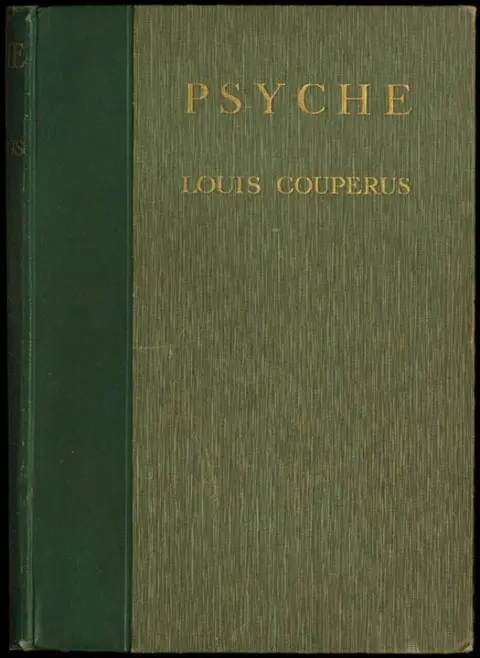
Louis Couperus
BEHIND THE BOOK
This eBook is for the use of anyone anywhere in the United States and most other parts of the world at no cost and with almost no restrictions whatsoever. You may copy it, give it away or re-use it under the terms of the Project Gutenberg License included with this eBook or online at www.gutenberg.org. If you are not located in the United States, you will have to check the laws of the country where you are located before using this eBook. Read the source licence.
The original source file, including credits and licence, is retained by this library. Request an original-format copy at no charge. Please include the book title and Project Gutenberg identifier #43827.
KEEP YOUR CURIOSITY GOING
Coulson Kernahan

Maurice Baring
Frances Wright
Cécile Tormay

Frederic Jesup Stimson

W. H. P. (William Henry Pope) Jarvis