THE CLASSIC COLLECTION✦Eline VereCLASSIC FREE BOOKS
Eline Vere
Louis Couperus
THE CLASSIC COLLECTION · 1921
"The Law Inevitable" by Louis Couperus is a novel written in the early 20th century. The story follows Cornélie de Retz van Loo, a young divorced woman traveling in Rome, seeking solace and a fresh start in life. As she navigates her new environment, the novel explores themes of identity, societal constraints, and the complexity of human relationships, set against the backdrop of a vibrant yet complex city. At the start of the book, the reader is introduced to Cornélie as she arrives at the Marchesa Belloni's boarding house in Rome. A mix of excitement and trepidation fills her as she settles into her new surroundings, and the initial interactions with other boarders reveal a rich tapestry of personalities, including the charming Mr. Rudyard, who seems to have a hidden agenda. Cornélie’s observations about her fellow guests and her inner musings about her past and future gradually paint a portrait of a woman in search of meaning amidst her disillusionment with the art and society she hoped would provide her solace. The opening chapters set the stage for her journey of self-discovery, as she grapples with loneliness, cultural expectations, and her desire to forge a new path in life.
Introduction adapted from the source catalogue; source summaries may be automatically generated.
Free to read · English · 85,792 words · No account needed
MAKE TIME FOR A GOOD BOOK
On by default. Untick to stop anonymous reading totals. Each page counts after 10 seconds in view. How this works.
Anonymous counting is on unless you have switched it off.
These were the days of the preparations. The date of the entertainment drew nearer; and at last the evening arrived. Mrs. Uxeley was trembling with nervousness like a young girl and found the necessary strength to walk through the whole villa, which was all light and flowers. And with a sigh of satisfaction she sat down for a moment. She was dressed. Her face was smooth as porcelain, her hair was waved and glittered with diamond pins. Her gown of pale-blue brocade was cut very low; and she gleamed like a reliquary. A triple rope of priceless pearls hung down to her waist. In her hand--she was not yet gloved--she held a gold-knobbed cane, which was indispensable when she wanted to rise. And it was only when she rose that she showed her age, when she worked herself erect by muscular efforts, with that look of pain in her face, with that twinge of rheumatism which shot through her. Cornélie, not yet dressed, after a last glance through the villa, blazing with light, swooning with flowers, hurried to her room and, already feeling tired, dropped into the chair in front of her dressing-table, to have her hair done quickly. She was just ready when the first guests arrived and she hastened to join Mrs. Uxeley. And the carriages rolled up. Cornélie, at the top of the monumental staircase, looked down into the hall, where the people were streaming in, the ladies in their long evening-wraps--almost more expensive even than their dresses--which they carefully gave up in the crowded, buzzing cloakroom. And the first arrivals came up the stairs, waiting so as not to be the very first, and were beamed upon by Mrs. Uxeley. The drawing-rooms soon filled. In addition to the reception-rooms, the hostess' own rooms were thrown open, forming in all a suite of twelve apartments. Whereas the corridors and stairs were adorned only with clumps of red and white and pink camellias, in the rooms the floral decorations were contained in hundreds of vases and bowls and dishes, which stood about on every hand and, with the light of the shaded candles, gave an intimate charm to the entertainment. That was the speciality of Mrs. Uxeley's decorations on great occasions: the electric light not used; instead, on every hand candles with little shades, on every hand glasses and bowls full of flowers, giving the effect of a fairy garden. Though perhaps the main outlines were broken, a most charming effect of cosiness was gained. Small groups and couples could find a place everywhere: behind a screen, in a loggia; you constantly found a spot for privacy; and this perhaps explained the vogue of Mrs. Uxeley's parties. The villa, suitable for giving a court ball, was used only for giving entertainments of a luxurious intimate character to hundreds of people who were quite unknown to one another. Each little set chose itself a little corner, where it made itself at home. A very tiny boudoir, all in Japanese lacquer and Japanese silk, was aimed at generally, but was at once captured by Gilio, the Contessa di Rosavilla, the Duchessa di Luca and Contessa Costi. They did not even go to the music-room, where a concert formed the first item. Paderewski was playing, Sigrid Arnoldson was to sing. The music-room also was lighted by shaded candles; and everybody whispered that, in this soft light, Airs. Uxeley did not look a day over forty. During the interval she simpered to two very young journalists who were to describe her party Urania, sitting beside Cornélie, was addressed by a Frenchman whom she introduced to her friend: the Chevalier de Breuil. Cornélie knew that Urania had met him at Ostend and that his name was coupled with the Princess of Forte-Braccio's. Urania had never mentioned De Breuil to her, but Cornélie now saw, by her smile, her blush and the sparkle in her eyes, that people were right. She left them to themselves, feeling sad when she thought of Urania. She understood that the little princess was consoling herself for her husband's neglect; and she suddenly thought this whole life of make-believe disgusting. She longed for Rome, for the studio, for Duco, for independence, love and happiness. She had had it all; but it had been fated not to endure. Everything around her was like one great lie, more brilliant than at the Hague, but even more false, brutal and depraved. People no longer even pretended to believe the lie: here they showed a brutal sincerity. The lie was respected, but nobody believed in it, nobody put forward the lie as a truth; the lie was nothing more than a form.
Your reading position is saved on this browser. Take it to another device with a library code. Reading pages adapt to text, rather than matching a printed edition.
Louis Couperus

Louis Couperus

Louis Couperus
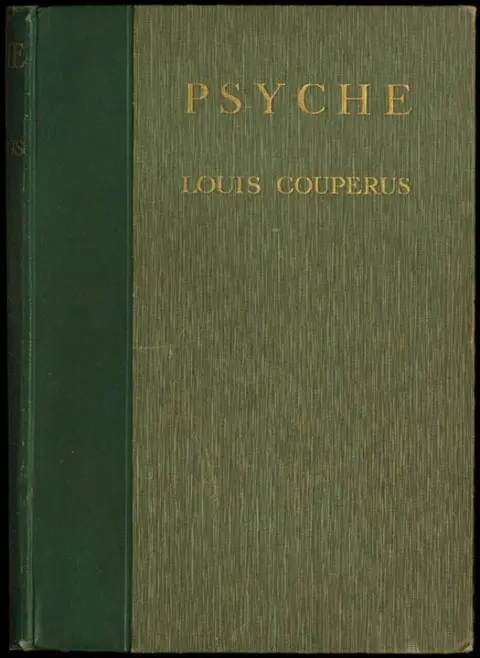
Louis Couperus
BEHIND THE BOOK
This eBook is for the use of anyone anywhere in the United States and most other parts of the world at no cost and with almost no restrictions whatsoever. You may copy it, give it away or re-use it under the terms of the Project Gutenberg License included with this eBook or online at www.gutenberg.org. If you are not located in the United States, you will have to check the laws of the country where you are located before using this eBook. Read the source licence.
The original source file, including credits and licence, is retained by this library. Request an original-format copy at no charge. Please include the book title and Project Gutenberg identifier #43827.
KEEP YOUR CURIOSITY GOING
Coulson Kernahan

Maurice Baring
Frances Wright
Cécile Tormay

Frederic Jesup Stimson

W. H. P. (William Henry Pope) Jarvis