THE CLASSIC COLLECTION✦Eline VereCLASSIC FREE BOOKS
Eline Vere
Louis Couperus
THE CLASSIC COLLECTION · 1921
"The Law Inevitable" by Louis Couperus is a novel written in the early 20th century. The story follows Cornélie de Retz van Loo, a young divorced woman traveling in Rome, seeking solace and a fresh start in life. As she navigates her new environment, the novel explores themes of identity, societal constraints, and the complexity of human relationships, set against the backdrop of a vibrant yet complex city. At the start of the book, the reader is introduced to Cornélie as she arrives at the Marchesa Belloni's boarding house in Rome. A mix of excitement and trepidation fills her as she settles into her new surroundings, and the initial interactions with other boarders reveal a rich tapestry of personalities, including the charming Mr. Rudyard, who seems to have a hidden agenda. Cornélie’s observations about her fellow guests and her inner musings about her past and future gradually paint a portrait of a woman in search of meaning amidst her disillusionment with the art and society she hoped would provide her solace. The opening chapters set the stage for her journey of self-discovery, as she grapples with loneliness, cultural expectations, and her desire to forge a new path in life.
Introduction adapted from the source catalogue; source summaries may be automatically generated.
Free to read · English · 85,792 words · No account needed
MAKE TIME FOR A GOOD BOOK
On by default. Untick to stop anonymous reading totals. Each page counts after 10 seconds in view. How this works.
Anonymous counting is on unless you have switched it off.
Ninety years old! How the woman must suffer, during the hours of her long toilet, while she was being made up into that caricature! Urania said that it was all false: the hair, the bust. And Cornélie felt a loathing at having to live for the future beside this woman, as though beside an ignominy. In the happiness of her love, a great part of her energy had become relaxed, as though their dual happiness--Duco's and hers--had unfitted her for any further struggle for life and diminished her zest for life; but it had refined and purified something in her soul and she loathed the sight of so much show for so vain and petty an object. And it was only necessity itself--the inevitability of the things of life, which urged and pushed her with a guiding finger along a line of life now winding solitary before her--that gave her the strength to hide within herself her sorrow, her longing, her nostalgia for everything that she had left behind. She did not talk about it to Urania. Urania was so glad to see her, looked upon her as a good friend, in the loneliness of her stately life, in her isolation among her aristocratic acquaintances. Urania accompanied her enthusiastically to dressmakers' establishments and shops and helped her to choose her new outfit. She did not care about it all. She, an elegant woman, a woman of innate elegance, who in her outward appearance had always fought against poverty and who, in the days of her happiness, was able, with the aid of a fresh ribbon, to wear an old blouse gracefully, was utterly indifferent to everything that she was now buying on Mrs. Uxeley's account. To her it was as though these things were not for her. She let Urania ask and choose; she approved of everything. She allowed herself to be fitted as though she had been a doll. She greatly disliked having to spend money at a stranger's expense. She felt lowered and humiliated: all her haughty pride of life was gone. She was afraid of what they would say of her in the circle of Mrs. Uxeley's friends, afraid lest they knew of her independent ideas, of her cohabitation with Duco, afraid of Mrs. Uxeley's opinion. For Urania had had to be honest and tell everything. It was only on Urania's eager recommendation that she had been taken by Mrs. Uxeley. She felt out of place, now that she would once more dare to play her part among all those people; and she was afraid of giving herself away. She would have to make believe, to conceal her ideas, to pick her words; and she was no longer accustomed to doing so. And all for that money. All because she had not had the energy, living with Duco, to earn her own bread and, gaily, independently, to cheer him in his work, in his art. Oh, if she could only have managed to do that, how happy she would have been! If only she had not allowed the wretched languor that was in her blood to increase within her like a morbid growth: the languor of her upbringing, her superficial, showy, drawing-room education, which had unfitted her for everything whatsoever! By temperament she was a creature of love as well as a woman of sensuousness and luxury, but there was more of love in her than of luxury: she would be happy under the simplest conditions if only she was able to love. And now life had torn her away from him, gradually but inexorably. And now her sensuous, luxurious nature was gratified, but in dependence; yet it no longer satisfied her cravings, because she could not satisfy her soul. In that lonely soul a miserable dissatisfaction sprang up like a riotous growth. Her only happiness was his letters, letters of longing but also letters of comfort. He wrote expressing his longing, but he also wrote enjoining courage and hope. He wrote to her every day. He was now at Florence, seeking his consolation in the Uffizi, in the Pitti Palace. He had found it impossible to stay in Rome; the studio was now locked up. At Florence he was a little nearer to her. And his letters were to her a love-story, the only novel that she read; and it was as though she saw his landscapes in his style, the same dim blending of colour and emotion, the pearly white, misty, dreamy distances filled with light, the horizon of his longing, as though his eyes were ever gazing at the vista in which she, on the night of departure, had vanished as in a mauve-grey sunset, a sky of the dreary Campagna. In those letters they still lived together. But she could not write to him in this strain. Though she wrote to him daily, she wrote briefly, telling him ever the same things in other words: her longing, her weary indifference. But she wrote of the happiness which she derived from his letters, which were her daily bread.
Your reading position is saved on this browser. Take it to another device with a library code. Reading pages adapt to text, rather than matching a printed edition.
Louis Couperus

Louis Couperus

Louis Couperus
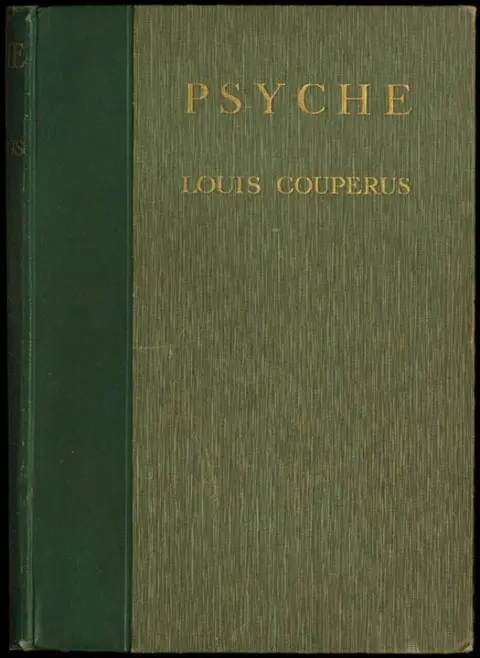
Louis Couperus
BEHIND THE BOOK
This eBook is for the use of anyone anywhere in the United States and most other parts of the world at no cost and with almost no restrictions whatsoever. You may copy it, give it away or re-use it under the terms of the Project Gutenberg License included with this eBook or online at www.gutenberg.org. If you are not located in the United States, you will have to check the laws of the country where you are located before using this eBook. Read the source licence.
The original source file, including credits and licence, is retained by this library. Request an original-format copy at no charge. Please include the book title and Project Gutenberg identifier #43827.
KEEP YOUR CURIOSITY GOING
Coulson Kernahan

Maurice Baring
Frances Wright
Cécile Tormay

Frederic Jesup Stimson

W. H. P. (William Henry Pope) Jarvis