
The Writing of News A Handbook with Chapters on Newspaper Correspondence and Copy Reading
Charles G. (Charles Griffith) Ross
THE CLASSIC COLLECTION · 1887
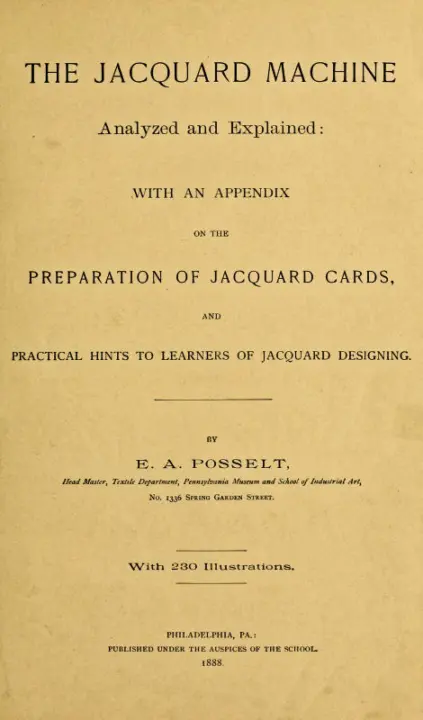
"The Jacquard Machine Analyzed and Explained" by E. A. Posselt is a scientific publication written in the late 19th century. This detailed work focuses on the Jacquard machine, a significant invention in textile manufacturing, exploring its mechanisms, applications, and operational techniques. It aims to provide practical insights into the machine's design, operation, and the preparation of Jacquard cards necessary for weaving complex fabrics. The opening portion introduces the Jacquard machine and its historical context, outlining its inventor Joseph Marie Jacquard's early life and challenges. Posselt emphasizes the machine's mechanical functions, such as the role of hooks, leashes, and needles in weaving, as well as the importance of punching cards for controlling the warp threads. The preface also mentions the lack of literature on this topic, positioning the book as a crucial resource for students and practitioners in the field of textile arts.
Introduction adapted from the source catalogue; source summaries may be automatically generated.
Free to read · English · 38,829 words · No account needed
MAKE TIME FOR A GOOD BOOK
On by default. Untick to stop anonymous reading totals. Each page counts after 10 seconds in view. How this works.
Anonymous counting is on unless you have switched it off.
The Jacquard Machine Analyzed and Explained; principles of construction and method of operation of the single lift machine; the various modifications, such as double lift single cylinder, double lift double cylinder; “laying out” of comber-boards, and figuring for various changes in texture; tying-up of harness for single cloth.
The Bridesburg Clipper Loom analyzed and explained, and practical work on it, with special reference to its use in connection with the double lift double cylinder Jacquard machine for damask table-covers, etc.
Card-stamping machines (French index) analyzed and explained, and actual work for single cloth on the machine; explanation of, and practical work in card-lacing.
Theoretical work; designing paper with reference to the different textures of single cloth fabrics.
Sketching of designs for single cloth, and transferring sketch to the
[O] designing paper.
Shading of fabrics by the weave.
Analysis of Jacquard work for actual reproduction; also for reproduction with various (given) changes.
Study of special fabrics, such as dress trimmings, fringes, etc.
Study of processes for textile fabrics before and after weaving.
Instrumental drawing in lettering; drawing plans for machinery, rooms,
mill buildings, etc.
Illustrating processes of weaving.
Illustrating sectional cuts of textile fabrics, etc.
Freehand drawing; sketching for the different textile fabrics on
Jacquard work.
Work in color; lectures (advanced course); practice in the use of color.
Chemistry.
Theory of Chemistry applicable to the textile art.
The two-ply ingrain carpet machine analyzed and explained.
The ingrain carpet hand-loom, and the ingrain carpet power-loom, built by the M. A. Furbush & Son Machine Co., analyzed, explained, and practical work.
Card-stamping machine (American index) analyzed, explained, and
practical work.
Tying-up of Jacquard harness (French index) machines for double cloth; three and four-ply fabrics.
Advanced Work for the Harness Loom.
Study and practical work of cut pile fabrics--velvets, plushes, etc.; terry pile fabrics, with wires and without wires; terry and velvet pile combined.
Astrakans, cut, uncut, also cut and uncut combined.
Chenille, rugs, curtains, etc.
Gauze fabrics, plain, figured, and combined with other weaves.
Designing for upholstery fabrics, Jacquard gauze, Brussels carpet, tapestry carpet, double face Brussels carpet, etc.
Card-stamping on the French index stamping machine for two, three, and
four-ply fabrics.
Instrumental and freehand drawing similar to second year’s course, but for more difficult objects in textile fabrics and machinery.
Work in color; application of theory of harmony to dyeing.
Chemistry.
Theory and practice of chemistry, including actual work in the laboratory and dyeing of fabrics.
Chairman Committee on Instruction of the School, and Pres. Phila. Textile Association.
The Circular of the Committee on Instruction will be mailed upon
application.
A Model School of Industrial Art.
Your reading position is saved on this browser. Take it to another device with a library code. Reading pages adapt to text, rather than matching a printed edition.
BEHIND THE BOOK
This eBook is for the use of anyone anywhere in the United States and most other parts of the world at no cost and with almost no restrictions whatsoever. You may copy it, give it away or re-use it under the terms of the Project Gutenberg License included with this eBook or online at www.gutenberg.org. If you are not located in the United States, you will have to check the laws of the country where you are located before using this eBook. Read the source licence.
The original source file, including credits and licence, is retained by this library. Request an original-format copy at no charge. Please include the book title and Project Gutenberg identifier #54193.
KEEP YOUR CURIOSITY GOING
Charles G. (Charles Griffith) Ross
Hannah Webster Foster

Emily Lawless
Edwin Hamlin Carr

Charles De Lano Hine
Andrew Ure