
The Writing of News A Handbook with Chapters on Newspaper Correspondence and Copy Reading
Charles G. (Charles Griffith) Ross
THE CLASSIC COLLECTION · 1887
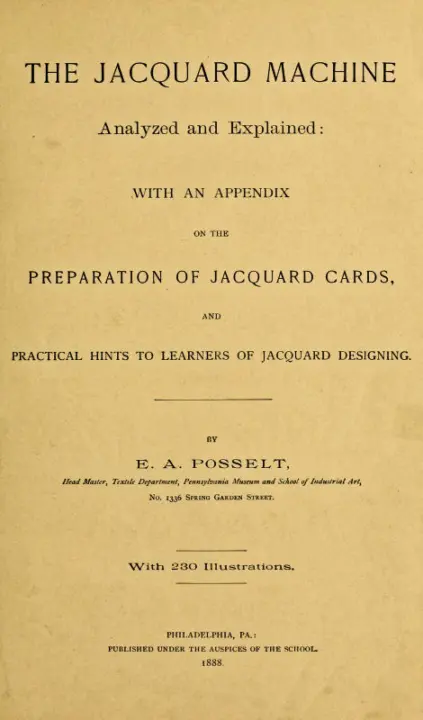
"The Jacquard Machine Analyzed and Explained" by E. A. Posselt is a scientific publication written in the late 19th century. This detailed work focuses on the Jacquard machine, a significant invention in textile manufacturing, exploring its mechanisms, applications, and operational techniques. It aims to provide practical insights into the machine's design, operation, and the preparation of Jacquard cards necessary for weaving complex fabrics. The opening portion introduces the Jacquard machine and its historical context, outlining its inventor Joseph Marie Jacquard's early life and challenges. Posselt emphasizes the machine's mechanical functions, such as the role of hooks, leashes, and needles in weaving, as well as the importance of punching cards for controlling the warp threads. The preface also mentions the lack of literature on this topic, positioning the book as a crucial resource for students and practitioners in the field of textile arts.
Introduction adapted from the source catalogue; source summaries may be automatically generated.
Free to read · English · 38,829 words · No account needed
MAKE TIME FOR A GOOD BOOK
On by default. Untick to stop anonymous reading totals. Each page counts after 10 seconds in view. How this works.
Anonymous counting is on unless you have switched it off.
We cannot, at this time, speak of its provisions by which drawing, modeling, designing, etc., are taught; but we desire to call particular attention to the facilities that are offered for a practical instruction in weaving and textile design. Special courses are provided for teaching designing for all varieties of textile fabrics, and its practical application to loom work. As a complete course in its theoretical and practical utility we do not hesitate to say it is without an equal in America. A school of this kind is of the highest importance to the manufacturing community that centres about Philadelphia.--Boston Journal of Commerce.
An American Textile School.
The Textile Department of the Pennsylvania Museum and School of Industrial Art clearly fulfils the requirements of a good Textile School, and the promise is that it will speedily become one of the best in the world, as it is now decidedly the most advanced in this country. Pupils are taught designing for all varieties of textile fabrics, and to make them thoroughly familiar with loom work, so that they may be able not only to prepare their own designs, but also to reproduce their own patterns in the cloth.
This institution, by fitting young Americans for exact scientific work in the textile industries, will confer a huge benefit upon them and upon the nation.--The Textile Record of America.
The Textile Department of the School of Industrial Art, 1336 Spring Garden St.
Many scholars who have been at this school in former years are now filling responsible and profitable positions.--The Bulletin, Phila.
Thomas Wood & Co.,
FAIRMOUNT MACHINE WORKS,
Twenty-Second and Wood Streets, Philadelphia, Pa.
Patent Bobbin Winding Machines.
Patent Cop Winding Machines.
Improved Presser Beaming Machines.
Plain Beaming Machines.
Improved Reels for Wool, Worsted, Cotton, Linen, etc.
Improved Presser Spoolers.
Plain Spoolers.
Warp Splitting Machines.
Hank Twisting Machines.
Warping Mills with Patent Driving Heads and Improved Hecks.
Single and Double Warp Sizing Machines.
Dyeing Machines for Warp and Piece Goods.
Cradle and Cone Indigo Mills.
Fulling Mills.
Calendering Machines.
Self-acting Wool Scouring Machines.
Yarn Bundling Presses.
Loom Beam Trucks.
Shafting, Hangers, Pulleys, etc.
Adjustable Self-oiling Bearings.
Patent Friction Pulleys.
Improved Cut-off Coupling.
Patent Couplings.
Patent Loose Pulleys.
Gearing.
ELEVATORS.
Plans Made and Factories Completely Equipped with Machinery.
Mill and Manufacturers’ Supplies.
SOLE PHILADELPHIA AGENT FOR
STODDARD, LOVERING & CO.,
Boston, Massachusetts, and Bradford, England.
Importers of English Worsted Machinery, and Hattersley Looms, for every class of work. Also, Pickers, Temples, Loom Springs, and White’s Picker Leather in the side or by the strap, Torlotin’s Sizing; also, all other English Supplies.
CHARLES L. IRESON,
Boston, Massachusetts.
Your reading position is saved on this browser. Take it to another device with a library code. Reading pages adapt to text, rather than matching a printed edition.
BEHIND THE BOOK
This eBook is for the use of anyone anywhere in the United States and most other parts of the world at no cost and with almost no restrictions whatsoever. You may copy it, give it away or re-use it under the terms of the Project Gutenberg License included with this eBook or online at www.gutenberg.org. If you are not located in the United States, you will have to check the laws of the country where you are located before using this eBook. Read the source licence.
The original source file, including credits and licence, is retained by this library. Request an original-format copy at no charge. Please include the book title and Project Gutenberg identifier #54193.
KEEP YOUR CURIOSITY GOING
Charles G. (Charles Griffith) Ross
Hannah Webster Foster

Emily Lawless
Edwin Hamlin Carr

Charles De Lano Hine
Andrew Ure