
The Writing of News A Handbook with Chapters on Newspaper Correspondence and Copy Reading
Charles G. (Charles Griffith) Ross
THE CLASSIC COLLECTION · 1887
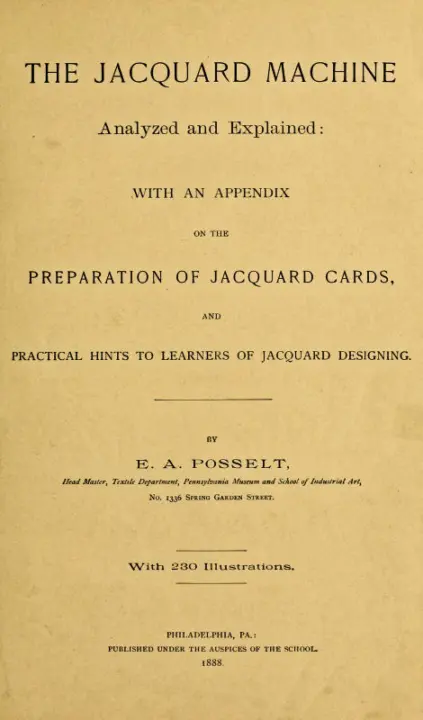
"The Jacquard Machine Analyzed and Explained" by E. A. Posselt is a scientific publication written in the late 19th century. This detailed work focuses on the Jacquard machine, a significant invention in textile manufacturing, exploring its mechanisms, applications, and operational techniques. It aims to provide practical insights into the machine's design, operation, and the preparation of Jacquard cards necessary for weaving complex fabrics. The opening portion introduces the Jacquard machine and its historical context, outlining its inventor Joseph Marie Jacquard's early life and challenges. Posselt emphasizes the machine's mechanical functions, such as the role of hooks, leashes, and needles in weaving, as well as the importance of punching cards for controlling the warp threads. The preface also mentions the lack of literature on this topic, positioning the book as a crucial resource for students and practitioners in the field of textile arts.
Introduction adapted from the source catalogue; source summaries may be automatically generated.
Free to read · English · 38,829 words · No account needed
MAKE TIME FOR A GOOD BOOK
On by default. Untick to stop anonymous reading totals. Each page counts after 10 seconds in view. How this works.
Anonymous counting is on unless you have switched it off.
Fig. I.,[A] represents the side view of the “frame” of a common 200 Jacquard machine by a, b, c, d. The width of the frame in its main part [see 6 to 7] is 9-1/2 inches.
1-1/8 inches is the width of the iron casting at the places marked 8
and 9.
2 inches is the height of casting at the place indicated by 1.
1-1/2 inches is the height of casting at the place indicated by 3.
1-3/4 inches is the height of casting at the place indicated by 5.
The open part of the frame, marked 2 in drawing, is 6 inches high.
[A] For illustration of the present article a 200 Jacquard machine is used, illustrated on pages 11-17 by Figs. I. to XI., which contains the same principles of construction as any other size machine. These illustrations are drawn one-fourth of the actual size; hence, any measures, etc., we have omitted may readily be found by any student.
The open part of the frame, marked 4 in drawing, is 5 inches high. Hence, the main height of the frame is as follows:
1 = 2 inches.
2 = 6 "
3 = 1-1/2 "
4 = 5 "
5 = 1-3/4 "
------
16-1/4 inches main height.
The perforated bottom board, through which the neck-cords are passed, contains one hole for every hook in the machine, and is illustrated in Fig. II. separately. It shows the following measurements:
Entire width of board = 8 inches.
" length " = 12 "
Thickness " = 3/4 "
Distance of {a, in length of board, 0.27 inch. (See l to b.) holes from { each centre, {b, in width " 7/8 " (See m to w.) " first row from the part of the frame illustrated in Fig. I., 2-3/4 inches. " " " " rear part of the frame, 2-1/2 inches.
This board is fastened by screws to the frame at places indicated in
Fig. I. by 11 and 12.
Besides the frame, Fig. I. illustrates: Under I. the Jacquard plunger, 3/4 inch diameter, for guiding the griffe (attached to its head) when raising. To strengthen the steadiness of this latter movement shoulders are attached to the frame at the three places where the plunger slides.
Height of frame at k, = 2-3/4 inches.
" " l, = 2 "
" " m, = 2 "
Screws, f, dotted in drawing, on head of plunger, fasten the griffe
to it.
Part III. in Fig. I. illustrates the attachment for providing the lifting of the plunger in a hand-loom, likewise the griffe, etc. This consists of a triangular shaped frame 14-1/4 inches high, or less, according to height of room. This part is fastened to the front part of the frame by bolts at o and p. In the slot at the top, between r and s, a wooden cylinder of 3-1/2 inches diameter is fastened to an iron shaft resting in the frame at t.
Your reading position is saved on this browser. Take it to another device with a library code. Reading pages adapt to text, rather than matching a printed edition.
BEHIND THE BOOK
This eBook is for the use of anyone anywhere in the United States and most other parts of the world at no cost and with almost no restrictions whatsoever. You may copy it, give it away or re-use it under the terms of the Project Gutenberg License included with this eBook or online at www.gutenberg.org. If you are not located in the United States, you will have to check the laws of the country where you are located before using this eBook. Read the source licence.
The original source file, including credits and licence, is retained by this library. Request an original-format copy at no charge. Please include the book title and Project Gutenberg identifier #54193.
KEEP YOUR CURIOSITY GOING
Charles G. (Charles Griffith) Ross
Hannah Webster Foster

Emily Lawless
Edwin Hamlin Carr

Charles De Lano Hine
Andrew Ure