
The Writing of News A Handbook with Chapters on Newspaper Correspondence and Copy Reading
Charles G. (Charles Griffith) Ross
THE CLASSIC COLLECTION · 1887
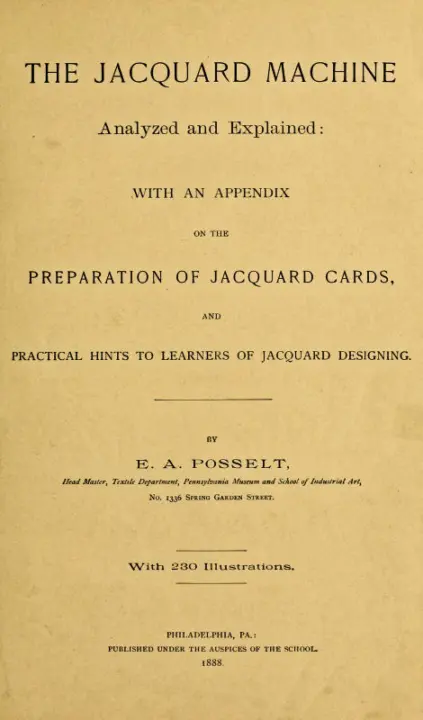
"The Jacquard Machine Analyzed and Explained" by E. A. Posselt is a scientific publication written in the late 19th century. This detailed work focuses on the Jacquard machine, a significant invention in textile manufacturing, exploring its mechanisms, applications, and operational techniques. It aims to provide practical insights into the machine's design, operation, and the preparation of Jacquard cards necessary for weaving complex fabrics. The opening portion introduces the Jacquard machine and its historical context, outlining its inventor Joseph Marie Jacquard's early life and challenges. Posselt emphasizes the machine's mechanical functions, such as the role of hooks, leashes, and needles in weaving, as well as the importance of punching cards for controlling the warp threads. The preface also mentions the lack of literature on this topic, positioning the book as a crucial resource for students and practitioners in the field of textile arts.
Introduction adapted from the source catalogue; source summaries may be automatically generated.
Free to read · English · 38,829 words · No account needed
MAKE TIME FOR A GOOD BOOK
On by default. Untick to stop anonymous reading totals. Each page counts after 10 seconds in view. How this works.
Anonymous counting is on unless you have switched it off.
THE LEADING TEXTILE SCHOOL IN AMERICA. Founded in co-operation with the Trustees of the Penna. Museum and School of Industrial Art,
WM. PLATT PEPPER, President,
by the following members of the Philadelphia Textile Association:
Thomas Dolan & Co.,
John & James Dobson,
William Wood & Co.,
William Arrott,
John Yewdall,
Fiss, Banes, Erben & Co.,
Conyers Button & Co.,
George & James Bromley,
Seville Schofield,
Alexander Crow & Son,
James Smith & Co.,
M. A. Furbush & Son,
John Bromley & Sons,
Thomas L. Leedom,
James Doak, Jr. & Co.,
Charles Spencer & Co.,
H. Becker & Co.,
Andreas Hartel,
S. B. M. Fleisher,
Grundy Bros. & Campion,
H. W. Butterworth & Sons,
Stead & Miller.
Extract from =COURSE OF STUDY= for Day Class, requiring three years’
attendance at School.
The hand-loom, analyzed and explained.
Elementary principles of “dressing” warps; beaming the same; fixing of harness; drawing-in; reed and reed calculations, etc., for single cloth.
A general study of the nature of materials used in weaving textile fabrics; explanation of the necessary materials and instruments used by designers.
Weaves.--Ground or Foundation Weaves.
I. Plain, or cotton weave, and fancy figuring through color arrangements in warp and filling, for light-weight fabrics.
II. Twill weaves--a, one-sided twills; b, even-sided twills; and fancy figuring with same through color arrangements in warp and filling.
III. Satin weaves--a, single satins; b, double satins; c,
figuring in single satins.
Drafting Weaves.
Lectures, with practical examples and rules observed.
Derivative Weaves.
Basket, rib, and granite weaves; steep, curved, broken, skip, corkscrew, and fancy twills; pointed twills and honeycomb weaves; pique weaves, and combinations of miscellaneous weaves.
Standard sizes of cotton wool and worsted yarns, with calculations.
Picking out samples of textile fabrics constructed on single weaves, with methods and rules employed in duplication.
Original weaves for single cloth; complete orders for manufacturing.
Instrumental drawing in elementary exercises, with instruments; construction of plane figures; line shading, etc.
Freehand drawing; enlargement and reduction of designs; analysis of plants for the purpose of design for textile fabrics.
Work in color; lectures on color harmony.
The power-looms analyzed and explained, and practical weaving and fixing; a, the Thos. Wood roller loom, for ginghams, shirtings, cottonades, dress goods, etc.; b, the Crompton loom, and c, the Knowles loom, for worsted and woolen fabrics of every description; single and double beam work.
Double Cloths--Study of the best methods of combining different weaves, as: Designs backed with weft; designs backed with warp; designs backed with warp and weft; designs for double cloth, double faced.
Calculation: ascertaining the cost, production, etc., of the different
fabrics.
Analyses of single cloth (fancy), and double cloth fabrics, and reproduction with various changes, as requested.
Your reading position is saved on this browser. Take it to another device with a library code. Reading pages adapt to text, rather than matching a printed edition.
BEHIND THE BOOK
This eBook is for the use of anyone anywhere in the United States and most other parts of the world at no cost and with almost no restrictions whatsoever. You may copy it, give it away or re-use it under the terms of the Project Gutenberg License included with this eBook or online at www.gutenberg.org. If you are not located in the United States, you will have to check the laws of the country where you are located before using this eBook. Read the source licence.
The original source file, including credits and licence, is retained by this library. Request an original-format copy at no charge. Please include the book title and Project Gutenberg identifier #54193.
KEEP YOUR CURIOSITY GOING
Charles G. (Charles Griffith) Ross
Hannah Webster Foster

Emily Lawless
Edwin Hamlin Carr

Charles De Lano Hine
Andrew Ure