THE CLASSIC COLLECTION✦Ruben and Ivy SênCLASSIC FREE BOOKS
Ruben and Ivy Sên
Louise Jordan Miln
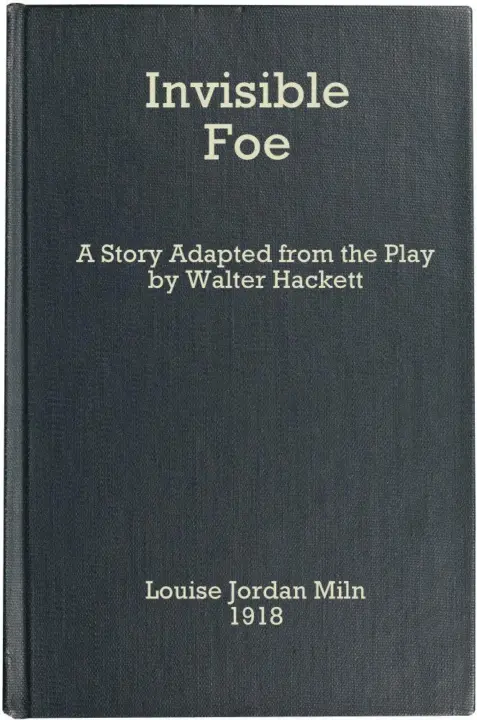
THE CLASSIC COLLECTION · 1918
"The Invisible Foe" by Louise Jordan Miln and Walter Hackett is a novel written in the early 20th century. The story centers around three children: Stephen, an orphan who is ambitious and masterful in nature; Hugh, who is more stolid and devoted; and Helen, the pretty, imaginative daughter of their guardian, Richard Bransby. As they navigate their childhood at Deep Dale, the dynamics of their relationships foreshadow deeper themes of power, longing, and the struggles of growing up. At the start of the novel, Stephen is depicted as a curious and observant boy, captivated by the flight of birds, while Hugh engages in simple play and Helen entertains herself with imaginary friends. Their interrelations are nuanced: Stephen's desire for power often clashes with his affection for Helen, who appears seraphic yet firmly controls her surroundings. Richard Bransby, their uncle and guardian, is portrayed as a stern and complex character, burdened by the loss of loved ones and the responsibility of caring for the children. The beginning sets the stage for a narrative that explores themes of love, ambition, and the burdens of inheritance against the backdrop of a seemingly idyllic childhood.
Introduction adapted from the source catalogue; source summaries may be automatically generated.
Free to read · English · 65,109 words · No account needed
MAKE TIME FOR A GOOD BOOK
On by default. Untick to stop anonymous reading totals. Each page counts after 10 seconds in view. How this works.
Anonymous counting is on unless you have switched it off.
Richard Bransby looked after her sourly.
“Humph,” he said. “What a foolish woman.”
“Yes, silly,” Stephen agreed.
“So foolish she dares to believe—in things,” Horace Latham said slowly.
They all looked at him in amazement. “Latham!” Bransby exclaimed.
The physician turned and met his gaze. “Yes?”
“You don’t mean to tell me that you believe in all this hopeless drivel of ‘mediums’ and ‘control’ and spirit communications.”
“I don’t know,” Latham said musingly.
“Well, upon my word!”
“Of course,” Latham continued, “some of it—much of it—sounds incredible—beyond belief—and yet—well, some years ago wireless telegraphy, the telephone, a hundred other things that we have seen proved, would have seemed quite as incredible. With those things in mind, how can we absolutely deny this thing? How can we be sure that these people—foolish as some of them certainly appear—are not upon the threshold of a great truth?”
The hand that held the paper-weight tightened angrily. “And you, a sensible man, tell me that you believe that the spirits of those who have gone before us come back to earth, and spend their time knocking on walls, rocking tables, whirling banjos, and giving silly women silly answers to silly questions!”
“No—not that exactly.” Latham was smiling. “But my profession—it brings me very close to death—I’ve seen so much suffering lately. Well—if one believes in God—how can we believe that death is the end? I know I don’t.”
Helen’s hand lay on the table, she was standing near her father. He laid his palm on hers—and sat musing.
“No,” he said after a pause, “neither do I.”
“I’m sure it isn’t!” the girl said.
“This is getting a bit over my head,” Stephen Pryde said with a shrug, rising. “If you don’t mind, I’ll take a stroll.”
Latham looked at him with a smile of apprisement, “I take it you don’t share our belief, Pryde?”
Stephen smiled in return, and a little contemptuously.
“I am afraid I am what you would call a rank materialist. To me death is the end—complete annihilation. That’s why I mean to get everything I can out of life.”
“Oh, Stephen—no!” his cousin cried. “You mustn’t believe that! You can’t! Think! What becomes of the mind, the heart, the soul, the thing that makes us think, and love and hate and eat and move, quite aside from muscles and bones and veins? The thing that is we, and drives us, the very life of us?”
Your reading position is saved on this browser. Take it to another device with a library code. Reading pages adapt to text, rather than matching a printed edition.
Louise Jordan Miln
Roi Cooper Megrue & Walter Hackett
Louise Jordan Miln & Harold Owen & Harry M. Vernon
Louise Jordan Miln
BEHIND THE BOOK
This eBook is for the use of anyone anywhere in the United States and most other parts of the world at no cost and with almost no restrictions whatsoever. You may copy it, give it away or re-use it under the terms of the Project Gutenberg License included with this eBook or online at www.gutenberg.org. If you are not located in the United States, you will have to check the laws of the country where you are located before using this eBook. Read the source licence.
The original source file, including credits and licence, is retained by this library. Request an original-format copy at no charge. Please include the book title and Project Gutenberg identifier #50188.
KEEP YOUR CURIOSITY GOING
Coulson Kernahan

Maurice Baring
Frances Wright
Cécile Tormay

Frederic Jesup Stimson

W. H. P. (William Henry Pope) Jarvis