THE CLASSIC COLLECTION✦Ruben and Ivy SênCLASSIC FREE BOOKS
Ruben and Ivy Sên
Louise Jordan Miln
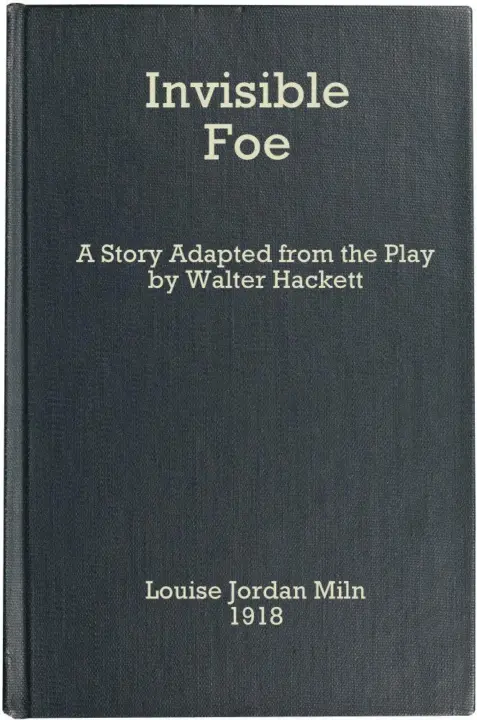
THE CLASSIC COLLECTION · 1918
"The Invisible Foe" by Louise Jordan Miln and Walter Hackett is a novel written in the early 20th century. The story centers around three children: Stephen, an orphan who is ambitious and masterful in nature; Hugh, who is more stolid and devoted; and Helen, the pretty, imaginative daughter of their guardian, Richard Bransby. As they navigate their childhood at Deep Dale, the dynamics of their relationships foreshadow deeper themes of power, longing, and the struggles of growing up. At the start of the novel, Stephen is depicted as a curious and observant boy, captivated by the flight of birds, while Hugh engages in simple play and Helen entertains herself with imaginary friends. Their interrelations are nuanced: Stephen's desire for power often clashes with his affection for Helen, who appears seraphic yet firmly controls her surroundings. Richard Bransby, their uncle and guardian, is portrayed as a stern and complex character, burdened by the loss of loved ones and the responsibility of caring for the children. The beginning sets the stage for a narrative that explores themes of love, ambition, and the burdens of inheritance against the backdrop of a seemingly idyllic childhood.
Introduction adapted from the source catalogue; source summaries may be automatically generated.
Free to read · English · 65,109 words · No account needed
MAKE TIME FOR A GOOD BOOK
On by default. Untick to stop anonymous reading totals. Each page counts after 10 seconds in view. How this works.
Anonymous counting is on unless you have switched it off.
“Just what becomes of an aeroplane when it flies foul, or is killed, and comes crashing down to earth: done, killed, I tell you, just as much as a dead man is killed—and no more. Last week, near Hendon, I saw a biplane, a single seater, fighter, die. Something went wrong when she was high, going beautifully, she side-slipped abruptly to port, and trembled on her wing-tip just as I’ve seen a bird do a thousand times, and she sickened and staggered down to her doom, faint, torn and bleeding, twisted and moaned on the grass, gave a last convulsive groan, a last shudder, and then lay still, a huddled mass of oil, broken struts, smashed propeller, petrol dripping slowly from her shattered engine, her sectional veins bleeding, her rudder gone, her ailerons useless, forever, her landing-gear ruined: killed—dead—a corpse—for the rubbish heap.”
“Oh! Stephen,” whispered Helen, “and the pilot?”
“The pilot?” Pryde said indifferently. “Oh! he was dead too, of course.”
He picked up a fresh cigarette and sauntered from the room.
Of the injured and destroyed machine he had spoken with more emotion than any one of them had ever heard in his voice before. And there was a long pause before Bransby, turning again to Latham, said:
“I’m afraid I don’t quite follow your argument, Doctor. Surely one can believe in immortality without believing in spiritualism?”
“I don’t know that that is my argument. But lately one has thought a great deal over such things. The war has brought them very close to all of us.”
“Yes,” Bransby concurred thoughtfully. And Caroline Leavitt laid down her work a moment and echoed sadly, “Yes.”
And Latham continued: “Those lives that were given out there—so unselfishly—surely that cannot be the end—and, if we don’t really die, how can we be certain that the spiritual power—the driving force, that continues to exist, cannot come back and make its existence felt? Oh! I don’t mean in rocking tables, or ringing bells, or showing lights, or in ghostly manifestations at séances.”
“What do you mean, then?” Bransby was half fascinated, half annoyed.
“They might make an impression upon the consciousness of the living.”
But Bransby was unimpressed by that.
“A sort of supernatural telepathy, eh?”
Latham pondered a moment. “I dare say I can explain best by giving you
an example.”
“Well?”
Your reading position is saved on this browser. Take it to another device with a library code. Reading pages adapt to text, rather than matching a printed edition.
Louise Jordan Miln
Roi Cooper Megrue & Walter Hackett
Louise Jordan Miln & Harold Owen & Harry M. Vernon
Louise Jordan Miln
BEHIND THE BOOK
This eBook is for the use of anyone anywhere in the United States and most other parts of the world at no cost and with almost no restrictions whatsoever. You may copy it, give it away or re-use it under the terms of the Project Gutenberg License included with this eBook or online at www.gutenberg.org. If you are not located in the United States, you will have to check the laws of the country where you are located before using this eBook. Read the source licence.
The original source file, including credits and licence, is retained by this library. Request an original-format copy at no charge. Please include the book title and Project Gutenberg identifier #50188.
KEEP YOUR CURIOSITY GOING
Coulson Kernahan

Maurice Baring
Frances Wright
Cécile Tormay

Frederic Jesup Stimson

W. H. P. (William Henry Pope) Jarvis