THE CLASSIC COLLECTION✦Ruben and Ivy SênCLASSIC FREE BOOKS
Ruben and Ivy Sên
Louise Jordan Miln
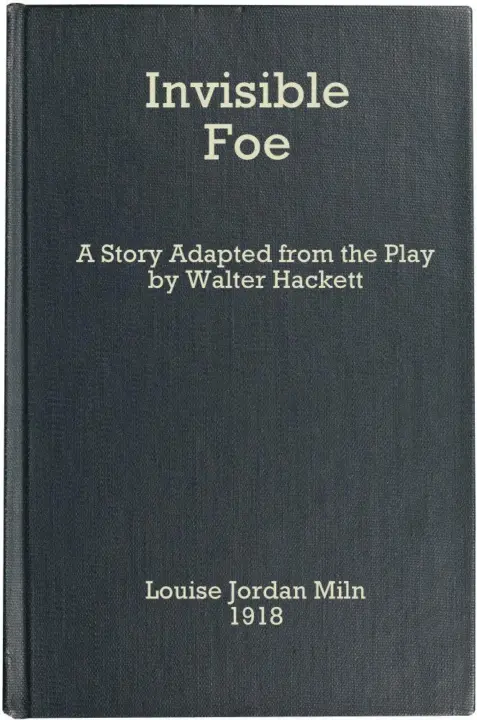
THE CLASSIC COLLECTION · 1918
"The Invisible Foe" by Louise Jordan Miln and Walter Hackett is a novel written in the early 20th century. The story centers around three children: Stephen, an orphan who is ambitious and masterful in nature; Hugh, who is more stolid and devoted; and Helen, the pretty, imaginative daughter of their guardian, Richard Bransby. As they navigate their childhood at Deep Dale, the dynamics of their relationships foreshadow deeper themes of power, longing, and the struggles of growing up. At the start of the novel, Stephen is depicted as a curious and observant boy, captivated by the flight of birds, while Hugh engages in simple play and Helen entertains herself with imaginary friends. Their interrelations are nuanced: Stephen's desire for power often clashes with his affection for Helen, who appears seraphic yet firmly controls her surroundings. Richard Bransby, their uncle and guardian, is portrayed as a stern and complex character, burdened by the loss of loved ones and the responsibility of caring for the children. The beginning sets the stage for a narrative that explores themes of love, ambition, and the burdens of inheritance against the backdrop of a seemingly idyllic childhood.
Introduction adapted from the source catalogue; source summaries may be automatically generated.
Free to read · English · 65,109 words · No account needed
MAKE TIME FOR A GOOD BOOK
On by default. Untick to stop anonymous reading totals. Each page counts after 10 seconds in view. How this works.
Anonymous counting is on unless you have switched it off.
As Stephen’s step died in the distance, all Hugh’s uncertainty came back, and he turned to Helen disconcertedly.
“I hope this is the right thing I am doing.”
“I am sure it is,” the girl said. “Dr. Latham thinks so too.”
“Are you? Still something keeps telling me I shouldn’t go—I dare say it’s my imagination.”
“Why, yes,” she reassured him, “what difference could it make, Hugh, whether you search this afternoon or this evening?”
“None, of course,” he admitted; “the strain has lasted so long it’s on my nerves. Oh,” he broke out anew, “if I could only think where to look now. But I can’t—I can’t.” He looked about the room distractedly.
Helen came to him, and put her hand on him. “It is going to be all right, Hugh—I’m certain it’s going to be all right.”
“Yes, I hope so,” he said; “but, Helen, if it shouldn’t?”
“If it shouldn’t?” she said, startled, and touched too now by his discomfort, his vacillation.
“This would have to be good-by, Helen.”
“No—no—no!” she said, choking.
“It would,” Hugh insisted sadly. “Oh, I dare say my record at the front—would help me; no doubt the penalty wouldn’t be very severe—but the whole story of the robbery would have to come out—the scandal would always cling to me—I couldn’t let you share that.”
“Do you think I’d mind?”
He took her face in his hands. “You don’t realize what unhappiness it
would bring you.”
“It doesn’t matter,” she said proudly. “I want to share it with you.”
“No, Helen—unless I clear myself I can never see you again.” She caught his hands, and held, them to her heart. He whitened under and over his war-tan, but he added almost sternly, “I mean it.”
“And what about me?” she cried passionately. “Have you thought about
that?”
“It’s you I am thinking of, believe that.”
“Oh!” she cried, hurt, angry, rebellious, freeing herself from his touch; but he caught her back and held her fast. He kissed her again and again, and then—again.
“Hugh, my boy, my boy,” Mrs. Leavitt sobbed, bustling in upon them.
Helen moved away, and sat down wearily. Hugh bent to his aunt’s embrace. “There, there, Aunt Caroline, don’t cry,” he entreated, as soon as he could disentangle himself enough to be articulate.
“I can’t help it—I can’t help it,” Mrs. Leavitt wailed.
“Yes, but such big tears,” he coaxed, dabbing at them affectionately with his khaki-colored handkerchief; “there, there, dear.”
Your reading position is saved on this browser. Take it to another device with a library code. Reading pages adapt to text, rather than matching a printed edition.
Louise Jordan Miln
Roi Cooper Megrue & Walter Hackett
Louise Jordan Miln & Harold Owen & Harry M. Vernon
Louise Jordan Miln
BEHIND THE BOOK
This eBook is for the use of anyone anywhere in the United States and most other parts of the world at no cost and with almost no restrictions whatsoever. You may copy it, give it away or re-use it under the terms of the Project Gutenberg License included with this eBook or online at www.gutenberg.org. If you are not located in the United States, you will have to check the laws of the country where you are located before using this eBook. Read the source licence.
The original source file, including credits and licence, is retained by this library. Request an original-format copy at no charge. Please include the book title and Project Gutenberg identifier #50188.
KEEP YOUR CURIOSITY GOING
Coulson Kernahan

Maurice Baring
Frances Wright
Cécile Tormay

Frederic Jesup Stimson

W. H. P. (William Henry Pope) Jarvis