THE CLASSIC COLLECTION✦Eline VereCLASSIC FREE BOOKS
Eline Vere
Louis Couperus

THE CLASSIC COLLECTION · 1920
"The Inevitable" by Louis Couperus is a novel written in the late 19th century. The story unfolds in a boarding house in Rome, focusing on the life of Cornélie de Retz van Loo, a young Dutch woman recovering from a recent divorce. As she navigates her new reality, the novel explores themes like loneliness, societal expectations, and the search for identity in a foreign city. The opening of the novel introduces the Marchesa Belloni's boarding house, where Cornélie arrives, filled with a mix of excitement and an undercurrent of foreboding. She is greeted by various characters, including the friendly porter and the boisterous marchesa, each representing different facets of life in the pension. While Cornélie attempts to settle into her new environment, she grapples with feelings of displacement and anticipates the arrival of new experiences. The foundation is laid for her introspective journey as she begins to confront not just the loneliness of travel but also the complexities of her past and the uncertain future that lies ahead.
Introduction adapted from the source catalogue; source summaries may be automatically generated.
Free to read · English · 85,880 words · No account needed
MAKE TIME FOR A GOOD BOOK
On by default. Untick to stop anonymous reading totals. Each page counts after 10 seconds in view. How this works.
Anonymous counting is on unless you have switched it off.
"Why not?" she repeated. "Because I think you a cheerful and pleasant companion with whom to take things lightly, but in other respects your temperament is not in tune with mine."
"What do you know about my temperament?"
"I can see you."
"You are not a doctor."
"No, but I am a woman."
"And I a man."
"But not for me."
Furiously, with a curse, he caught her in his quivering arms. Before she could prevent him, he had kissed her fiercely. She struggled out of his grasp and slapped his face. He gave another curse and flung out his arms to seize her again, but she drew herself up:
"Prince!" she cried, screaming with laughter. "You surely don't think
that you can compel me?"
"Of course I do!"
She gave a disdainful laugh:
"You can not," she said, aloud. "For I refuse and I will not be
compelled."
He saw red, he was furious. He had never before been defied and thwarted; he had always conquered.
She saw him rushing at her, but she quietly flung back the door of
the room.
The long galleries and apartments stretched out before them, as though endlessly. There was something in that vista of ancestral spaciousness that restrained him. He was an impetuous rather than a deliberate ravisher. She walked on very slowly, looking attentively to right and left.
He came up with her:
"You struck me!" he panted, furiously. "I'll never forgive it, never!"
"I beg your pardon," she said, with her sweetened voice and smile. "I had to defend myself, you know."
"Why?"
"Prince," she said, persuasively, "why all this anger and passion and exasperation? You can be so nice; when I saw you last in Rome you were so charming. We were always such good friends. I enjoyed your conversation and your wit and your good-nature. Now it's all spoilt."
"No," he entreated.
"Yes, it is. You won't understand me. Your temperament is not in harmony with mine. Don't you understand? You force me to speak coarsely, because you are coarse yourself."
"Yes. You don't believe in the sincerity of my independence."
"No, I don't!"
"Is that courteous, towards a woman?"
"I am courteous only up to a certain point."
"We have left that point behind. So be courteous again as before."
"You are playing with me. I shall never forget it; I will be revenged."
"So it's a struggle for life and death?"
"No, a struggle for victory, for me."
They had reached the atrio:
"Thanks for showing me round," she said, a little mockingly. "The
camera degli sposi, above all, was splendid. Don't let us be angry
any more."
And she offered him her hand.
Your reading position is saved on this browser. Take it to another device with a library code. Reading pages adapt to text, rather than matching a printed edition.
Louis Couperus

Louis Couperus
Louis Couperus
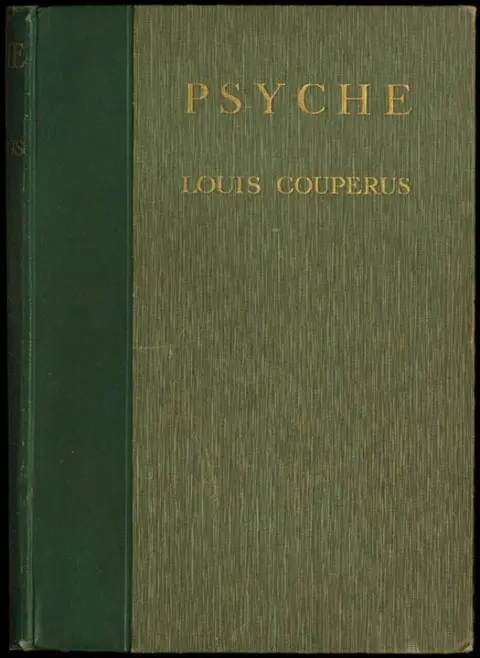
Louis Couperus
BEHIND THE BOOK
This eBook is for the use of anyone anywhere in the United States and most other parts of the world at no cost and with almost no restrictions whatsoever. You may copy it, give it away or re-use it under the terms of the Project Gutenberg License included with this eBook or online at www.gutenberg.org. If you are not located in the United States, you will have to check the laws of the country where you are located before using this eBook. Read the source licence.
The original source file, including credits and licence, is retained by this library. Request an original-format copy at no charge. Please include the book title and Project Gutenberg identifier #43005.
KEEP YOUR CURIOSITY GOING
Coulson Kernahan

Maurice Baring
Frances Wright
Cécile Tormay

Frederic Jesup Stimson

W. H. P. (William Henry Pope) Jarvis