THE CLASSIC COLLECTION✦Eline VereCLASSIC FREE BOOKS
Eline Vere
Louis Couperus
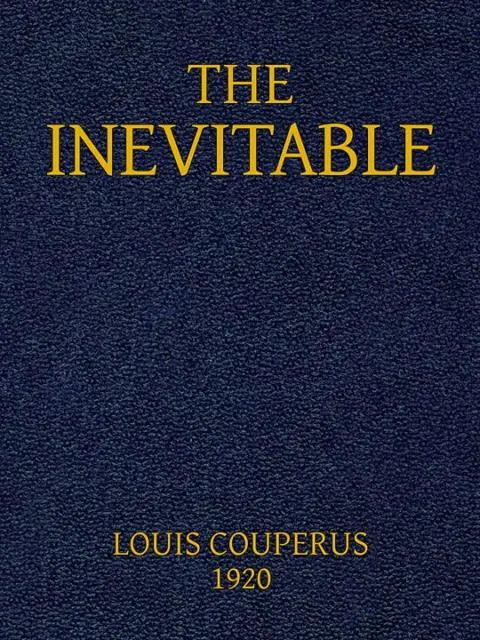
THE CLASSIC COLLECTION · 1920
"The Inevitable" by Louis Couperus is a novel written in the late 19th century. The story unfolds in a boarding house in Rome, focusing on the life of Cornélie de Retz van Loo, a young Dutch woman recovering from a recent divorce. As she navigates her new reality, the novel explores themes like loneliness, societal expectations, and the search for identity in a foreign city. The opening of the novel introduces the Marchesa Belloni's boarding house, where Cornélie arrives, filled with a mix of excitement and an undercurrent of foreboding. She is greeted by various characters, including the friendly porter and the boisterous marchesa, each representing different facets of life in the pension. While Cornélie attempts to settle into her new environment, she grapples with feelings of displacement and anticipates the arrival of new experiences. The foundation is laid for her introspective journey as she begins to confront not just the loneliness of travel but also the complexities of her past and the uncertain future that lies ahead.
Introduction adapted from the source catalogue; source summaries may be automatically generated.
Free to read · English · 85,880 words · No account needed
MAKE TIME FOR A GOOD BOOK
On by default. Untick to stop anonymous reading totals. Each page counts after 10 seconds in view. How this works.
Anonymous counting is on unless you have switched it off.
She remained indoors for a day or two and had her meals served in her room. One morning, however, she was going for a stroll in the Villa Borghese, when she met young Van der Staal, on his bicycle.
"Don't you ride?" he asked, jumping off.
"No."
"Why not?"
"It is an exercise which doesn't suit my style," Cornélie replied, vexed at meeting any one who disturbed the solitude of her stroll.
"May I walk with you?"
"Certainly."
He gave his machine into the charge of the porter at the gate and walked on with her, quite naturally, without saying very much:
"It's beautiful here," he remarked.
His words seemed to convey a simple meaning. She looked at him,
for the first time, attentively.
"You're an archæologist?" she asked.
"No," he said, deprecatingly.
"What are you, then?"
"Nothing. Mamma says that, just to excuse me. I am nothing and a very useless member of society at that. And I am not even well off."
"But you are studying, aren't you?"
"No. I do a little casual reading. My sisters call it studying."
"Do you like going about, as your sisters do?"
"No, I hate it. I never go with them."
"Don't you like meeting and studying people?"
"No. I like pictures, statues and trees."
"A poet?"
"No. Nothing. I am nothing, really."
She looked at him, with increased attention. He was walking very simply by her side, a tall, thin fellow of perhaps twenty-six, more of a boy than a man in face and figure, but endowed with a certain assurance and restfulness that made him seem older than his years. He was pale; he had dark, cool, almost reproachful eyes; and his long, lean figure, in his badly-kept cycling-suit, betrayed a slight indifference, as though he did not care what his arms and legs looked like.
He said nothing but walked on pleasantly, unembarrassed, without finding it necessary to talk. Cornélie, however, grew fidgety and sought for words:
"It is beautiful here," she stammered.
"Oh, it's very beautiful!" he replied, calmly, without seeing that she was constrained. "So green, so spacious, so peaceful: those long avenues, those vistas of avenues, like an antique arch, over yonder; and, far away in the distance, look, St. Peter's, always St. Peter's. It's a pity about those queer things lower down: that restaurant, that milk-tent. People spoil everything nowadays.... Let us sit down here: it is so lovely here."
They sat down on a bench.
"It is such a joy when a thing is beautiful," he continued. "People are never beautiful. Things are beautiful: statues and paintings. And then trees and clouds!"
"Do you paint?"
Your reading position is saved on this browser. Take it to another device with a library code. Reading pages adapt to text, rather than matching a printed edition.
Louis Couperus
Louis Couperus
Louis Couperus
Louis Couperus
BEHIND THE BOOK
This eBook is for the use of anyone anywhere in the United States and most other parts of the world at no cost and with almost no restrictions whatsoever. You may copy it, give it away or re-use it under the terms of the Project Gutenberg License included with this eBook or online at www.gutenberg.org. If you are not located in the United States, you will have to check the laws of the country where you are located before using this eBook. Read the source licence.
The original source file, including credits and licence, is retained by this library. Request an original-format copy at no charge. Please include the book title and Project Gutenberg identifier #43005.
KEEP YOUR CURIOSITY GOING
Coulson Kernahan

Maurice Baring
Frances Wright
Cécile Tormay

Frederic Jesup Stimson

W. H. P. (William Henry Pope) Jarvis