THE CLASSIC COLLECTION✦An outlaw’s diary: the CommuneCLASSIC FREE BOOKS
An outlaw’s diary: the Commune
Cécile Tormay
THE CLASSIC COLLECTION · 1897
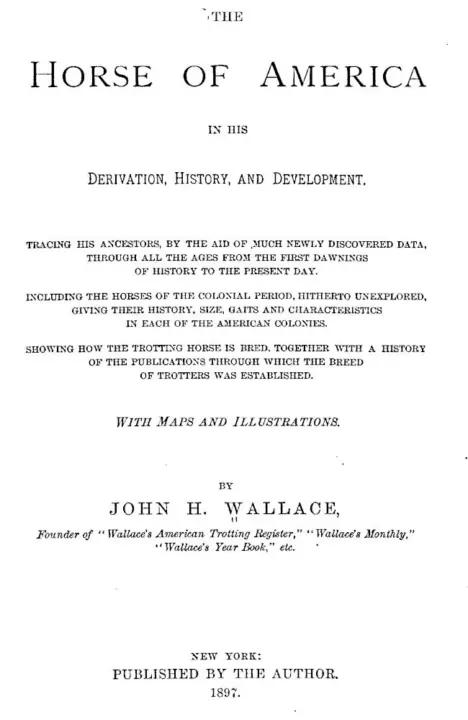
"The Horse of America in His Derivation, History, and Development" by John H. Wallace is a historical account written in the late 19th century. This work meticulously explores the lineage and evolution of the American horse, focusing particularly on its historical roots and development through the ages. Wallace seeks to challenge widely held misconceptions about horse breeds, particularly those concerning the renowned Arabian horse, while illuminating the largely neglected history of horses during the Colonial period in America. The opening of this work sets the stage for an extensive inquiry into the history and ancestry of American horses, emphasizing the author's desire to uncover facts about their lineage that have not been extensively documented before. Wallace introduces his examination by critiquing common narratives regarding the origins of the horse, dismissing the notion that the Arabian breed is superior and asserting that its actual influence on the American horse is minimal. He highlights that much of the existing knowledge surrounding horse history is founded on repetition of previous works, rather than original research. The author expresses satisfaction in the thorough research he has conducted into the equine ancestry and colonial history, intending to provide readers with a more accurate understanding of both the American trotter and the complexities of horse breeding.
Introduction adapted from the source catalogue; source summaries may be automatically generated.
Free to read · English · 251,000 words · No account needed
MAKE TIME FOR A GOOD BOOK
On by default. Untick to stop anonymous reading totals. Each page counts after 10 seconds in view. How this works.
Anonymous counting is on unless you have switched it off.
The ownership of Messenger, after he was transferred from Philadelphia to New York, like his earlier history, seems to be very much muddled. Henry Astor, a New York butcher, certainly bought him in the fall of 1793, and located him at Philip Platt’s, four miles from Jamaica, on Long Island. In the spring of 1796 Mr. Cornelius W. Van Ranst bought one-third interest in him and removed him to Pine Plains in Dutchess County, New York, and, without specifying the time, he says he afterward purchased the remaining two-thirds, for which he paid two thousand seven hundred and fifty dollars. There appears to have been some mistake about this, for in 1802 we find Henry Astor, of New York, conveying one-third interest in the horse to Benjamin B. Cooper, of Camden, New Jersey. Some other parties also claim to have owned an interest in the horse, and I heard that there was a lawsuit about him between Astor and Van Ranst. The latter claims to have owned an interest in him till the time of his death, in 1808. It is not known how much Mr. Astor paid for him when he bought him, nor have I any data from which to determine the probable market value of the horse except that Mr. Van Ranst says he paid two thousand seven hundred and fifty dollars for two-thirds of him. If we accept this as a basis, he must have been valued at about four thousand one hundred and twenty-five dollars. It is true, beyond doubt, that for several years he brought to his owners a net annual rental of one thousand dollars. This would indicate a very large patronage at very high prices for those times. For the twenty years of his stud services in this country, we find him located as follows:
1788, at Alexander Clay’s, Market Street, Philadelphia, at $15 the season and $1 to the groom, privilege of returning.
1789, at Thomas Clayton’s, Lombard Street, Philadelphia, at $10 the season and $1 to the groom.
1790, at Noah Hunt’s, in the Jersies, near Pennington, at $8.
1791, at “Mount Benger,” two miles from Bristol, Bucks Co., Pa., at $16.
1792, at the same place and the same price.
1793, at the same place and the same price.
1794, at Philip Platt’s, fifteen miles from New York and four from Jamaica, Long Island, at $25 the season.
1795, at the same place and the same price, when, as Mr. Van Ranst expressed it, “he took with our horsemen.”
1796, at Pine Plains, Dutchess County, N. Y., where he covered 106 mares
at $30 the season.
1797, I have no advertisement for this year, but it is probable he was at the same place at the same price.
Your reading position is saved on this browser. Take it to another device with a library code. Reading pages adapt to text, rather than matching a printed edition.
BEHIND THE BOOK
This eBook is for the use of anyone anywhere in the United States and most other parts of the world at no cost and with almost no restrictions whatsoever. You may copy it, give it away or re-use it under the terms of the Project Gutenberg License included with this eBook or online at www.gutenberg.org. If you are not located in the United States, you will have to check the laws of the country where you are located before using this eBook. Read the source licence.
The original source file, including credits and licence, is retained by this library. Request an original-format copy at no charge. Please include the book title and Project Gutenberg identifier #62972.
KEEP YOUR CURIOSITY GOING
Cécile Tormay

Moritz Busch
John L. Ransom
Frances Wright
Cécile Tormay

Mabel Potter Daggett