THE CLASSIC COLLECTION✦An outlaw’s diary: the CommuneCLASSIC FREE BOOKS
An outlaw’s diary: the Commune
Cécile Tormay
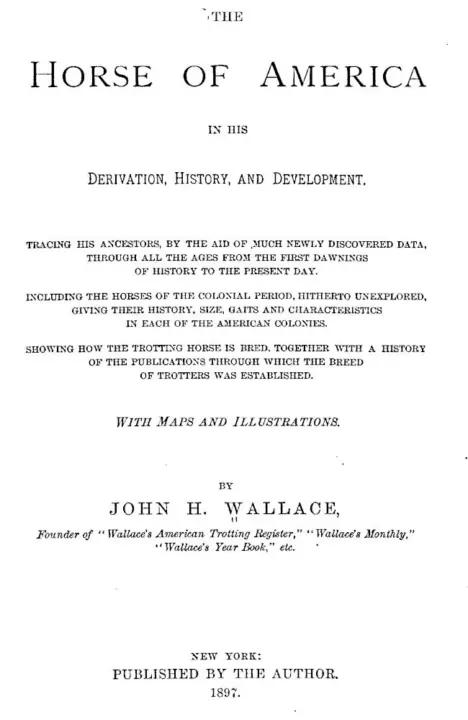
THE CLASSIC COLLECTION · 1897
"The Horse of America in His Derivation, History, and Development" by John H. Wallace is a historical account written in the late 19th century. This work meticulously explores the lineage and evolution of the American horse, focusing particularly on its historical roots and development through the ages. Wallace seeks to challenge widely held misconceptions about horse breeds, particularly those concerning the renowned Arabian horse, while illuminating the largely neglected history of horses during the Colonial period in America. The opening of this work sets the stage for an extensive inquiry into the history and ancestry of American horses, emphasizing the author's desire to uncover facts about their lineage that have not been extensively documented before. Wallace introduces his examination by critiquing common narratives regarding the origins of the horse, dismissing the notion that the Arabian breed is superior and asserting that its actual influence on the American horse is minimal. He highlights that much of the existing knowledge surrounding horse history is founded on repetition of previous works, rather than original research. The author expresses satisfaction in the thorough research he has conducted into the equine ancestry and colonial history, intending to provide readers with a more accurate understanding of both the American trotter and the complexities of horse breeding.
Introduction adapted from the source catalogue; source summaries may be automatically generated.
Free to read · English · 251,000 words · No account needed
MAKE TIME FOR A GOOD BOOK
On by default. Untick to stop anonymous reading totals. Each page counts after 10 seconds in view. How this works.
Anonymous counting is on unless you have switched it off.
Settlement and capture of Port Royal—Early plantations—First French horses brought over 1665—Possibly illicit trading—Sire of “Old Tippoo”—His history—“Scape Goat” and his descendants—Horses of the Maritime Provinces.
Before taking up the two provinces of the Dominion—Quebec and Ontario—to which reference is made in this volume as “Canada,” there is an incident in the history of Nova Scotia, full of sadness, that I cannot pass over without mention. The French made a settlement here in 1602, and named the country New France. The settlement to which I refer was at Port Royal, afterward named Annapolis by the English. This seems to have been a thrifty and flourishing little plantation, far removed from all outside associations, except the savages of the forests, with whom they lived in peace. The first horses brought to North America were owned and bred by the people of Port Royal. In November, 1613, Captain Argall, of Virginia, organized a plundering expedition, and having learned of the defenseless condition of Port Royal from Captain John Smith, he sailed up there with two or three ships, captured the place and carried away horses, cattle, sheep, wheat, farming utensils, and indeed everything their ships would carry, and then sailed away to Virginia. This raid was without authority or orders, but it was winked at by the officials, and forthwith a second raid was made by Argall, and all that had been left in the first was carried away in the second, as well as some of the inhabitants.
The pacer of Canada, generally believed to be of French origin, has long been an object of diligent investigation, without reaching any satisfactory results. Again and again I have gone over the first half-century of the history of the French plantations on the St. Lawrence; examining everything in the English language that held out any hope of throwing light upon the question, but nothing was revealed. The trouble was that my search stopped a little short of the date when the first horses arrived. The management of the affairs of the plantations on the St. Lawrence being in a company located in France, there was a lack of vigor, not much growth, and still less profits to the projectors of the colony. The energies of the people seemed to be directed almost wholly to collecting and trading in peltry instead of building up a commonwealth from the productions of the soil. For half a century these primitive people lived without horses. Their farms, if they could be called farms, all had a frontage on the water, running back in narrow strips to the highlands. They did their plowing with cattle and their canoes supplied the place of the saddle horse, the family carriage and the lumber wagon to carry the scanty surplus of their little farms to market. At last the company in France, holding direction and control, got out of the way, and the king of France assumed direct authority over the affairs of the plantation. On June 30, 1665, the Marquis de Tracy arrived at Quebec, as viceroy, with a numerous suite of retainers and a regiment of French soldiers. Two months later a large fleet arrived bringing many colonists, embracing artisans, farmers, peasants, etc., with their families, and a good number of horses, the first that had ever been seen on the St. Lawrence. There is a tradition that a horse had been sent over to the governor in 1642, but it is probable he was lost on the voyage, as the older people of the colony had no recollection or knowledge of any such animal. These colonists came from the ancient province of Picardy, not now to be found on the modern maps of France, but it lay on the English Channel in the extreme northwest of France. As it is expressly stated that these colonists came from Picardy, it is fair to conclude that the horses came from that portion of the kingdom also. At this period in history there had been no wars between France and England for many years, and commercial as well as social intercourse had long been cultivated between the people on both sides of the channel. We know but little of the early horse history of France, but in our own time we know that France has been largely benefited by the diffusion of the English blood among her horse stock, so we may conclude that if a man in Kent had a horse that a man in Picardy wanted, he very soon got him in the way of legitimate trade. I think, therefore, it is safe to conclude that the horse stock of Northwestern France and the horse stock of England were very much the same in appearance, action and blood. On this basis of reasoning, which involves no improbabilities, we may conclude that the same proportion of the horses from Picardy were natural pacers.
Your reading position is saved on this browser. Take it to another device with a library code. Reading pages adapt to text, rather than matching a printed edition.
BEHIND THE BOOK
This eBook is for the use of anyone anywhere in the United States and most other parts of the world at no cost and with almost no restrictions whatsoever. You may copy it, give it away or re-use it under the terms of the Project Gutenberg License included with this eBook or online at www.gutenberg.org. If you are not located in the United States, you will have to check the laws of the country where you are located before using this eBook. Read the source licence.
The original source file, including credits and licence, is retained by this library. Request an original-format copy at no charge. Please include the book title and Project Gutenberg identifier #62972.
KEEP YOUR CURIOSITY GOING
Cécile Tormay

Moritz Busch
John L. Ransom
Frances Wright
Cécile Tormay

Mabel Potter Daggett