THE CLASSIC COLLECTION✦An outlaw’s diary: the CommuneCLASSIC FREE BOOKS
An outlaw’s diary: the Commune
Cécile Tormay
THE CLASSIC COLLECTION · 1897
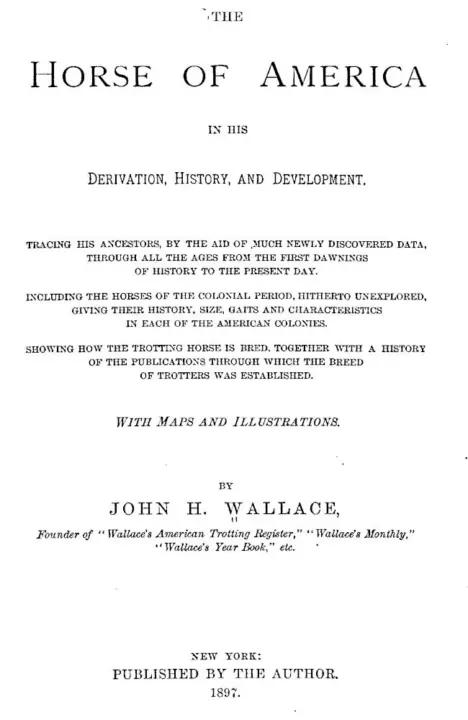
"The Horse of America in His Derivation, History, and Development" by John H. Wallace is a historical account written in the late 19th century. This work meticulously explores the lineage and evolution of the American horse, focusing particularly on its historical roots and development through the ages. Wallace seeks to challenge widely held misconceptions about horse breeds, particularly those concerning the renowned Arabian horse, while illuminating the largely neglected history of horses during the Colonial period in America. The opening of this work sets the stage for an extensive inquiry into the history and ancestry of American horses, emphasizing the author's desire to uncover facts about their lineage that have not been extensively documented before. Wallace introduces his examination by critiquing common narratives regarding the origins of the horse, dismissing the notion that the Arabian breed is superior and asserting that its actual influence on the American horse is minimal. He highlights that much of the existing knowledge surrounding horse history is founded on repetition of previous works, rather than original research. The author expresses satisfaction in the thorough research he has conducted into the equine ancestry and colonial history, intending to provide readers with a more accurate understanding of both the American trotter and the complexities of horse breeding.
Introduction adapted from the source catalogue; source summaries may be automatically generated.
Free to read · English · 251,000 words · No account needed
MAKE TIME FOR A GOOD BOOK
On by default. Untick to stop anonymous reading totals. Each page counts after 10 seconds in view. How this works.
Anonymous counting is on unless you have switched it off.
First evidences of horses in Egypt about 1700 B.C.—Supported by Egyptian records and history—The Patriarch Job had no horses—Solomon’s great cavalry force organized—Arabia as described by Strabo at the beginning of our era—No horses then in Arabia—Constantius sends two hundred Cappadocian horses into Arabia A.D. 356—Arabia the last country to be supplied with horses—The ancient Phœnician merchants and their colonies —Hannibal’s cavalry forces in the Punic Wars—Distant ramifications of Phœnician trade and colonization—Commerce reached as far as Britain and the Baltic—Probable source of Britain’s earliest horses.
Having considered the different theories or opinions as to the original habitat of the horse and the means and facilities by which distribution to the different portions of the earth may have been effected, I have omitted land migration, which will be self-evident to all as an important factor in the problem. It is now in order, therefore, to consider such dates and facts as are pertinent and may be gleaned from history, sacred and profane.
When Abraham, with Sarah his wife, visited Egypt about 1920 B.C., the Pharaoh for her sake bestowed upon him many gifts: “Sheep and oxen and he asses and men servants and maid servants and she asses and camels.” Among these great gifts there were no horses, evidently because Egypt had no horses at that time. There is no mention nor reference to horses in Egypt till Joseph became prime minister two hundred years later, when there were a few horses, and they were traded or sold to Joseph by their owners in exchange for food, not in droves, but as individuals. These scriptural facts in the experiences of Abraham and Joseph seem to be circumstantially sustained by the discoveries of those learned Egyptologists who, in late years and with the spade in their hands, have resurrected so much of history that had been buried for thousands of years. It was during the reign of the Hyksos, or Shepherd Kings, that Abraham and Joseph were in Egypt, and in order to approximate the time when horses were first introduced, we must glance at a few facts in connection with what is known of the Hyksos. Some have claimed they were from Chaldea, some from Northern Syria and Asia Minor, and some again from Phœnicia, and it is one of the strangest things in history that a great nation should be overthrown and held in subjection for over five hundred years and nobody know who did it. Then again, it is equally incomprehensible that any nation should have subdued Egypt and held it in bondage so long and yet never have claimed the honor of having done so. Still another mystery remains that never has been solved, and that is, what became of the Shepherds and their followers when they were driven out? At the period of the conquest the governing class was rent by factions and under a weak and tyrannical king. The Delta and the Valley of the Nile were crowded with slaves, many of them of Asiatic origin. The elevated plains and mountain sides were covered with fierce and intractable nomads, all of Asiatic origin, tending their flocks. Some brave and skillful shepherd organized the shepherds and the slaves and at their head swept down upon the government with a power that was so mighty as to be irresistible. Manetho, the great Egyptian historian of more than two thousand years ago, thus describes the event: “Under this king, then, I know not wherefore, the god caused to blow upon us a baleful wind, and in the face of all probability bands from the East, people of ignoble race, came upon us unawares, attacked the country and subdued it easily and without fighting.” In remarking upon this same event Professor Maspero, who stands at the very head of the Egyptologists, says: “It is possible that they (the shepherds) owed this rapid victory to the presence in their armies of a factor hitherto unknown to the Africans—the war chariot—and before the horse and his driver the Egyptians gave way in a body.” In view of the direct declaration of Manetho that the question of the succession was settled “without fighting,” the mere suggestion of an unsustained “possibility” from Maspero that the result may have been determined by the war chariots cannot be accepted. All the authorities agree that the horse was introduced into Egypt at some period during the rule of the Shepherd Kings, but there is absolutely no evidence that this was at the beginning or anywhere near the beginning of that rule.
Your reading position is saved on this browser. Take it to another device with a library code. Reading pages adapt to text, rather than matching a printed edition.
BEHIND THE BOOK
This eBook is for the use of anyone anywhere in the United States and most other parts of the world at no cost and with almost no restrictions whatsoever. You may copy it, give it away or re-use it under the terms of the Project Gutenberg License included with this eBook or online at www.gutenberg.org. If you are not located in the United States, you will have to check the laws of the country where you are located before using this eBook. Read the source licence.
The original source file, including credits and licence, is retained by this library. Request an original-format copy at no charge. Please include the book title and Project Gutenberg identifier #62972.
KEEP YOUR CURIOSITY GOING
Cécile Tormay

Moritz Busch
John L. Ransom
Frances Wright
Cécile Tormay

Mabel Potter Daggett