THE CLASSIC COLLECTION✦An outlaw’s diary: the CommuneCLASSIC FREE BOOKS
An outlaw’s diary: the Commune
Cécile Tormay
THE CLASSIC COLLECTION · 1897
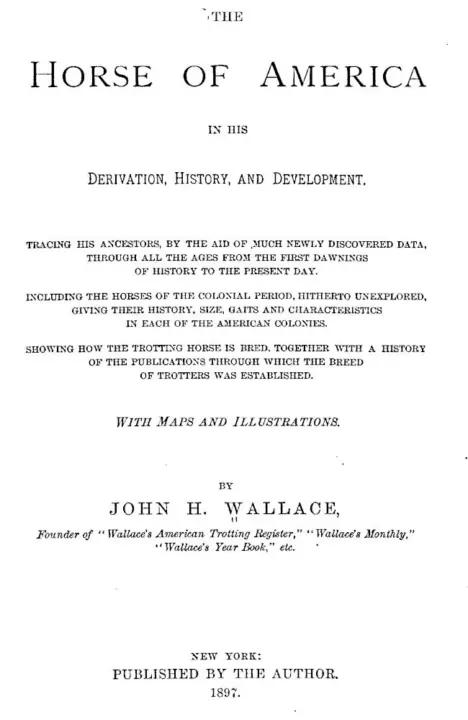
"The Horse of America in His Derivation, History, and Development" by John H. Wallace is a historical account written in the late 19th century. This work meticulously explores the lineage and evolution of the American horse, focusing particularly on its historical roots and development through the ages. Wallace seeks to challenge widely held misconceptions about horse breeds, particularly those concerning the renowned Arabian horse, while illuminating the largely neglected history of horses during the Colonial period in America. The opening of this work sets the stage for an extensive inquiry into the history and ancestry of American horses, emphasizing the author's desire to uncover facts about their lineage that have not been extensively documented before. Wallace introduces his examination by critiquing common narratives regarding the origins of the horse, dismissing the notion that the Arabian breed is superior and asserting that its actual influence on the American horse is minimal. He highlights that much of the existing knowledge surrounding horse history is founded on repetition of previous works, rather than original research. The author expresses satisfaction in the thorough research he has conducted into the equine ancestry and colonial history, intending to provide readers with a more accurate understanding of both the American trotter and the complexities of horse breeding.
Introduction adapted from the source catalogue; source summaries may be automatically generated.
Free to read · English · 251,000 words · No account needed
MAKE TIME FOR A GOOD BOOK
On by default. Untick to stop anonymous reading totals. Each page counts after 10 seconds in view. How this works.
Anonymous counting is on unless you have switched it off.
A good many years ago I made a special study of all that had been written about Messenger, and I was fortunate in being able to supplement this information by interviews with a few old gentlemen who knew the horse personally. Nearly all that generation of horsemen had passed away before I commenced this personal search for them. But a few then remained with excellent memories and with characters above suspicion or reproach. From these sources I gathered a great many incidents, facts and descriptions which I succeeded in harmonizing, to my own mind at least, and thus was able, to compile a complete description of the horse at every point. That description was written out more than twenty years ago, and in presenting it now I will not change a single word. At the time it was written, as will be seen from its perusal, I had really no doubt the horse was thoroughbred. It will not be charged, therefore, that the coarse traits brought out in the description were influenced in any degree by a theory of his breeding:
“Messenger was a grey, that became lighter and flea-bitten with age. He was fifteen hands three inches high, and for a thoroughbred his appearance was coarse. He did not supply the mind with an idea of beauty, but he impressed upon it a conception of solidity and power. His head was large and bony, with a nose that had a decided Roman tendency, though not to a marked degree. His nostrils were unusually large and flexible, and when distended they were enormous. His eye was large, full, very dark and remarkably brilliant. In this particular he does not appear to have inherited the weakness of his great-grandsire, Sampson. His ear was larger than usual in the blood horse, but thin and tapering and always active and expressive. The windpipe was so unusually large and stood out so much as a distinct feature that it marred what otherwise would have been a gamelike throat-latch and setting on of the head. His neck was very short for a blood horse, but was not coarse and thick like a bull’s; neither did it rise into such an enormous crest as that of his sire. It was not a bad neck in any sense, but like Lexington’s of our own day, it was too short to be handsome. His mane and foretop were thin and light. His withers were low and round, which appears to have been a family characteristic in the male line, back for three generations at least. His shoulders were heavy and altogether too upright for our ideas of a race horse. His barrel was perfection itself, both for depth and rotundity. His loin was well arched, broad and strong. His hips and quarters were ‘incomparably superior to all others.’ The column of the vertebra being of unusual depth and strength, gave the setting on of the tail a distinctive, but elegant character. The tail was carried in fine style; like the mane, it was not in superabundant quantity, but there was no such scantiness as to detract from the beauty and grace of the animal. His stifles were well spread and swelling, but there appears to have been no unusual development at this point. From the stifle to the hock and from the elbow to the knee, no writer that we can now recall has given us any description of either length or strength. We may, therefore, take it for granted that these points had no unusual development of muscle, but were in harmony with the general contour and make-up of a great strong horse. His hocks and knees were unusually large and bony, with all the members strong and clearly defined. The cannon bones were short and flat and the ligaments back of them were very large and braced a good way off, so that the leg was broad and flat. Mr. Jones says this part of the limb was of medium size, but other writers all agree that he had an unusual amount of bone at this point. Considering the whole style and character of the horse, and especially the character of his ancestors in the male line, and of Turf, the [reputed] sire of his dam, all of whom were distinguished for their quantity of bone, we are disposed to think Mr. Jones’ memory has not served him with entire accuracy in this particular. The conviction is reasonable and grows out of evidence that comes from every quarter, and we have no disposition to surrender it, that the bones of Messenger’s limbs were unusually large and strong for those of a thoroughbred. His pasterns and feet were all that could be desired, and as an evidence of the excellence and health of his underpinning several writers have put it on record that whether in the stable or on the show ground he never was known to mopingly rest one leg by standing on the other three, but was always prompt and upright. This is our conception of the form and appearance of the horse as we have reached it after a diligent and careful study of all that has been said by those who saw him while he lived. From this description it is a very easy matter to pick out the features which gave him his coarse and badly bred appearance. His big head, long ears, short neck, low withers, upright shoulders, large bones and, possibly, coarse hair, complete the catalogue. From these features the purity of his blood has been doubted and denounced, just as that of his sire, his grandsire and his great-grandsire had been denounced. The coarseness, the cart-horse appearance was in the family, but it did not seem to prevent some of them from beating some of the best that England produced in successive generations. There are many traditions that have been handed down to us concerning his temper, some of which, no doubt, have accumulated and gathered strength and ferocity in the years through which they have rolled. There have been perhaps half a dozen stories about his killing his keepers, but we are not able to say whether any one of them is true. It is known with certainty, however, that he was willful and vicious and would tolerate no familiarity from strangers.”
Your reading position is saved on this browser. Take it to another device with a library code. Reading pages adapt to text, rather than matching a printed edition.
BEHIND THE BOOK
This eBook is for the use of anyone anywhere in the United States and most other parts of the world at no cost and with almost no restrictions whatsoever. You may copy it, give it away or re-use it under the terms of the Project Gutenberg License included with this eBook or online at www.gutenberg.org. If you are not located in the United States, you will have to check the laws of the country where you are located before using this eBook. Read the source licence.
The original source file, including credits and licence, is retained by this library. Request an original-format copy at no charge. Please include the book title and Project Gutenberg identifier #62972.
KEEP YOUR CURIOSITY GOING
Cécile Tormay

Moritz Busch
John L. Ransom
Frances Wright
Cécile Tormay

Mabel Potter Daggett