THE CLASSIC COLLECTION✦Tattle-tales of CupidCLASSIC FREE BOOKS
Tattle-tales of Cupid
Paul Leicester Ford
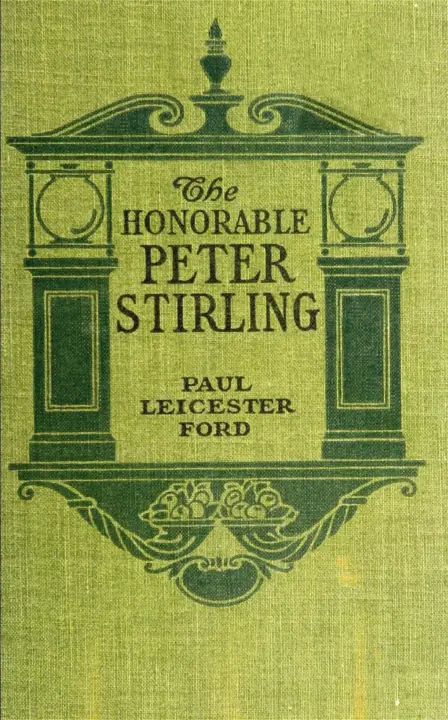
THE CLASSIC COLLECTION · 1894
"The Honorable Peter Stirling and What People Thought of Him" by Paul Leicester Ford is a novel written in the late 19th century. The narrative revolves around the character of Peter Stirling, a young man from a humble background who navigates his way through society's expectations and personal relationships, particularly focusing on themes of romance, ambition, and personal growth. At the start of the novel, we are introduced to Mr. Pierce, a dominating conversationalist who dismisses Peter as lacking in romance and imagination due to his upbringing in a mill village. This sets the stage for contrasting perspectives on love and life. Peter is portrayed as earnest and diligent, walking the deck of a yacht as others engage in conversation about romance, while he is mostly an observer. The scene offers a glimpse into his character, suggesting an introspective and serious nature. As the narrative unfolds, we see Peter's struggles with both societal expectations and his internal conflicts regarding love, particularly his feelings for Miss Pierce, leading to significant developments in his journey.
Introduction adapted from the source catalogue; source summaries may be automatically generated.
Free to read · English · 156,539 words · No account needed
MAKE TIME FOR A GOOD BOOK
On by default. Untick to stop anonymous reading totals. Each page counts after 10 seconds in view. How this works.
Anonymous counting is on unless you have switched it off.
If Peter had roamed about the hall that evening, he was still more restless the next morning. He was down early, though for no apparent reason, and did nothing but pass from hall to room, and room to hall, spending most of his time in the latter, however.
How Leonore could have got from her room into the garden without Peter’s seeing her was a question which puzzled him not a little, when, by a chance glance out of a window, he saw that personage clipping roses off the bushes. He did not have time to spare, however, to reason out an explanation. He merely stopped roaming, and went out to—to the roses.
“Good-morning,” said Leonore pleasantly, though not looking at Peter, as she continued her clipping.
Peter did not say anything for a moment. Then he asked, “Is that all?”
“I don’t know what you mean,” said Leonore, innocently. “Besides, someone might be looking out of a window.”
Peter calmly took hold of the basket to help Leonore sustain its enormous weight. “Let me help you carry it,” he said.
“Very well,” said Leonore. “But there’s no occasion to carry my hand too. I’m not decrepit.”
“I hoped I was helping you,” said Peter.
“You are not. But you may carry the basket, since you want to hold
something.”
“Very well,” said Peter meekly.
“Do you know,” said Leonore, as she snipped, and dropped roses into the basket, “you are not as obstinate as people say you are.”
“Don’t deceive yourself on that score,” said Peter.
“Well! I mean you are not absolutely determined to have your own way.”
“I never give up my own views,” said Peter, “unless I can see more to be gained by so doing. To that extent I am not at all obstinate.”
“Suppose,” said Leonore, “that you go and cut the roses on those furthest bushes while I go in and arrange these?”
“Suppose,” said Peter calmly, and with an evident lack of enthusiasm.
“Well. Will you?”
“No.”
“Why not?”
“The motion to adjourn,” said Peter, “is never debatable.”
“Do you know,” said Leonore, “that you are beginning very badly?”
“That is what I have thought ever since I joined you.”
“Then why don’t you go away?”
“Why make bad, worse?”
“There,” said Leonore, “Your talking has made me cut my finger,
almost.”
“Let me see,” said Peter, reaching out for her hand.
“I’m too busy,” said Leonore.
“Do you know,” said Peter, “that if you cut many more buds, you won’t have any more roses for a week. You’ve cut twice as many roses as you usually do.”
Your reading position is saved on this browser. Take it to another device with a library code. Reading pages adapt to text, rather than matching a printed edition.
Paul Leicester Ford
Paul Leicester Ford
Paul Leicester Ford
Paul Leicester Ford
BEHIND THE BOOK
This eBook is for the use of anyone anywhere in the United States and most other parts of the world at no cost and with almost no restrictions whatsoever. You may copy it, give it away or re-use it under the terms of the Project Gutenberg License included with this eBook or online at www.gutenberg.org. If you are not located in the United States, you will have to check the laws of the country where you are located before using this eBook. Read the source licence.
The original source file, including credits and licence, is retained by this library. Request an original-format copy at no charge. Please include the book title and Project Gutenberg identifier #14532.
KEEP YOUR CURIOSITY GOING
Coulson Kernahan

Maurice Baring
Frances Wright
Cécile Tormay

Frederic Jesup Stimson

W. H. P. (William Henry Pope) Jarvis