THE CLASSIC COLLECTION✦Tattle-tales of CupidCLASSIC FREE BOOKS
Tattle-tales of Cupid
Paul Leicester Ford
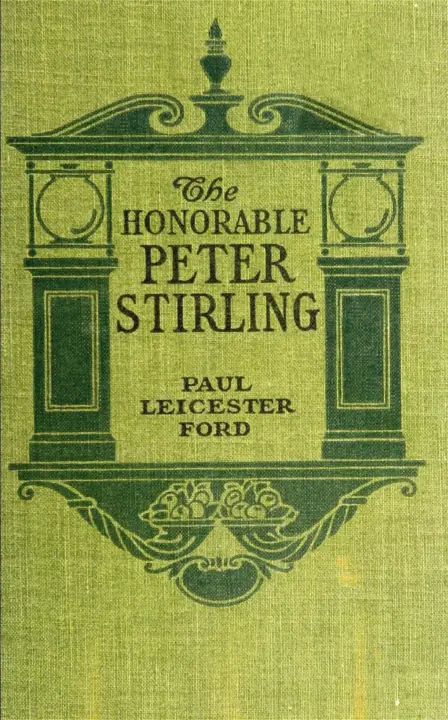
THE CLASSIC COLLECTION · 1894
"The Honorable Peter Stirling and What People Thought of Him" by Paul Leicester Ford is a novel written in the late 19th century. The narrative revolves around the character of Peter Stirling, a young man from a humble background who navigates his way through society's expectations and personal relationships, particularly focusing on themes of romance, ambition, and personal growth. At the start of the novel, we are introduced to Mr. Pierce, a dominating conversationalist who dismisses Peter as lacking in romance and imagination due to his upbringing in a mill village. This sets the stage for contrasting perspectives on love and life. Peter is portrayed as earnest and diligent, walking the deck of a yacht as others engage in conversation about romance, while he is mostly an observer. The scene offers a glimpse into his character, suggesting an introspective and serious nature. As the narrative unfolds, we see Peter's struggles with both societal expectations and his internal conflicts regarding love, particularly his feelings for Miss Pierce, leading to significant developments in his journey.
Introduction adapted from the source catalogue; source summaries may be automatically generated.
Free to read · English · 156,539 words · No account needed
MAKE TIME FOR A GOOD BOOK
On by default. Untick to stop anonymous reading totals. Each page counts after 10 seconds in view. How this works.
Anonymous counting is on unless you have switched it off.
The evening on which Peter had left Grey-Court, Leonore had been moved “for sundry reasons” to go to her piano and sing an English ballad entitled “Happiness.” She had sung it several times, and with gusto.
The next morning she read the political part of the papers. “I don’t see anything to have taken him back,” she said “but I am really glad, for he was getting hard to manage. I couldn’t send him away, but now I hope he’ll stay there.” Then Leonore fluttered all day, in the true Newport style, with no apparent thought of her “friend.”
But something at a dinner that evening interested her.
“I’m ashamed,” said the hostess, “of my shortage of men. Marlow was summoned back to New York last night, by business, quite unexpectedly, and Mr. Dupont telegraphed me this afternoon that he was detained there.”
“It’s curious,” said Dorothy. “Mr. Rivington and my brother came on Tuesday expecting to stay for a week, but they had special delivery letters yesterday, and both started for New York. They would not tell me what it was.”
“Mr. Stirling received a special delivery, too,” said Leonore, “and started at once. And he wouldn’t tell.”
“How extraordinary!” said the hostess. “There must be something very good at the roof-gardens.”
“It has something to do with headwears,” said Leonore, not hiding her
light under a bushel.
“Headwear?” said a man.
“Yes,” said Leonore. “I only had a glimpse of the heading, but I saw ‘Headwears N.G.S.N.Y.’”
A sudden silence fell, no one laughing at the mistake.
“What’s the matter?” asked Leonore.
“We are wondering what will happen,” said the host, “if men go in for
headwear too.”
“They do that already,” said a man, “but unlike women, they do it on the inside, not the outside of the head.”
But nobody laughed, and the dinner seemed to drag from that moment.
Leonore and Dorothy had come together, and as soon as they were in their carriage, Leonore said, “What a dull dinner it was?”
“Oh, Leonore,” cried Dorothy, “don’t talk about dinners. I’ve kept up till now, bu—” and Dorothy’s sentence melted into a sob.
“Is it home, Mrs. Rivington?” asked the tiger, sublimely unconscious, as a good servant should be, of this dialogue, and of his mistress’s tears.
“No, Portman, the Club,” sobbed Dorothy.
“Dorothy,” begged Leonore, “what is it?”
“Don’t you understand?” sobbed Dorothy. “All this fearful anarchist talk and discontent? And my poor, poor darling! Oh, don’t talk to me.” Dorothy became inarticulate once more.
Your reading position is saved on this browser. Take it to another device with a library code. Reading pages adapt to text, rather than matching a printed edition.
Paul Leicester Ford
Paul Leicester Ford
Paul Leicester Ford
Paul Leicester Ford
BEHIND THE BOOK
This eBook is for the use of anyone anywhere in the United States and most other parts of the world at no cost and with almost no restrictions whatsoever. You may copy it, give it away or re-use it under the terms of the Project Gutenberg License included with this eBook or online at www.gutenberg.org. If you are not located in the United States, you will have to check the laws of the country where you are located before using this eBook. Read the source licence.
The original source file, including credits and licence, is retained by this library. Request an original-format copy at no charge. Please include the book title and Project Gutenberg identifier #14532.
KEEP YOUR CURIOSITY GOING
Coulson Kernahan

Maurice Baring
Frances Wright
Cécile Tormay

Frederic Jesup Stimson

W. H. P. (William Henry Pope) Jarvis