THE CLASSIC COLLECTION✦Tattle-tales of CupidCLASSIC FREE BOOKS
Tattle-tales of Cupid
Paul Leicester Ford
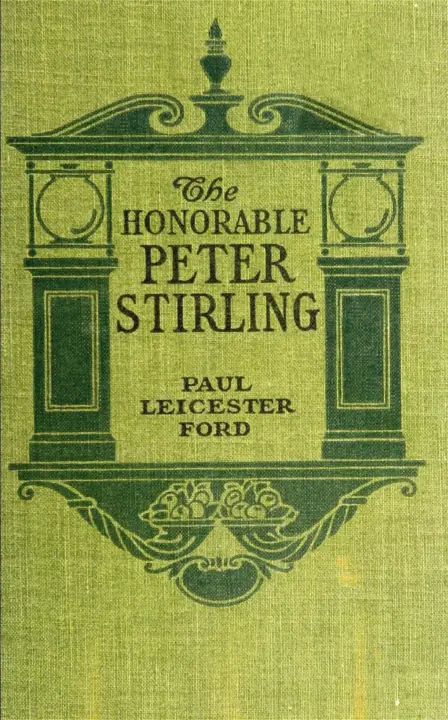
THE CLASSIC COLLECTION · 1894
"The Honorable Peter Stirling and What People Thought of Him" by Paul Leicester Ford is a novel written in the late 19th century. The narrative revolves around the character of Peter Stirling, a young man from a humble background who navigates his way through society's expectations and personal relationships, particularly focusing on themes of romance, ambition, and personal growth. At the start of the novel, we are introduced to Mr. Pierce, a dominating conversationalist who dismisses Peter as lacking in romance and imagination due to his upbringing in a mill village. This sets the stage for contrasting perspectives on love and life. Peter is portrayed as earnest and diligent, walking the deck of a yacht as others engage in conversation about romance, while he is mostly an observer. The scene offers a glimpse into his character, suggesting an introspective and serious nature. As the narrative unfolds, we see Peter's struggles with both societal expectations and his internal conflicts regarding love, particularly his feelings for Miss Pierce, leading to significant developments in his journey.
Introduction adapted from the source catalogue; source summaries may be automatically generated.
Free to read · English · 156,539 words · No account needed
MAKE TIME FOR A GOOD BOOK
On by default. Untick to stop anonymous reading totals. Each page counts after 10 seconds in view. How this works.
Anonymous counting is on unless you have switched it off.
“Did you understand what it all meant, Cousin Anneke?” asked Dorothy, as they were coming downstairs.
“No. The man who got so angry seemed to think Mr. Stirling had—”
She stopped short. A group of men on the sidewalk were talking, and she
paused to hear one say:
“To see that young chap Stirling handling Maguire was an eye-opener.”
Another man laughed, rather a deep, quiet laugh. “Maguire understands everything but honesty,” he said. “You can always beat him with that.”
Miss De Voe would have like to stay and listen, but there were too many men. So the ladies entered the carriage.
“At least we know that he said he was trying to tell the truth,” she went on, “and you just heard what that man said. I don’t know why they all laughed.”
“He didn’t seem to mind a bit.”
“No. Hasn’t he a funny half-embarrassed, half-cool manner?”
“He wasn’t embarrassed after he was fairly speaking. You know he was really fine-looking, when he spoke.”
“Yes,” said Dorothy. “You said he had a dull, heavy face.”
“That was the first time I saw him, Dorothy. It’s a face which varies very much. Oliver, drive to the United States. We will take him home to dinner.”
“Oh, good,” cried the youngest. “Then he will tell us why they
laughed.”
As they drove up to the hotel, Peter had just reached the steps. He turned to the carriage, the moment he saw that they wanted him.
“We wish to carry you off to a simple country dinner,” Miss De Voe told
him.
“I am going to take the special to New York, and that leaves in half an
hour.”
“Take a later train.”
“My ticket wouldn’t be good on it.”
Most men Miss De Voe would have snubbed on the spot, but to Peter she said: “Then get another ticket.”
“I don’t care to do that,” said Peter.
“Oh, please, Mr. Stirling,” said Minna. “I want to ask you a lot of questions about the convention.”
“Hush, Minna,” said Miss De Voe. She was nettled that Peter should refuse, and that her niece could stoop to beg of “a criminal lawyer and ward politician,” as she put it mentally. But she was determined not to show it “We are sorry. Good-evening. Home, Oliver.”
So they did not learn from Peter why the convention laughed. The subject was brought up at dinner, and Dorothy asked the opinion of the voters of the family.
“Probably he had made a fluke of some kind,” one said.
“More probably he had out-sharped the other side,” suggested a second.
Your reading position is saved on this browser. Take it to another device with a library code. Reading pages adapt to text, rather than matching a printed edition.
Paul Leicester Ford
Paul Leicester Ford
Paul Leicester Ford
Paul Leicester Ford
BEHIND THE BOOK
This eBook is for the use of anyone anywhere in the United States and most other parts of the world at no cost and with almost no restrictions whatsoever. You may copy it, give it away or re-use it under the terms of the Project Gutenberg License included with this eBook or online at www.gutenberg.org. If you are not located in the United States, you will have to check the laws of the country where you are located before using this eBook. Read the source licence.
The original source file, including credits and licence, is retained by this library. Request an original-format copy at no charge. Please include the book title and Project Gutenberg identifier #14532.
KEEP YOUR CURIOSITY GOING
Coulson Kernahan

Maurice Baring
Frances Wright
Cécile Tormay

Frederic Jesup Stimson

W. H. P. (William Henry Pope) Jarvis