THE CLASSIC COLLECTION✦Tattle-tales of CupidCLASSIC FREE BOOKS
Tattle-tales of Cupid
Paul Leicester Ford
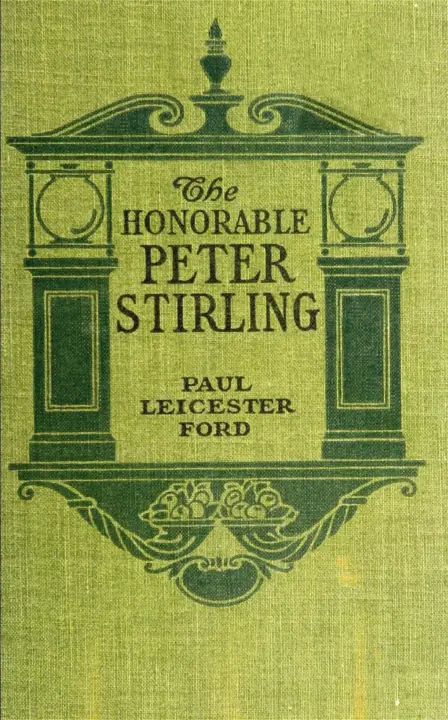
THE CLASSIC COLLECTION · 1894
"The Honorable Peter Stirling and What People Thought of Him" by Paul Leicester Ford is a novel written in the late 19th century. The narrative revolves around the character of Peter Stirling, a young man from a humble background who navigates his way through society's expectations and personal relationships, particularly focusing on themes of romance, ambition, and personal growth. At the start of the novel, we are introduced to Mr. Pierce, a dominating conversationalist who dismisses Peter as lacking in romance and imagination due to his upbringing in a mill village. This sets the stage for contrasting perspectives on love and life. Peter is portrayed as earnest and diligent, walking the deck of a yacht as others engage in conversation about romance, while he is mostly an observer. The scene offers a glimpse into his character, suggesting an introspective and serious nature. As the narrative unfolds, we see Peter's struggles with both societal expectations and his internal conflicts regarding love, particularly his feelings for Miss Pierce, leading to significant developments in his journey.
Introduction adapted from the source catalogue; source summaries may be automatically generated.
Free to read · English · 156,539 words · No account needed
MAKE TIME FOR A GOOD BOOK
On by default. Untick to stop anonymous reading totals. Each page counts after 10 seconds in view. How this works.
Anonymous counting is on unless you have switched it off.
Peter smiled at her, and said: “If I do, will you give me another waltzing lesson after lunch?”
“Don’t bargain,” said Leonore, disapprovingly.
“Very well,” said Peter, putting the telegrams in his pocket, and turning towards the stairs.
Leonore let him go up to the first landing. But as soon as she became convinced that he was really going to his room, she said, “Peter.”
Peter turned and looked down at the pretty figure at the foot of the stairs. He came down again. When he had reached the bottom he said, “Well?”
Leonore was half angry, and half laughing. “You ought to want to read them to me,” she said, “since we are such friends.”
“I do,” said Peter, “And you ought to want to teach me to waltz, since we are such friends.”
“But I don’t like the spirit,” said Leonore.
Peter laughed. “Nor I,” he said. “Still, I’ll prove I’m the better, by reading them to you.”
“Now I will teach him,” said Leonore to herself.
Peter unfolded the many sheets. “This is very secret, of course,” he
said.
“Yes.” Leonore looked round the hall as if she was a conspirator. “Come to the window-seat upstairs,” she whispered, and led the way. When they had ensconced themselves there, and drawn the curtains, she said, “Now.”
“You had better sit nearer me,” said Peter, “so that I can whisper it.”
“No,” said Leonore. “No one can hear us.” She thought, “I’d snub you for that, if I wasn’t afraid you wouldn’t read it.”
“You understand that you are not to repeat this to anyone.” Peter was smiling over something.
Leonore said, “Yes,” half crossly and half eagerly.
So Peter read:
“Use Hudson knowledge counties past not belief local twenty imbecility certified of yet till yesterday noon whose Malta could accurately it at seventeen. Potomac give throw Haymarket estimated Moselle thirty-three to into fortify through jurist arrived down right—”
“I won’t be treated so!” interrupted Leonore, indignantly.
“What do you mean,” said Peter, still smiling. “I’m reading it to you,
as you asked.”
“No you are not. You are just making up.”
“No,” said Peter. “It’s all here.”
“Let me see it.” Leonore shifted her seat so as to overlook Peter.
“That’s only two pages,” said Peter, holding them so that Leonore had to sit very close to him to see. “There are eighteen more.”
Leonore looked at them. “Was it written by a lunatic?” she asked.
“No.” Peter looked at the end. “It’s from Green. Remember. You are not to repeat it to any one.”
“Luncheon is served, Miss D’Alloi,” said a footman.
Your reading position is saved on this browser. Take it to another device with a library code. Reading pages adapt to text, rather than matching a printed edition.
Paul Leicester Ford
Paul Leicester Ford
Paul Leicester Ford
Paul Leicester Ford
BEHIND THE BOOK
This eBook is for the use of anyone anywhere in the United States and most other parts of the world at no cost and with almost no restrictions whatsoever. You may copy it, give it away or re-use it under the terms of the Project Gutenberg License included with this eBook or online at www.gutenberg.org. If you are not located in the United States, you will have to check the laws of the country where you are located before using this eBook. Read the source licence.
The original source file, including credits and licence, is retained by this library. Request an original-format copy at no charge. Please include the book title and Project Gutenberg identifier #14532.
KEEP YOUR CURIOSITY GOING
Coulson Kernahan

Maurice Baring
Frances Wright
Cécile Tormay

Frederic Jesup Stimson

W. H. P. (William Henry Pope) Jarvis