THE CLASSIC COLLECTION✦Tattle-tales of CupidCLASSIC FREE BOOKS
Tattle-tales of Cupid
Paul Leicester Ford
THE CLASSIC COLLECTION · 1894
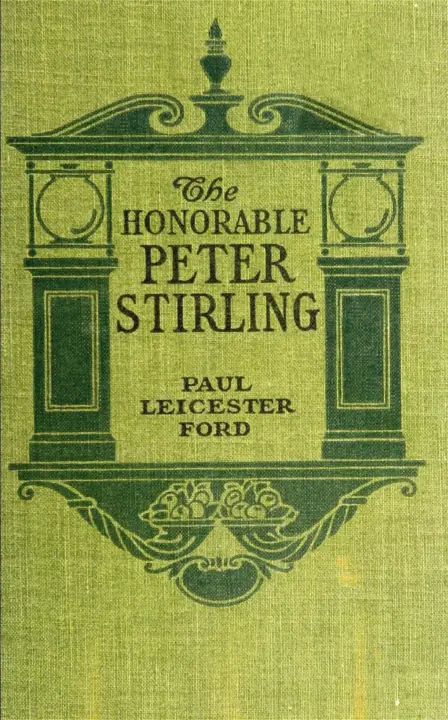
"The Honorable Peter Stirling and What People Thought of Him" by Paul Leicester Ford is a novel written in the late 19th century. The narrative revolves around the character of Peter Stirling, a young man from a humble background who navigates his way through society's expectations and personal relationships, particularly focusing on themes of romance, ambition, and personal growth. At the start of the novel, we are introduced to Mr. Pierce, a dominating conversationalist who dismisses Peter as lacking in romance and imagination due to his upbringing in a mill village. This sets the stage for contrasting perspectives on love and life. Peter is portrayed as earnest and diligent, walking the deck of a yacht as others engage in conversation about romance, while he is mostly an observer. The scene offers a glimpse into his character, suggesting an introspective and serious nature. As the narrative unfolds, we see Peter's struggles with both societal expectations and his internal conflicts regarding love, particularly his feelings for Miss Pierce, leading to significant developments in his journey.
Introduction adapted from the source catalogue; source summaries may be automatically generated.
Free to read · English · 156,539 words · No account needed
MAKE TIME FOR A GOOD BOOK
On by default. Untick to stop anonymous reading totals. Each page counts after 10 seconds in view. How this works.
Anonymous counting is on unless you have switched it off.
“I always play billiards with papa. Will you play too?”
“I don’t know how,” said Peter.
“Then it’s time you learned. I’ll take you on my side, because papa always beats me. I’ll teach you.”
So there was the jolliest of hours spent in this way, all of them laughing at Peter’s shots, and at Leonore’s attempts to show him how. “Every woman ought to play billiards,” Peter thought, when it was ended. “It’s the most graceful sight I’ve seen in years.”
Leonore said, “You get the ideas very nicely, but you hit much too hard. You can’t hit a ball too softly. You pound it as if you were trying to smash it.”
“It’s something I really must learn,” said Peter, who had refused over and over again in the past.
“I’ll teach you, while you are here,” said Leonore.
Peter did not refuse this time.
Nor did he refuse another lesson. When they had drifted into the drawing-room, Leonore asked: “Have you been learning how to valse?”
Peter smiled at so good an American using so European a word, but said seriously, “No. I’ve been too busy.”
“That’s a shame,” said Leonore, “because there are to be two dances this week, and mamma has written to get you cards.”
“Is it very hard?” asked Peter.
“No,” said Leonore. “It’s as easy as breathing, and much nicer.”
“Couldn’t you teach me that, also?”
“Easily. Mamma, will you play a valse? Now see.” Leonore drew her skirts back with one hand, so as to show the little feet, and said: “one, two, three, so. One, two, three, so. Now do that.”
Peter had hoped that the way to learn dancing was to take the girl in one’s arms. But he recognized that this would follow. So he set to work manfully to imitate that dainty little glide. It seemed easy as she did it. But it was not so easy when he tried it.
“Oh, you clumsy,” said Leonore laughing. “See. One, two, three, so. One, two, three, so.”
Peter forgot to notice the step, in his admiration of the little feet
and the pretty figure.
“Well,” said Leonore after a pause, “are you going to do that?”
So Peter tried again, and again, and again. Peter would have done it all night, with absolute contentment, so long as Leonore, after every failure, would show him the right way in her own person.
Finally she said, “Now take my hands. No. Way apart, so that I can see your feet. Now. We’ll try it together. One, two, change. One, two, change.”
Your reading position is saved on this browser. Take it to another device with a library code. Reading pages adapt to text, rather than matching a printed edition.
Paul Leicester Ford
Paul Leicester Ford
Paul Leicester Ford
Paul Leicester Ford
BEHIND THE BOOK
This eBook is for the use of anyone anywhere in the United States and most other parts of the world at no cost and with almost no restrictions whatsoever. You may copy it, give it away or re-use it under the terms of the Project Gutenberg License included with this eBook or online at www.gutenberg.org. If you are not located in the United States, you will have to check the laws of the country where you are located before using this eBook. Read the source licence.
The original source file, including credits and licence, is retained by this library. Request an original-format copy at no charge. Please include the book title and Project Gutenberg identifier #14532.
KEEP YOUR CURIOSITY GOING
Coulson Kernahan

Maurice Baring
Frances Wright
Cécile Tormay

Frederic Jesup Stimson

W. H. P. (William Henry Pope) Jarvis