THE CLASSIC COLLECTION✦Tattle-tales of CupidCLASSIC FREE BOOKS
Tattle-tales of Cupid
Paul Leicester Ford
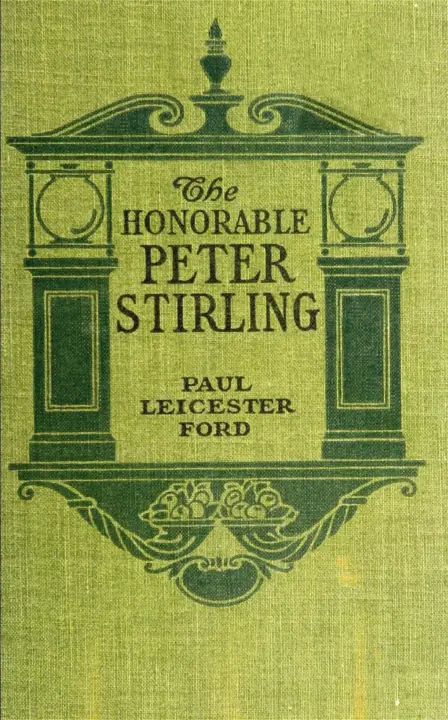
THE CLASSIC COLLECTION · 1894
"The Honorable Peter Stirling and What People Thought of Him" by Paul Leicester Ford is a novel written in the late 19th century. The narrative revolves around the character of Peter Stirling, a young man from a humble background who navigates his way through society's expectations and personal relationships, particularly focusing on themes of romance, ambition, and personal growth. At the start of the novel, we are introduced to Mr. Pierce, a dominating conversationalist who dismisses Peter as lacking in romance and imagination due to his upbringing in a mill village. This sets the stage for contrasting perspectives on love and life. Peter is portrayed as earnest and diligent, walking the deck of a yacht as others engage in conversation about romance, while he is mostly an observer. The scene offers a glimpse into his character, suggesting an introspective and serious nature. As the narrative unfolds, we see Peter's struggles with both societal expectations and his internal conflicts regarding love, particularly his feelings for Miss Pierce, leading to significant developments in his journey.
Introduction adapted from the source catalogue; source summaries may be automatically generated.
Free to read · English · 156,539 words · No account needed
MAKE TIME FOR A GOOD BOOK
On by default. Untick to stop anonymous reading totals. Each page counts after 10 seconds in view. How this works.
Anonymous counting is on unless you have switched it off.
“It is unusual,” said Leonore, reluctantly, and evidently selecting a word that should not offend Peter.
“You ought to be hung for treating fine pictures so,” said Watts.
“I had to give them those broad flat mats, because the books gave no
background.”
“It’s—it’s—” Leonore hesitated. “It’s not so startling, after a
moment.”
“You see they had to hang this way, or go unhung. I hadn’t wall space for both pictures and books. And by giving a few frames a turn, occasionally, I can always have fresh pictures to look at.”
“Look here, Dot, here’s a genuine Rembrandt’s ‘Three Crosses,’” called Watts. “I didn’t know, old man, that you were such a connoisseur.”
“I’m not,” said Peter. “I’m fond of such things, but I never should have had taste or time to gather these.”
“Then how did you get them?”
“A friend of mine—a man of exquisite taste—gathered them. He lost his money, and I bought them of him.”
“That was Mr. Le Grand?” asked Leonore, ceasing her study of the “Three
Crosses.”
“Yes.”
“Mrs. Rivington told me about it.”
“It must have been devilish hard for him to part with such a
collection,” said Watts.
“He hasn’t really parted with them. He comes down here constantly, and has a good time over them. It was partly his scheme to arrange them this way.”
“And are the paintings his, too, Peter?”
Peter could have hugged her for the way she said Peter. “No,” he managed to remark. “I bought some of them, and Miss De Voe and Lispenard Ogden the others. People tell me I spoil them by the flat framing, and the plain, broad gold mats. But it doesn’t spoil them to me. I think the mixture of gold mats and white mats breaks the monotony. And the variation just neutralizes the monotone which the rest of the room has. But of course that is my personal equation.”
“Then this room is the real taste of the ‘plain man,’ eh?” inquired
Watts.
“Really, papa, it is plain. Just as simple as can be.”
“Simple! Yes, sweet simplicity! Three-thousand-dollar-etching simplicity! Millet simplicity! Oh, yes. Peter’s a simple old dog.”
“No, but the woodwork and the furniture. Isn’t this an enticing chair? I must try it.” And Leonore almost dissolved from view in its depths. Peter has that chair still. He would probably knock the man down who offered to buy it.
Your reading position is saved on this browser. Take it to another device with a library code. Reading pages adapt to text, rather than matching a printed edition.
Paul Leicester Ford
Paul Leicester Ford
Paul Leicester Ford
Paul Leicester Ford
BEHIND THE BOOK
This eBook is for the use of anyone anywhere in the United States and most other parts of the world at no cost and with almost no restrictions whatsoever. You may copy it, give it away or re-use it under the terms of the Project Gutenberg License included with this eBook or online at www.gutenberg.org. If you are not located in the United States, you will have to check the laws of the country where you are located before using this eBook. Read the source licence.
The original source file, including credits and licence, is retained by this library. Request an original-format copy at no charge. Please include the book title and Project Gutenberg identifier #14532.
KEEP YOUR CURIOSITY GOING
Coulson Kernahan

Maurice Baring
Frances Wright
Cécile Tormay

Frederic Jesup Stimson

W. H. P. (William Henry Pope) Jarvis