THE CLASSIC COLLECTION✦Tattle-tales of CupidCLASSIC FREE BOOKS
Tattle-tales of Cupid
Paul Leicester Ford
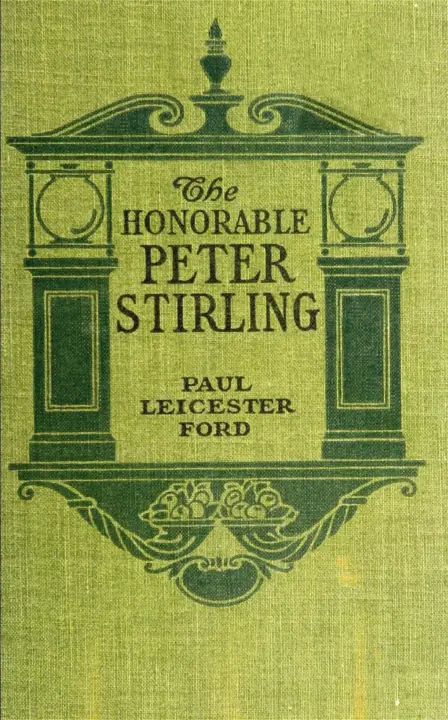
THE CLASSIC COLLECTION · 1894
"The Honorable Peter Stirling and What People Thought of Him" by Paul Leicester Ford is a novel written in the late 19th century. The narrative revolves around the character of Peter Stirling, a young man from a humble background who navigates his way through society's expectations and personal relationships, particularly focusing on themes of romance, ambition, and personal growth. At the start of the novel, we are introduced to Mr. Pierce, a dominating conversationalist who dismisses Peter as lacking in romance and imagination due to his upbringing in a mill village. This sets the stage for contrasting perspectives on love and life. Peter is portrayed as earnest and diligent, walking the deck of a yacht as others engage in conversation about romance, while he is mostly an observer. The scene offers a glimpse into his character, suggesting an introspective and serious nature. As the narrative unfolds, we see Peter's struggles with both societal expectations and his internal conflicts regarding love, particularly his feelings for Miss Pierce, leading to significant developments in his journey.
Introduction adapted from the source catalogue; source summaries may be automatically generated.
Free to read · English · 156,539 words · No account needed
MAKE TIME FOR A GOOD BOOK
On by default. Untick to stop anonymous reading totals. Each page counts after 10 seconds in view. How this works.
Anonymous counting is on unless you have switched it off.
The convention laughed. Peter rose and said: “Mr. Chairman, I gave a truthful account of what actually took place last evening in the United States hotel. I made no charges.”
“But you left the impression that Mr. Kennedy and I had made a deal,”
shrieked Maguire.
“If the gentleman draws that conclusion from what passed, it is not my
fault.”
The convention laughed. “Do you mean to charge such a bargain?” angrily
shouted Maguire.
“Will you deny it?” asked Peter calmly.
“Then you do charge it?”
Here the convention laughed for the third time. Green shouted “deny it,” and the cry was taken up by many of the delegates.
“Yes,” screamed Maguire. “I do deny it”
Peter turned to Kennedy. “Do you too, deny it?”
“Yes,” shouted Kennedy, loudly.
Again the convention laughed.
“Then,” said Peter, “if I had charged you with a bargain, I should now find it necessary to apologize.”
The convention roared. Maguire screamed something, but it could not be heard. The tenor of his remarks was indicated by his red face and clinched fist.
Costell smiled his deep smile. “I’m very glad,” he said to the man next him, “that we didn’t pick Stirling up.”
Then Milton was nominated and seconded, as were also Catlin, and four minor stars. That done, a ballot was taken and the vote stood:
Porter 206 Milton 197 Catlin 52 Scattering 29
A second ballot showed:
Porter 206 Milton 202 Catlin 54 Scattering 22
A third ballot gave:
Porter 206 Milton 210 Catlin 52 Scattering 16
“Porter’s done for on the next,” was whispered round the hall, though where it started, no one knew. Evidently his adherents thought so, for one made a motion to adjourn. It was voted down, and once more the roll call started.
“I shall vote for Milton,” Peter told Schlurger, and the changes in the delegations as the call proceeded, proved that many changes were being made the same way. Yet the fourth ballot showed:
Porter 125 Milton 128 Catlin 208 Scattering 14
The wildest excitement broke out in the Porter delegates. “They’ve beaten us,” screamed Kennedy, as much to himself as to those about. “They’ve used Milton to break our ranks, meaning Catlin all the time.” So in truth, it was. Milton had been put up to draw off Porter’s delegates, but the moment they had begun to turn to Milton, enough New York City delegates had been transferred to Catlin to prevent Milton being chosen. Amid protests and angry words on all sides another ballot was taken:
Catlin 256 Porter 118 Milton 110
Before the result was announced. Green was at Peter’s elbow.
“Will you move to make it unanimous?” he asked.
Your reading position is saved on this browser. Take it to another device with a library code. Reading pages adapt to text, rather than matching a printed edition.
Paul Leicester Ford
Paul Leicester Ford
Paul Leicester Ford
Paul Leicester Ford
BEHIND THE BOOK
This eBook is for the use of anyone anywhere in the United States and most other parts of the world at no cost and with almost no restrictions whatsoever. You may copy it, give it away or re-use it under the terms of the Project Gutenberg License included with this eBook or online at www.gutenberg.org. If you are not located in the United States, you will have to check the laws of the country where you are located before using this eBook. Read the source licence.
The original source file, including credits and licence, is retained by this library. Request an original-format copy at no charge. Please include the book title and Project Gutenberg identifier #14532.
KEEP YOUR CURIOSITY GOING
Coulson Kernahan

Maurice Baring
Frances Wright
Cécile Tormay

Frederic Jesup Stimson

W. H. P. (William Henry Pope) Jarvis