THE CLASSIC COLLECTION✦Tattle-tales of CupidCLASSIC FREE BOOKS
Tattle-tales of Cupid
Paul Leicester Ford
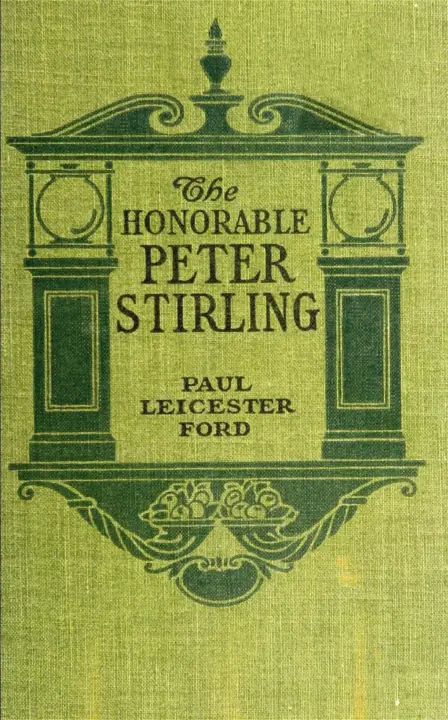
THE CLASSIC COLLECTION · 1894
"The Honorable Peter Stirling and What People Thought of Him" by Paul Leicester Ford is a novel written in the late 19th century. The narrative revolves around the character of Peter Stirling, a young man from a humble background who navigates his way through society's expectations and personal relationships, particularly focusing on themes of romance, ambition, and personal growth. At the start of the novel, we are introduced to Mr. Pierce, a dominating conversationalist who dismisses Peter as lacking in romance and imagination due to his upbringing in a mill village. This sets the stage for contrasting perspectives on love and life. Peter is portrayed as earnest and diligent, walking the deck of a yacht as others engage in conversation about romance, while he is mostly an observer. The scene offers a glimpse into his character, suggesting an introspective and serious nature. As the narrative unfolds, we see Peter's struggles with both societal expectations and his internal conflicts regarding love, particularly his feelings for Miss Pierce, leading to significant developments in his journey.
Introduction adapted from the source catalogue; source summaries may be automatically generated.
Free to read · English · 156,539 words · No account needed
MAKE TIME FOR A GOOD BOOK
On by default. Untick to stop anonymous reading totals. Each page counts after 10 seconds in view. How this works.
Anonymous counting is on unless you have switched it off.
At the present moment Mr. Pierce was having things very much his own way. Seated in the standing-room of a small yacht, were some eight people. With a leaden sky overhead, and a leaden sea about it, the boat gently rose and fell with the ground swell. Three miles away could be seen the flash-light marking the entrance to the harbor. But though slowly gathering clouds told that wind was coming, the yacht now lay becalmed, drifting with the ebb tide. The pleasure-seekers had been together all day, and were decidedly talked out. For the last hour they had been singing songs—always omitting Mr. Pierce, who never so trifled with his vocal organs. During this time he had been restless. At one point he had attempted to deliver his opinion on the relation of verse to music, but an unfeeling member of the party had struck up “John Brown’s Body,” and his lecture had ended, in the usual serial style, at the most interesting point, without even the promise of a “continuation in our next.” Finally, however, the singers had sung themselves hoarse in the damp night air, the last “Spanish Cavalier” had been safely restored to his inevitable true-love, and the sound of voices and banjo floated away over the water. Mr. Pierce’s moment had come.
Some one, and it is unnecessary to mention the sex, had given a sigh, and regretted that nineteenth century life was so prosaic and unromantic. Clearing his throat, quite as much to pre-empt the pause as to articulate the better, Mr. Pierce spoke:
“That modern times are less romantic and interesting than bygone centuries is a fallacy. From time immemorial, love and the battle between evil and good are the two things which have given the world romance and interest. Every story, whether we find it in the myths of the East, the folklore of Europe, the poems of the Troubadours, or in our newspaper of this morning, is based on one or the other of these factors, or on both combined. Now it is a truism that love never played so important a part as now in shaping the destinies of men and women, for this is the only century in which it has obtained even a partial divorce from worldly and parental influences. Moreover the great battle of society, to crush wrong and elevate right, was never before so bravely fought, on so many fields, by so many people as to-day. But because our lovers and heroes no longer brag to the world of their doings; no longer stand in the moonlight, and sing of their ‘dering does,’ the world assumes that the days of tourneys and guitars were the only days of true love and noble deeds. Even our professed writers of romance join in the cry. ‘Draw life as it is,’ they say. ‘We find nothing in it but mediocrity, selfishness, and money-loving.’ By all means let us have truth in our novels, but there is truth and truth. Most of New York’s firemen presumably sat down at noon to-day to a dinner of corned-beef and cabbage. But perhaps one of them at the same moment was fighting his way through smoke and flame, to save life at the risk of his own. Boiled dinner and burned firemen are equally true. Are they equally worthy of description? What would the age of chivalry be, if the chronicles had recorded only the brutality, filthiness and coarseness of their contemporaries? The wearing of underclothing unwashed till it fell to pieces; the utter lack of soap; the eating with fingers; the drunkenness and foul-mouthedness that drove women from the table at a certain point, and so inaugurated the custom, now continued merely as an excuse for a cigar? Some one said once that a man finds in a great city just the qualities he takes to it. That’s true of romance as well. Modern novelists don’t find beauty and nobility in life, because they don’t look for them. They predicate from their inner souls that the world is ‘cheap and nasty’ and that is what they find it to be. There is more true romance in a New York tenement than there ever was in a baron’s tower—braver battles, truer love, nobler sacrifices. Romance is all about us, but we must have eyes for it. You are young people, with your lives before you. Let me give you a little advice. As you go through life look for the fine things—not for the despicable. It won’t make you any richer. It won’t make you famous. It won’t better you in a worldly way. But it will make your lives happier, for by the time you are my age, you’ll love humanity, and look upon the world and call it good. And you will have found romance enough to satisfy all longings for mediæval times.”
Your reading position is saved on this browser. Take it to another device with a library code. Reading pages adapt to text, rather than matching a printed edition.
Paul Leicester Ford
Paul Leicester Ford
Paul Leicester Ford
Paul Leicester Ford
BEHIND THE BOOK
This eBook is for the use of anyone anywhere in the United States and most other parts of the world at no cost and with almost no restrictions whatsoever. You may copy it, give it away or re-use it under the terms of the Project Gutenberg License included with this eBook or online at www.gutenberg.org. If you are not located in the United States, you will have to check the laws of the country where you are located before using this eBook. Read the source licence.
The original source file, including credits and licence, is retained by this library. Request an original-format copy at no charge. Please include the book title and Project Gutenberg identifier #14532.
KEEP YOUR CURIOSITY GOING
Coulson Kernahan

Maurice Baring
Frances Wright
Cécile Tormay

Frederic Jesup Stimson

W. H. P. (William Henry Pope) Jarvis