THE CLASSIC COLLECTION✦Ruben and Ivy SênCLASSIC FREE BOOKS
Ruben and Ivy Sên
Louise Jordan Miln
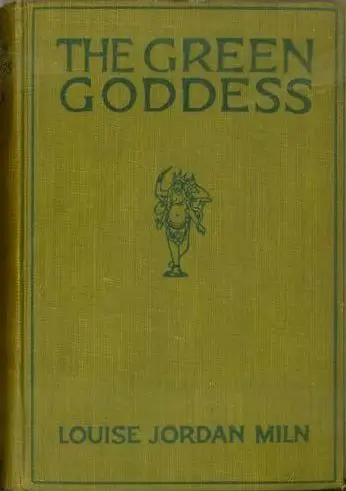
THE CLASSIC COLLECTION · 1922
"The Green Goddess" by Louise Jordan Miln is a novel written in the early 20th century. The story revolves around the Reverend Philip Reynolds, a devoted father and vicar grappling with profound loss as he prepares to marry off his beloved daughter, Lucilla. Set against a backdrop of pastoral life and the struggles of human emotion, the narrative explores themes of love, faith, and the complexities of relationships. The opening of the book introduces the character of Philip Reynolds, highlighting his deep love for his deceased wife, Helen, their son, Jack, and his living daughter, Lucilla. As the vicar reflects on his past, the reader learns about his joyful life filled with books, gardening, and a close relationship with his daughter, who is about to embark on a new chapter by marrying Captain Crespin. The narrative poignantly captures the quiet yet profound changes in their lives, as Philip struggles to maintain his sunny facade despite the impending loss of his daughter, underscoring the themes of love and the bittersweet nature of letting go.
Introduction adapted from the source catalogue; source summaries may be automatically generated.
Free to read · English · 88,728 words · No account needed
MAKE TIME FOR A GOOD BOOK
On by default. Untick to stop anonymous reading totals. Each page counts after 10 seconds in view. How this works.
Anonymous counting is on unless you have switched it off.
“No, sir?” the servant replied respectfully. “’P’raps ’Is ’Ighness’ll explain, sir,” he added significantly.
Dr. Traherne accepted the hint, and turned away his eyes and attention, giving them both again to the door.
There was a pause—the English “sahibs” busy each with his own thoughts, the English servant still, and patiently waiting, apparently interested in nothing on earth, and, if occupied or busy, entirely so with his own vacuity. As a matter of fact, Watkins gladly would have beat a soft-footed retreat, but he had had his orders, and he would obey them. For Watkins, as he had more than hinted in the courtyard of the Green Goddess’ temple, knew who buttered his bread, and knew acutely how sharp and sure the knife was by means of which that butter was spread.
Crespin broke the pause. Something the Raja of Rukh had said, down there by the temple, scarcely had struck him at the moment, but he had remembered it persistently, and the more he’d thought of it the more it had rankled, and he had been chewing it over in an impotent way ever since. He went at it now, “Your master spoke of visits from European ladies—do they come from Russia?” he questioned.
“From various parts, I understand, sir,” the man replied discreetly, but added tonelessly, “Mostly from Paris,” but an eye twitched slightly, as if it might under easier circumstances have winked not unlasciviously.
“Any here now?” Crespin asked roughly—and there was a rough lump in his throat—and Traherne knotted his hands, and went a stride nearer the door.
“I really couldn’t say, sir,” was all Watkins would own.
“They don’t dine with His Highness?” Traherne asked crisply.
“Oh, no, sir,” the valet assured him, adding, “’Is ’Ighness sometimes sups with them.”
“And my wife—Mrs. Crespin—?” Crespin began miserably—asking it because he was tortured indeed, and after all this bounder was British too.
“Make your mind easy, sir,” Watkins told him staunchly, speaking with a genuine something of kindness and more respectfully than he had before—perhaps because after all he was, or at least had been, British—“the lady won’t meet any hundesirable characters, sir. I give,” he added a touch pompously, “strict orders to the—female what took charge of the lady.”
“She is to be trusted?” Traherne swung round as he spoke.
“Habsolutely, sir,” the man said proudly, with a bow. “She is—in a manner of speakin’—my wife, sir.”
“Mrs. Watkins, eh?” Crespin exclaimed, a little amused in spite of his growing anxiety. Thomas Atkins never did that. But apparently Watkins had. “Mrs. Watkins!”
Your reading position is saved on this browser. Take it to another device with a library code. Reading pages adapt to text, rather than matching a printed edition.
Louise Jordan Miln
Louise Jordan Miln & Harold Owen & Harry M. Vernon

William Archer
Louise Jordan Miln
BEHIND THE BOOK
This eBook is for the use of anyone anywhere in the United States and most other parts of the world at no cost and with almost no restrictions whatsoever. You may copy it, give it away or re-use it under the terms of the Project Gutenberg License included with this eBook or online at www.gutenberg.org. If you are not located in the United States, you will have to check the laws of the country where you are located before using this eBook. Read the source licence.
The original source file, including credits and licence, is retained by this library. Request an original-format copy at no charge. Please include the book title and Project Gutenberg identifier #48112.
KEEP YOUR CURIOSITY GOING
Coulson Kernahan

Maurice Baring
Frances Wright
Cécile Tormay

Frederic Jesup Stimson

W. H. P. (William Henry Pope) Jarvis