THE CLASSIC COLLECTION✦Ruben and Ivy SênCLASSIC FREE BOOKS
Ruben and Ivy Sên
Louise Jordan Miln
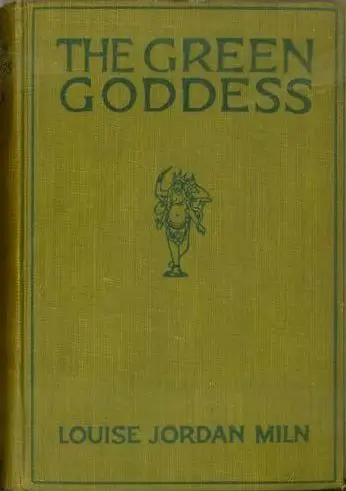
THE CLASSIC COLLECTION · 1922
"The Green Goddess" by Louise Jordan Miln is a novel written in the early 20th century. The story revolves around the Reverend Philip Reynolds, a devoted father and vicar grappling with profound loss as he prepares to marry off his beloved daughter, Lucilla. Set against a backdrop of pastoral life and the struggles of human emotion, the narrative explores themes of love, faith, and the complexities of relationships. The opening of the book introduces the character of Philip Reynolds, highlighting his deep love for his deceased wife, Helen, their son, Jack, and his living daughter, Lucilla. As the vicar reflects on his past, the reader learns about his joyful life filled with books, gardening, and a close relationship with his daughter, who is about to embark on a new chapter by marrying Captain Crespin. The narrative poignantly captures the quiet yet profound changes in their lives, as Philip struggles to maintain his sunny facade despite the impending loss of his daughter, underscoring the themes of love and the bittersweet nature of letting go.
Introduction adapted from the source catalogue; source summaries may be automatically generated.
Free to read · English · 88,728 words · No account needed
MAKE TIME FOR A GOOD BOOK
On by default. Untick to stop anonymous reading totals. Each page counts after 10 seconds in view. How this works.
Anonymous counting is on unless you have switched it off.
A cold something iced in the room. Out in the far open a bird of prey screamed exultantly. Somewhere in the palace a gong was struck, three barbaric, ominous, bellowing notes.
Rukh gave no sign that he listened, but he listened. A child was being
born.
They were silent.
No one spoke, no one moved. But Rukh smoked on quietly.
When the silence had lasted so long that all their English nerves were tortured, and cried for relief, any relief, Major Crespin broke it, trying to speak naturally, and failing.
“It surely,” he said, “can’t be so very far, since you had heard of the sentence passed on those assassins.”
The Raja smiled slightly. “I am glad, Major,” he said smoothly, “that you have so tactfully spared me the pain of re-opening that subject. We should have had to come to it sooner or later.”
There was another pause—an embarrassed pause. Rukh waited patient and
imperturbable.
“When Your Highness”—Traherne spoke slowly, he was picking his words with care—“said they were your brothers, you were of course speaking figuratively. You meant your tribesmen.”
“Not at all,” the Raja replied; “they are sons of my father—not of my
mother.”
Lucilla Crespin turned to him quickly, and he turned his eyes away from the unmistakable sympathy in hers. “And we,” she cried impulsively, “intrude upon you at such a time! How dreadful!” And the Raja of Rukh knew that the woman had spoken and not the hostage.
“Oh, pray don’t apologize,” he begged formally, smothering from his voice the inevitable Oriental gratitude that stirred at his heart. “Believe me, your arrival has given great satisfaction.”
“How do you mean?” Traherne demanded quickly. There had been nothing but menace and hardness in the Rukh’s last sentence.
“I’ll explain presently,” the Raja promised. “But first—”
Crespin interrupted rashly, blundering in the accredited British way. “First, let us understand each other—” and his tone and manner were crassly mandatory. “You surely can’t approve of this abominable crime?” he demanded—more as if Rukh had been his prisoner than he Rukh’s.
“My brothers,” the Raja said with an enigmatic smile, an ominous smoothness, “are fanatics, and there is no fanaticism in me.”
“How do they come to be so different from you?” Lucilla Crespin asked him, again speaking impulsively—and it was ill-advised.
But Rukh showed no resentment. Traherne wondered if he felt none. Perhaps—Oriental susceptibilities, though quicker and sharper, differ widely from ours.
Your reading position is saved on this browser. Take it to another device with a library code. Reading pages adapt to text, rather than matching a printed edition.
Louise Jordan Miln
Louise Jordan Miln & Harold Owen & Harry M. Vernon
William Archer
Louise Jordan Miln
BEHIND THE BOOK
This eBook is for the use of anyone anywhere in the United States and most other parts of the world at no cost and with almost no restrictions whatsoever. You may copy it, give it away or re-use it under the terms of the Project Gutenberg License included with this eBook or online at www.gutenberg.org. If you are not located in the United States, you will have to check the laws of the country where you are located before using this eBook. Read the source licence.
The original source file, including credits and licence, is retained by this library. Request an original-format copy at no charge. Please include the book title and Project Gutenberg identifier #48112.
KEEP YOUR CURIOSITY GOING
Coulson Kernahan

Maurice Baring
Frances Wright
Cécile Tormay

Frederic Jesup Stimson

W. H. P. (William Henry Pope) Jarvis