THE CLASSIC COLLECTION✦Ruben and Ivy SênCLASSIC FREE BOOKS
Ruben and Ivy Sên
Louise Jordan Miln
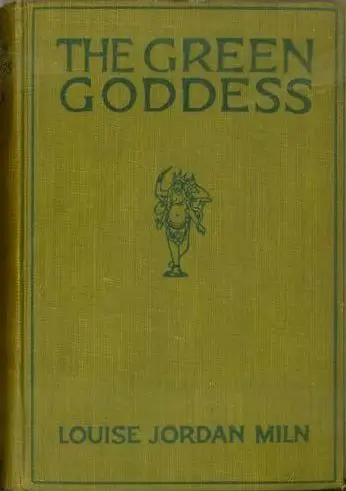
THE CLASSIC COLLECTION · 1922
"The Green Goddess" by Louise Jordan Miln is a novel written in the early 20th century. The story revolves around the Reverend Philip Reynolds, a devoted father and vicar grappling with profound loss as he prepares to marry off his beloved daughter, Lucilla. Set against a backdrop of pastoral life and the struggles of human emotion, the narrative explores themes of love, faith, and the complexities of relationships. The opening of the book introduces the character of Philip Reynolds, highlighting his deep love for his deceased wife, Helen, their son, Jack, and his living daughter, Lucilla. As the vicar reflects on his past, the reader learns about his joyful life filled with books, gardening, and a close relationship with his daughter, who is about to embark on a new chapter by marrying Captain Crespin. The narrative poignantly captures the quiet yet profound changes in their lives, as Philip struggles to maintain his sunny facade despite the impending loss of his daughter, underscoring the themes of love and the bittersweet nature of letting go.
Introduction adapted from the source catalogue; source summaries may be automatically generated.
Free to read · English · 88,728 words · No account needed
MAKE TIME FOR A GOOD BOOK
On by default. Untick to stop anonymous reading totals. Each page counts after 10 seconds in view. How this works.
Anonymous counting is on unless you have switched it off.
“No, sir,” Watkins spoke meekly now, but something far from meekness lurked in his shifty eyes. “Excuse me, sir—I’ve never been in India.”
“Not been in India?” Crespin was openly incredulous. And he added, “I was just thinking, as I looked at you, that I seemed to have seen you before.”
“Not in India,” Watkins said quickly—too quickly, Dr. Traherne thought. “We might ’ave met in England, but I don’t call to mind having that pleasure.”
Crespin was too angry at that impertinence to allow himself to notice it, and only said, “But, if you haven’t been in India, how the hell did you get here?”
“I came with ’Is ’Ighness, sir, by way of Tashkent,” Watkins explained glibly—but Traherne thought that he said it anxiously too. “All our dealings with Europe is by way of Russia.”
“I daresay,” Crespin grunted, not too wisely.
“But it’s possible to get to India direct,” Traherne broke in, “and not by way of central Asia?”
“Oh, yes, it’s done, sir,” Watkins admitted; “but I’m told there are some very tight places to negotiate—like the camel and the needle’s eye, as you might say.”
“Difficult traveling for a lady, eh?” Traherne asked it, knowing the answer, but he wished to keep the man talking, on the chance of even one useful word that might be let slip; and he thought the prompting safer in his hands than in Crespin’s.
“Next door to himpossible, I should guess, sir,” the man said promptly.
Crespin groaned. “A nice lookout, Traherne!” Then he turned to Watkins, with, “Tell me, my man—is His Highness—h’m—married?”
Watkins permitted himself a respectful smile. “Oh, yessir—very much so,
sir.”
“Children?”
“He has fifteen sons, sir.”
“The daughters don’t count, eh?” Crespin demanded.
“I’ve never ’ad a hopportunity of counting ’em, sir,” Watkins said as if gently correcting a not too excusable ignorance.
“He said,” Traherne slipped in, “the men accused of assassinating a political officer were his brothers—”
“Did ’e say that, sir?” the man asked quickly—evidently he was startled out of his well-trained impersonality. Clearly Watkins was excited.
“Didn’t you hear him? What did he mean?” Traherne said it carefully, not as if too much interested, watching Watkins narrowly though, and pressing swiftly into the possible opening.
But Watkins had remembered himself. “I’m sure I couldn’t say, sir,” he said colorlessly, permitting himself the slightest shrug. “’Is ’Ighness is what you’d call a very playful gentleman, sir.”
“But,” Traherne insisted, “I don’t see the joke in saying that.”
Your reading position is saved on this browser. Take it to another device with a library code. Reading pages adapt to text, rather than matching a printed edition.
Louise Jordan Miln
Louise Jordan Miln & Harold Owen & Harry M. Vernon
William Archer
Louise Jordan Miln
BEHIND THE BOOK
This eBook is for the use of anyone anywhere in the United States and most other parts of the world at no cost and with almost no restrictions whatsoever. You may copy it, give it away or re-use it under the terms of the Project Gutenberg License included with this eBook or online at www.gutenberg.org. If you are not located in the United States, you will have to check the laws of the country where you are located before using this eBook. Read the source licence.
The original source file, including credits and licence, is retained by this library. Request an original-format copy at no charge. Please include the book title and Project Gutenberg identifier #48112.
KEEP YOUR CURIOSITY GOING
Coulson Kernahan

Maurice Baring
Frances Wright
Cécile Tormay

Frederic Jesup Stimson

W. H. P. (William Henry Pope) Jarvis